


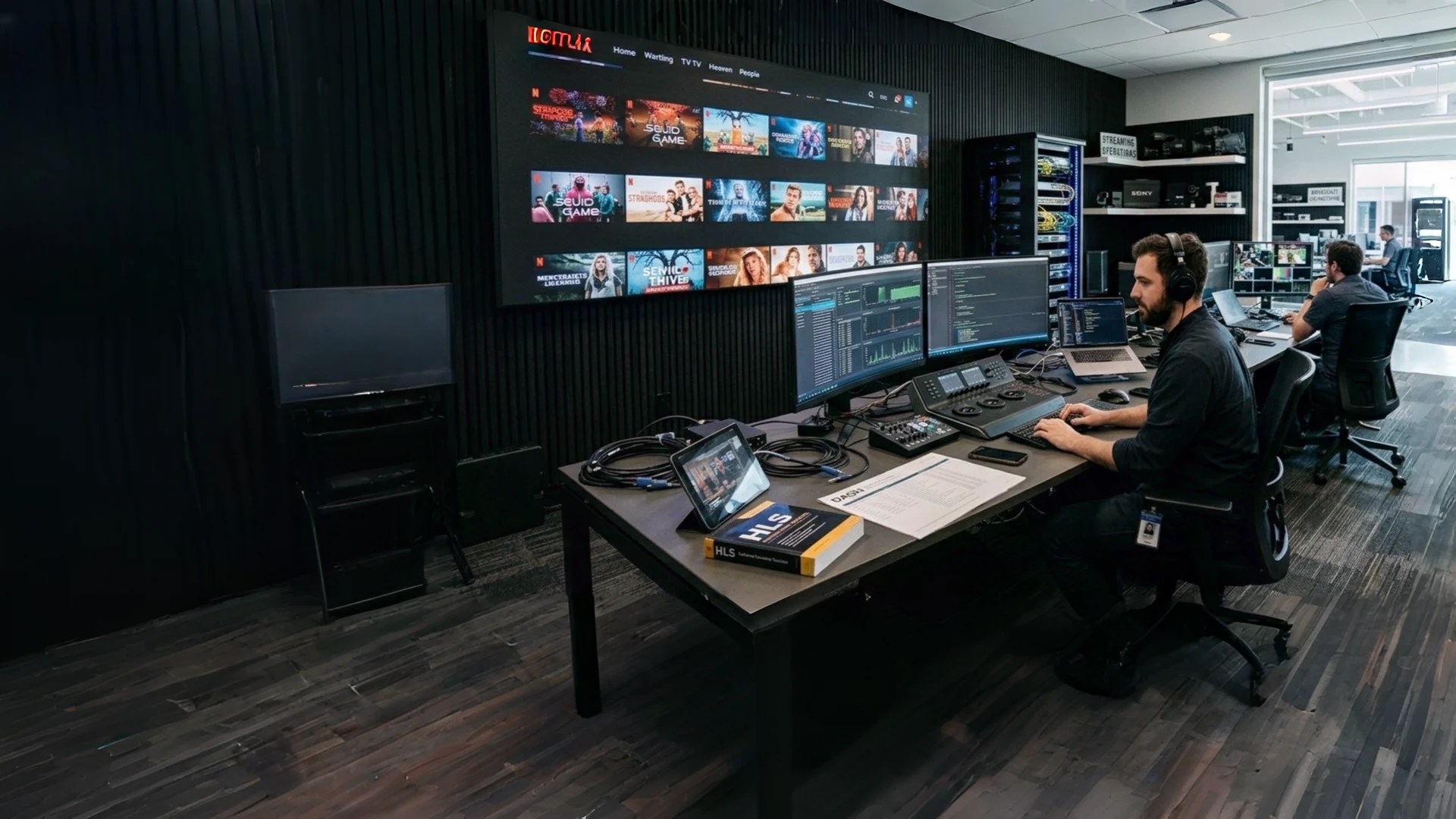
Key Takeaways
- Choosing the right video streaming protocol isn’t a one-time technical decision; it’s an ongoing business strategy.
- The global video streaming market is growing at 21.5% annually, and the platforms that scale successfully are the ones that match their protocol architecture to their actual use case, not the most advanced option available.
- HLS and DASH handle scale. WebRTC manages interaction. SRT takes care of reliability under pressure.
- The smartest streaming stack doesn’t pick one and takes the pause. They layer protocols internationally at every stage, from ingest to delivery to playback, so that no single weak link can bring down the viewer experience.
Video content is no longer just an entertainment source. For OTT platforms, live commerce brands, e-learning companies, and enterprise teams, it’s the product that drives revenue. Get it wrong, and viewers leave. Get it right, and you have a scalable, monetizable business asset.
Video content is no longer just an entertainment source but it’s the product that drives revenue for commerce brands, e-learning companies, and enterprise teams. The content doesn’t align to the interest, viewers leave. Once your content aligns to preferences, you have a scalable, monetizable business asset.
The numbers back this up. According to Grand View Research, the worldwide live video streaming industry was valued at USD 129.26 billion in 2024 and is expected to grow to USD 416.8 billion by 2030 at a compound annual growth rate (CAGR) of 21.5%. At the same time, Americans spend over 3 hours 20 minutes daily on streaming video, and live streaming already accounts for 62% of the entire streaming market in 2025. That’s an enormous amount of data being moved across networks every single day, and how it gets moved matters enormously.
When your streaming platform buffers, it isn’t just a technical inconvenience. It’s viewer churn. Latency isn’t just lag; it kills the interaction window in live commerce and online gaming. Therefore, picking the wrong video streaming protocol doesn’t just hurt performance; it drives up infrastructure costs in ways that only become obvious at scale.
By the end of this blog, you’ll know exactly how to choose the right video streaming protocol based on your business model, audience expectations, scalability goals, and technical realities.
Why Enterprise OTT Platforms Accumulate Security Debt?
Most of the OTT platforms never accumulate security debts due to negligence, but accumulate them for shipping the delivery features faster than the underlying security architecture can be scaled and validated. As a result, the platform that previously appeared well-optimized is now suddenly exposed to something for which it was not trained.
DRM enforcement gaps don’t emerge from a single missed configuration, but it emerges from the multi-CDN architecture where the token validation logic is not consistently propagated. Similarly, content protection vulnerabilities are not the perimeter problem but the delivery stack problem, embedded in key rotation cadence, packaging layer, and rights orchestration logic beneath every stream.
Launch AI-Powered Streaming Platform with The NineHertz
Convert Your idea into Reality
Video Streaming Protocol Architecture Defining Latency, Scalability, and Viewer Experience at Enterprise Scale
Think of a video streaming protocol as the set of shipping instructions, as opposed to the shipping package. A video streaming protocol establishes how video data will be broken into smaller pieces, sent on a network, received on the other end, and put back together so that the user can watch it. The video content that is being transmitted (the package) is created with either codecs or containers. The protocol is the delivery system that decides the route, the speed, and what happens when something goes wrong in transit.
Working Mechanism and Principles of Video Streaming Technology
Before picking a protocol, it helps to understand what’s actually happening under the hood. A camera or screen capture tool creates raw video. That raw video gets encoded and compressed into a format that’s transmittable without consuming the enormous bandwidth. The encoded data is then packaged into a container format and sent across the internet to a CDN or server. From there, it reaches the player on the viewer’s device, which decodes it and displays it in real time (or near-real time, depending on the use case).
Each stage of that journey involves different technologies. But the protocol controls the delivery leg. If the protocol is inefficient, and every other optimization effort falls apart.
Codec vs Container vs Protocol
These three terms get mixed up constantly, even by experienced developers.
- Codec: how video data is compressed and decompressed (H.264, H.265, AV1)
- Container: the file format that wraps the encoded data (MP4, MPEG-TS)
- Protocol: the rules governing how that data travels across a network (HLS, WebRTC, RTMP)
In a real streaming pipeline, all three work together. But they’re separate decisions. You can use H.265 encoding inside an MP4 container delivered over HLS. The codec doesn’t dictate the protocol.
Streaming Protocol Selection Is an Infrastructure Commitment
The wrong protocol choice shows up in the bottom line. High latency on an interactive stream means a host’s call-to-action lands after viewers have already scrolled away. Poor scalability means your infrastructure collapses during peak traffic. Inadequate DRM support means your paid content is accessible without authentication. At the same time, some protocols simply don’t work on certain devices, which shrinks your audience before you’ve even started.
Types of Video Streaming Protocols Explained: Architecture, Fit, and Enterprise Deployment
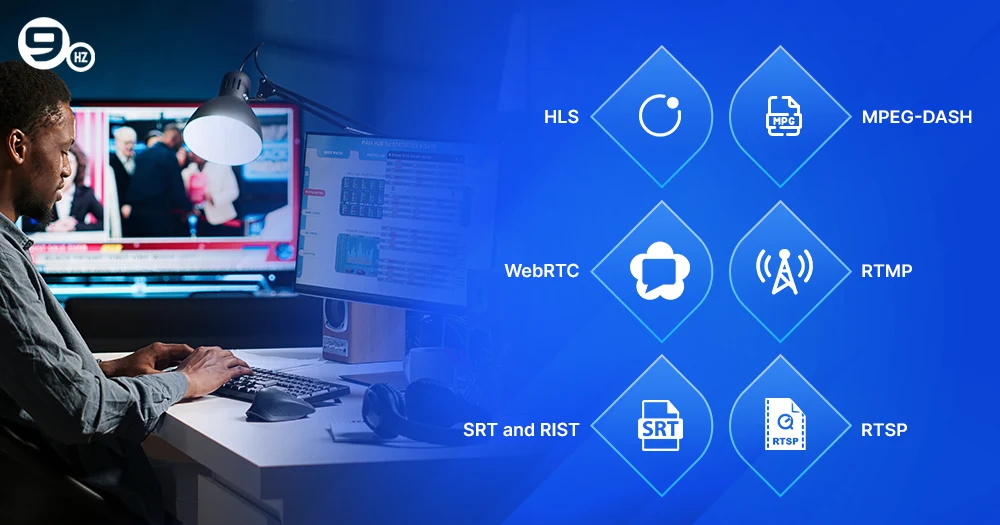
Not all protocols are built for the same job, and using the wrong one for your use case is one of the most common and costly mistakes in streaming architecture.
HLS (HTTP Live Streaming)
Developed by Apple, HLS is now the dominant protocol for on-demand and live streaming. It works by breaking video into small chunks and serving them over standard HTTP connections. Almost every CDN and player supports it.
- Biggest advantage: Massive compatibility across iOS, Android, browsers, and smart TVs.
- Main limitation: Latency typically runs 6–30 seconds in standard form, which rules it out for truly interactive use cases.
MPEG-DASH
MPEG-DASH is the open-standard alternative to HLS. It’s codec-agnostic, meaning it works with H.264, H.265, AV1, and whatever comes next. YouTube and Netflix use it heavily for adaptive bitrate delivery.
- Biggest advantage: Open standard, highly flexible, excellent for adaptive bitrate streaming.
- Main limitation: No native support on iOS Safari, which still requires HLS.
WebRTC
WebRTC is a different beast. Originally designed for browser-based video calls, it’s now used for ultra-low latency streaming, think under 500 milliseconds. That makes it the go-to for interactive gaming, live auctions, one-to-one video, and co-streaming features.
- Biggest advantage: Sub-second latency right in the browser, no plugins required.
- Main limitation: Doesn’t scale well on its own. Broadcasting to thousands of concurrent viewers requires additional infrastructure, which adds cost and complexity.
RTMP (Real-Time Messaging Protocol)
RTMP was built by Macromedia (later Adobe) for Flash-based streaming. Flash is dead, but RTMP isn’t. It’s still widely used as an ingest protocol, the connection between an encoder (like OBS) and a streaming server. YouTube, Twitch, and Facebook Live all accept RTMP ingest.
- Biggest advantage: Low-latency ingest, universally supported by encoders.
- Main limitation: Not suitable for last-mile delivery to viewers anymore.
SRT and RIST
SRT (Secure Reliable Transport) and RIST (Reliable Internet Stream Transport) are designed for broadcast-grade live contribution over unreliable public internet connections. If you’re sending a live feed from a stadium or remote location to a production hub, these protocols handle packet loss gracefully.
- Biggest advantage: Reliable transmission under poor network conditions, built-in encryption.
- Main limitation: Niche use, primarily for contribution and production, not viewer delivery.
RTSP (Real Time Streaming Protocol)
RTSP is mostly used in IP camera systems and surveillance setups. It’s a control protocol that tells a server to play, pause, or record a stream. You’ll rarely encounter it in consumer-facing video products.
- Biggest advantage: Low latency, efficient for IP camera ecosystems.
- Main limitation: Poor browser compatibility, not CDN-friendly.
What Enterprise Platform Architects Must Evaluate Before Selecting a Video Streaming Protocol: Latency, Scale, Compliance, and Total Delivery Cost
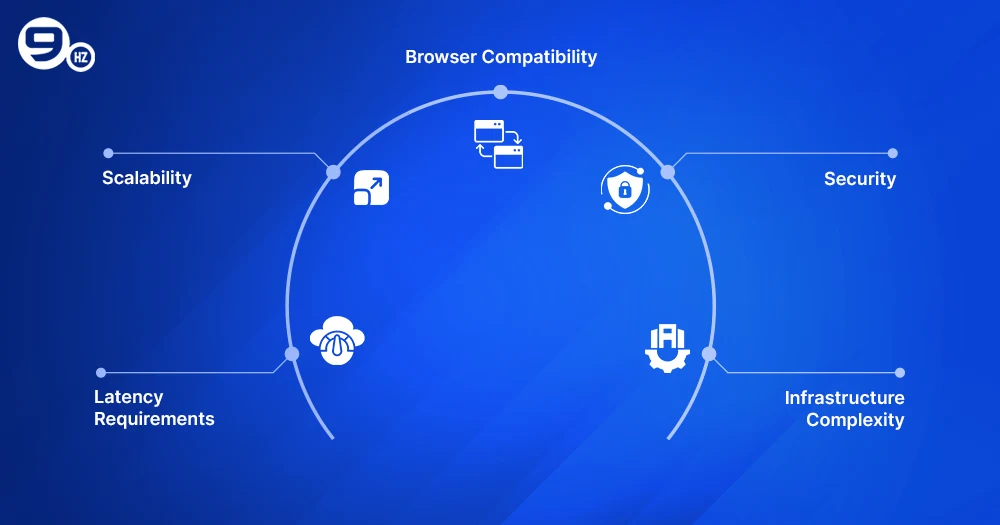
Protocol selection isn’t a purely technical decision; it’s a business one, and each factor below directly affects cost, user experience, and scalability.
Latency Requirements
This is the first question to ask. Is your product broadcast-first or interaction-first?
An OTT platform streaming a documentary can tolerate 10–30 seconds of latency without any viewer noticing. A live auction where bidders need to react to real-time price changes needs under two seconds. An online poker or gaming platform needs sub-500 millisecond latency. The answer fundamentally narrows your protocol options before you consider anything else.
Scalability and CDN Delivery
WebRTC is brilliant for low latency, but scaling it to 50,000 concurrent viewers requires a purpose-built WebRTC CDN or a hybrid architecture. HLS and DASH, by contrast, ride standard HTTP CDN infrastructure that handles millions of concurrent viewers without breaking a sweat.
The economics matter here. HLS at scale is far cheaper per viewer than WebRTC at scale. For large broadcast audiences that don’t need real-time interaction, paying for WebRTC infrastructure is wasteful.
Device and Browser Compatibility
HLS is the only protocol with native support across iOS Safari, which still represents a significant share of mobile traffic globally. MPEG-DASH covers most browsers but requires a polyfill or workaround on iOS. WebRTC works natively in all major browsers. RTSP and RTMP require specific players or apps.
Map your target audience’s devices before picking a protocol. A corporate enterprise tool deployed on Windows desktops has completely different compatibility requirements than a consumer OTT app targeting mobile-first markets.
Security and DRM Requirements
Subscription platforms need content protection. HLS supports AES-128 encryption and integrates cleanly with DRM systems like Widevine, FairPlay, and PlayReady. MPEG-DASH also has strong DRM support through CENC. WebRTC doesn’t have native DRM, which is fine for interactive content, but a problem if you’re protecting premium video.
Infrastructure Complexity and Cost
Some protocols are deceptively expensive to operate. WebRTC requires more compute per connection. SRT needs a dedicated ingest infrastructure. HLS and DASH benefit from commodity CDN pricing. Before finalizing a protocol decision, model the infrastructure cost at your projected peak concurrency, not just at launch traffic levels.
Comparison of Popular Video Streaming Protocols
Side by side, the differences become a lot clearer, especially when you’re trying to justify a protocol choice to a technical or business stakeholder.
| Protocol | Latency | Scalability | DRM Support | Compatibility | Best Use Case |
| HLS | 6–30s (2–5s with LL-HLS) | Excellent | Yes (FairPlay, Widevine) | Universal | OTT, VOD, live broadcast |
| MPEG-DASH | 6–30s (low-latency variants exist) | Excellent | Yes (CENC) | All except iOS Safari | OTT, adaptive streaming |
| WebRTC | <500ms | Limited (needs special CDN) | No native DRM | All major browsers | Interactive, gaming, auctions |
| RTMP | 1–3s | Moderate | No | Encoder-to-server only | Live ingest |
| SRT | 0.5–2s | Moderate | Yes (built-in encryption) | Broadcast tools | Remote production, contribution |
| RTSP | <1s | Poor | Limited | IP cameras, VMS | Surveillance, CCTV |
Is Ultra-Low Latency Always Better?
No, and this is a mistake worth calling out directly. Chasing sub-second latency for a VOD platform or a pre-recorded course adds infrastructure cost with zero user benefit. Ultra-low latency is valuable when the viewer needs to react to what’s happening on screen. For everything else, it’s an over-engineered solution to a problem that doesn’t exist. Pick the latency tier that your actual use case demands, not the lowest one that technology allows.
Streaming Protocols Applications by Vertical Across OTT, Telehealth, EdTech, and Financial Media Organizations
Different streaming environments solve different problems. A protocol that works well for large-scale OTT delivery may fail in interactive streaming, while protocols optimized for ultra-low latency often become expensive to scale globally. Most modern streaming platforms, therefore, combine multiple live streaming protocols instead of relying on a single delivery method.
OTT Platforms
All OTT and subscription streaming providers primarily utilize HLS and MPEG-DASH, which are the best video streaming protocols because they efficiently scale through content delivery networks (CDNs), allow adaptive bitrate streaming, and can integrate with Digital Rights Management (DRM) solutions such as Widevine, FairPlay, or PlayReady. In addition, many OTT providers also leverage SRT for ingest to enhance the reliability of the stream when utilizing an unreliable network prior to converting the streams into either HLS or DASH for delivery to the viewer.
Live Events and Webinars
Live sports, product launches, and enterprise webinars typically use LL-HLS or LL-DASH to reduce latency while still maintaining CDN scalability. RTMP is still widely used as the ingest protocol because of broad encoder compatibility, while SRT is increasingly preferred for higher reliability across unpredictable internet connections.
Interactive Streaming and Gaming
Interactive platforms such as live auctions, multiplayer gaming, betting, and video conferencing rely heavily on WebRTC because it delivers sub-second latency. That near real-time performance improves engagement and two-way communication, but WebRTC infrastructure becomes significantly more complex and expensive at massive audience scale compared to HTTP-based delivery protocols.
Enterprise Communication
Enterprise communication platforms often use a hybrid approach. WebRTC is used for real-time meetings or collaborations, whereas HLS or DASH can provide large-scale internal meetings or recorded training content. This combination results in scalability without compromising the interactive functionality of small group communications.
Surveillance and IP Cameras
RTSP remains common in surveillance systems and IP camera infrastructure because it supports continuous low-latency camera feeds. However, RTSP is not ideal for direct browser playback, so many platforms now convert RTSP streams into WebRTC or HLS for remote monitoring across web and mobile devices.
Remote Production and Broadcast
Remote production workflows increasingly depend on SRT and RIST because both protocols handle packet loss and unstable internet conditions more effectively than traditional TCP-based streaming methods. Broadcasters utilize these methods to send high-quality contribution feeds from remote locations into cloud production environments with reduced latency and increased reliability.
What Protocol Evolution Means for CDN Architecture, DRM Modernization, and Platform Scalability Investments Over the Next 36 Months?
The trend of video delivery nowadays moves towards architectures that will lower the latency of delivery with no detriment to scalability. This means that instead of using just one video streaming protocol, platforms are combining multiple protocols to provide a user experience, infrastructure costs, and device compatibility for viewers.
Low-Latency OTT Streaming
Typically, OTT streaming has a 15-30 second delay in delivering content. But companies are now implementing low-latency HTTP live streaming (LL-HLS) or low-latency DASH (LL-DASH) to reduce the latency even closer to “real-time” delivery through CDN-based delivery. This shift plays a pivotal role in live sporting events, auctions, betting, or interactive commerce, where even a 1-2 second lag impacts viewer engagement and results in missed opportunities for monetization. While WebRTC delivers the lowest amount of latency, most large-scale broadcasters prefer a traditional low-latency HTTP streaming method of delivery because they provide more scalability for large audiences.
AI-Driven Streaming Optimization
AI is increasingly being used to create solutions that optimize adaptive bit-rate streaming, encode video more efficiently, and predict buffer situations in real-time. Instead of reacting to bad network conditions, the newer capabilities of AI-powered solutions monitor for network congestion predictively by simulating patterns of traffic in advance of playback quality suffering.
Multi-Protocol Streaming Architectures
New streaming stack architectures are largely protocol agnostic in nature. To illustrate the point, many of these platforms use SRT or RTMP for ingest, transcode their video into HLS/DASH for large-scale delivery, and selectively incorporate WebRTC for interactive features. The use of multiple protocols allows businesses to better optimize for latency, reliability, and scalability at various stages in the streaming pipeline as opposed to using only one protocol to solve all their issues.
Launch AI-Powered Streaming Platform with The NineHertz
Convert Your idea into Reality
Conclusion
There’s no single best video streaming protocol for every situation. That’s not a cop-out; it’s the reality of a technology space where latency requirements, audience size, device mix, and security needs genuinely pull in different directions. HLS dominates on-demand and broadcast delivery. WebRTC owns the interactive layer. SRT holds down contribution pipelines. Modern streaming platforms don’t pick one and force it everywhere. They combine protocols strategically, matching each layer of the delivery chain to the tool built for it. The right video streaming protocol isn’t the most advanced one. It’s the one that fits your use case, your budget, and your audience.
That’s where The NinerHertz comes forward to help you to design scalable streaming architectures tailored to your latency, scalability, infrastructure, and audience requirements.
FAQ’s
Which video streaming protocol is best for OTT platforms?
HLS combined with MPEG-DASH covers the widest range of devices while supporting DRM, adaptive bitrate, and CDN delivery. Most OTT platforms use both simultaneously: HLS for Apple devices and DASH for everything else.
What protocol does Netflix use?
Netflix primarily uses MPEG-DASH for video delivery, combined with the Widevine DRM system. For Apple devices, they also support HLS with FairPlay DRM.
Which protocol does YouTube Live use?
YouTube Live accepts RTMP for ingest from encoders and streamers, then transcodes and delivers the stream to viewers via MPEG-DASH (and HLS for Apple devices).
Which streaming protocol has the lowest latency?
WebRTC consistently achieves the lowest latency, typically under 500 milliseconds. SRT and RTMP sit in the 1–3 second range. Standard HLS runs 6–30 seconds, though low-latency HLS brings this down to 2–5 seconds.
Why do modern streaming platforms use multiple protocols together?
Because no single protocol does everything well. RTMP is ideal for ingest; HLS and DASH scale efficiently for delivery; WebRTC handles interactive features. A mature streaming architecture layers these protocols at different stages of the pipeline rather than forcing one protocol to do everything it wasn’t designed for.
