



I’ve been on both sides of the screen. I’ve sat in my fair share of video interviews nervously checking my lighting before hitting “join,” and I’ve been the one conducting them, wondering if there’s a better way to run this whole process. That tension on both sides is exactly why the best video interview software exists.
But video interviews still come with their own brand of chaos. There was the candidate who joined with an AI note-taker, transcribing every word. Another time, someone was clearly getting real-time help from an AI assistant mid-conversation. Impressive? Sure. Distracting? Definitely.
HR teams and recruiters ask the same questions constantly: How do I screen hundreds of applicants without burning out my team? Is one-way video interviewing effective, or does it hurt the candidate experience? How do I know if a candidate is genuinely answering or using AI to cheat? The platform you choose determines whether these are problems or non-issues.
To find the best video interviewing software, hiring teams must align their tech stack with specific role requirements. Based on 1,000+ G2 review data, asynchronous screeners like Hireflix, Willo, and Spark Hire automate scheduling and generate structured summaries for high-volume hiring, while autonomous AI platforms like Braintrust AIR and AI Interviewer conduct real-time conversational interviews.
For technical positions, specialized screening tools like HackerRank focus on code assessment and flagging integrity issues, ensuring hiring managers receive clear, consistent candidate insights across every department.
Read on to know which one fits your needs.
8 best video interviewing software: My top picks
- Braintrust AIR: Best for automating first-round interviews at scale
End-to-end AI recruiting with voice-based interviews, candidate matching, and scorecards that eliminate manual screening effort. (Custom pricing) - AI Interviewer: Best for AI-led structured video interviews
Runs one-way and two-way AI interviews, coding assessments, and proctoring from a single platform. ($99/month) - HackerRank Developer Skills Platform: Best for technical hiring at mid-market and enterprise scale
Combines realistic coding challenges, AI-led technical interviews, and integrity controls built for engineering-focused teams. ($199/month) - Hireflix One-Way Video Interviewing: Best for high-volume one-way screening
Record questions once, send to unlimited candidates, and review responses on your own schedule with no coordination needed. ($150/month) - Indeed Hiring Platform: Best for reaching a large candidate pool fast
Goes from job post to browser-based interview with built-in matching, AI messaging, and scheduling in one workflow. (Custom pricing) - Metaview: Best for AI-generated interview notes and structured summaries Layered over your existing video tools, it captures notes automatically so interviewers can stay focused on the conversation. ($60/month)
- Willo Video Interviewing: Best for asynchronous video interviewing
Browser-based one-way interviews that candidates complete on any device, with standardized questions that make comparison easy. ($279/month) - Spark Hire: Best for an all-in-one video interview tool
Supports one-way and live video interviews, behavioral assessments, reference checks, and an optional built-in ATS. ($299/month)
These are top-rated in their category, according to G2’s Summer 2026 Grid Report. I’ve added their monthly pricing wherever available to make comparisons easier for you.
8 best video interviewing software I recommend
Video interviews are hard. After running a few too many interviews over random video call links, I finally understood what video interviewing software really is. It’s not just a place to talk to candidates, it’s a full hiring assistant. These tools bring everything into one space: scheduling, recording, structured feedback, and even AI-generated notes.
The best video interview software goes further: integrating with your ATS, enabling coding tests or technical assessments right within the platform, and helping teams collaborate without endless back-and-forth emails.
And the payoff is real. According to G2 Data, companies see an average ROI within nine months of adopting video interviewing software. It’s especially impactful for small businesses (43%) and mid-market teams (36%) that need to scale hiring efficiently, while 21% of enterprise users use it to bring consistency and data-backed insights into high-volume recruitment.
Whether it’s assessing a developer’s problem-solving skills in real time or capturing structured feedback across multiple rounds, the right platform turns interviews into measurable, bias-free hiring decisions.
How did I find and evaluate the best video interviewing software?
To start, I used G2 Grid reports to build a shortlist of 15+ video interviewing tools, then narrowed it down based on category rankings, review volume, and how well each platform mapped to real hiring workflows.
From there, I spoke with recruiters, hiring managers, and HR leaders across various industries, including tech, finance to healthcare, and retail, to understand what actually works for teams of different sizes.
Using their input, I researched each platform in depth to see how it supported real hiring workflows, from scheduling and candidate experience to AI summaries, coding tests, and feedback collection. I also used AI to analyze G2 user reviews and understand common pain points, what people loved and hated, and whether these tools lived up to the hype. I also consulted professionals with hands-on experience with these tools and validated their insights using verified G2 reviews.
The screenshots featured in this article may include those captured during evaluations from publicly available materials and those obtained from the vendor’s G2 page.
What makes the best video interviewing software?
After diving deep into research and talking to recruiters across industries, I’ve found that the best video interviewing software goes far beyond video quality. It’s about how well it supports every step of the hiring process. Here’s what I looked at:
- Seamless scheduling and calendar sync: The best tools make coordination effortless. Automatic time zone detection, real-time availability, and calendar integrations eliminate scheduling headaches. Bonus points if it adjusts for cancellations and sends smart reminders to keep everyone on track.
- Recording and transcription: Built-in recording is a lifesaver, especially when one is running multiple interviews a day. I look for platforms that generate searchable transcripts, let’s the user tag moments or keywords, and make it easy to revisit highlights for later evaluation or team discussions.
- Structured feedback tools: Having feedback forms, customizable scorecards, and shared evaluations ensures every candidate is reviewed fairly. It also speeds up debriefs without having to sift through messy notes or follow-up emails after each round.
- AI-powered summaries and insights: AI that actually helps, not distracts. I value tools that create digestible interview summaries, flag key phrases, and even suggest next steps, while still leaving the final decision in human hands.
- Built-in coding and skills assessments: For technical roles, I look for tools that integrate coding challenges, whiteboarding, or role-specific assessments within the same interface, keeping everything in one place and preserving the interview flow.
- AI interview integrity and fraud detection: With AI-assisted cheating becoming more common, I look for platforms that actively detect suspicious behavior, including AI-generated responses, lip-sync cheating, eye-gaze anomalies, multiple faces, tab switching, and identity verification.
- ATS and HR integrations: The right platform should connect effortlessly with ATS, HRIS, and CRM systems. That way, candidate data, notes, and recordings sync automatically, reducing manual entry and the risk of losing context between systems.
- Scalability and security: Whether hiring for a startup or a global enterprise, the platform should grow with the organization. I always check for SOC 2 or GDPR compliance, secure data encryption, and admin-level access controls to protect candidate information.
- Candidate experience and branding: A good tool makes candidates feel seen, not processed. Custom-branded portals, prep instructions, and practice environments help present a professional, welcoming impression, especially in remote or hybrid hiring.
- Reliable performance and analytics: A smooth, lag-free experience matters more than flashy features. I look for platforms that track metrics like time-to-hire, candidate engagement, and interview-to-offer ratios to help teams measure and continuously improve their process.
I’ll be honest and admit that not every platform I’ve included in this list checks every single box, but each one shines in its own way. Whether it’s for structured interviews, technical assessments, or seamless collaboration, every tool here stands out for something it does exceptionally well.
The list below contains real user reviews from the Video Interviewing Software category page. To be included in this category, a solution must:
- Streamline and simplify the interviewing process
- Provide video interviewing technology for a wide range of roles, including pre-recorded interviews, live video interviews, or both
- Track candidate screening processes and/or provide integrations to ATS
*This data was pulled from G2 in 2026. Some reviews may have been edited for clarity.
1. Braintrust AIR: Best for automating first-round interviews at scale
When I first came across Braintrust AIR, I didn’t expect it to feel quite as different as it does. This isn’t just a tool that records interviews or schedules calls. It’s an end-to-end AI recruiting platform that handles first-round interviews on your behalf, from candidate matching to running the conversation itself.
With a 4.4/5 rating on G2 and 94% of users saying the product is headed in the right direction, it’s clearly resonating with teams that want automation without sacrificing quality.
What reviewers keep coming back to is how dramatically it reduces the manual effort involved in early-stage hiring. The AI conducts structured first-round interviews, delivers video transcripts, notes, and candidate summaries automatically, and helps teams move to shortlisting much faster.
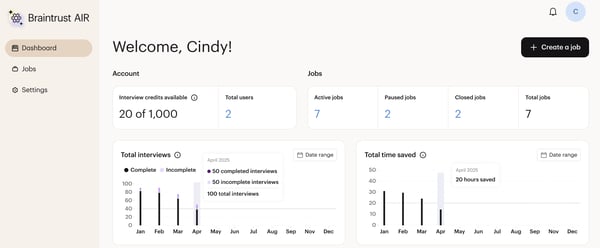
One thing I didn’t expect until I dug into the reviews is how well it integrates with tools teams already rely on. Reviewers specifically call out smooth connections with Workday and Slack, with all interview recordings, transcripts, and notes automatically organized in one place. That means hiring managers can revisit a candidate’s interview later without hunting across platforms, and teams can stay aligned during check-ins without adding extra meetings to anyone’s calendar.
The conversational quality of the AI interviewer also comes up repeatedly. Reviewers describe the voice as natural and empathetic rather than mechanical, with a question flow that follows the candidate’s answers rather than just firing off a static list. Several candidates who left reviews mentioned feeling genuinely at ease during the process, which matters more than it might seem when you’re trying to get authentic answers at scale.
Braintrust AIR draws primarily from small businesses (54%) and mid-market teams (31%), though enterprise organizations (15%) are also represented in its user base. It naturally fits teams that hire at volume and want a structured, consistent first round without tying up recruiters’ calendars.
Like any AI-led interview platform, the experience does come with some nuance. Because the process runs without a live human on the other end, some candidates are less comfortable engaging with AI at this stage, which can lead to drop-off before completing the interview. This is something worth factoring in when thinking about candidate experience, and teams often address it by clearly communicating the AI format upfront so candidates know what to expect.
All things considered, Braintrust AIR is best for recruiting teams that want to move faster without growing their headcount. If your challenge is managing high volumes of first-round interviews without compromising consistency, it offers a genuinely different approach to how that work gets done.
What I like about Braintrust AIR:
- I appreciate how much manual effort it removes from early-stage screening. From transcripts to candidate rankings, everything is handled automatically so recruiters can focus on the shortlist rather than the process of building it.
- I also like how naturally it fits into existing workflows. Interview notes and recordings land directly in tools like Workday and Slack, so nothing gets siloed or lost between platforms.
What G2 users like about Braintrust AIR:
“Braintrust AIR is the most authentic interviewer that I have come across. One of the features that I like most is the AI Interviewer, which performs almost all the interviewing tasks. As a marketing leader, I am able to enroll the best talents on my team through a robust and candid selection model that assesses the most competitive skills. Our candidates have reported a fair selection process via the AI Video interviews.”
– Braintrust AIR review, Christine P.
What I dislike about Braintrust AIR:
- Because the process runs without a live human, some candidates who prefer direct human interaction may disengage before completing the interview. Teams that address this upfront by clearly communicating the AI format tend to see stronger completion rates and more confident responses from candidates.
- Some reviewers mention that the AI’s per-question timing can feel tight for candidates who pause to organize their thoughts, occasionally cutting off answers before they’re finished. Choosing a platform that lets you configure timing settings for different role types can help here.
What G2 users dislike about Braintrust AIR:
“I had a problem with the timing during my interview using Braintrust AIR. I couldn’t give all the information or share all my experiences because I had only one or two minutes, while I needed at least five to answer properly. It suddenly interrupted me, which was really frustrating. Timing is the main problem.”
– Braintrust AIR review, Ali Omar F.
2. AI Interviewer: Best for AI-led structured video interviews
AI Interviewer by Hyring caught my attention because it approaches video interviewing from an automation and AI-first mindset. It uses AI to conduct initial resume and phone screening as well as structured, human-like interviews, and evaluates coding assessments on its own, freeing teams to focus on later-stage candidates.
With a 5/5 rating on G2 and 100% of users giving it 4 or 5 stars, it’s one of the highest-rated platforms in the video interviewing category.
Interviewers can set up one-way interviews for high-volume screening or two-way conversational interviews where the AI agent asks follow-ups in real time, giving teams the flexibility to match the format to the role. Either way, every session is automatically transcribed, summarized, and analyzed, with detailed reports covering recordings, screenshots, proctoring results, topic-wise scores, and candidate rankings, so hiring teams get a clear picture of each applicant without hours of manual review.
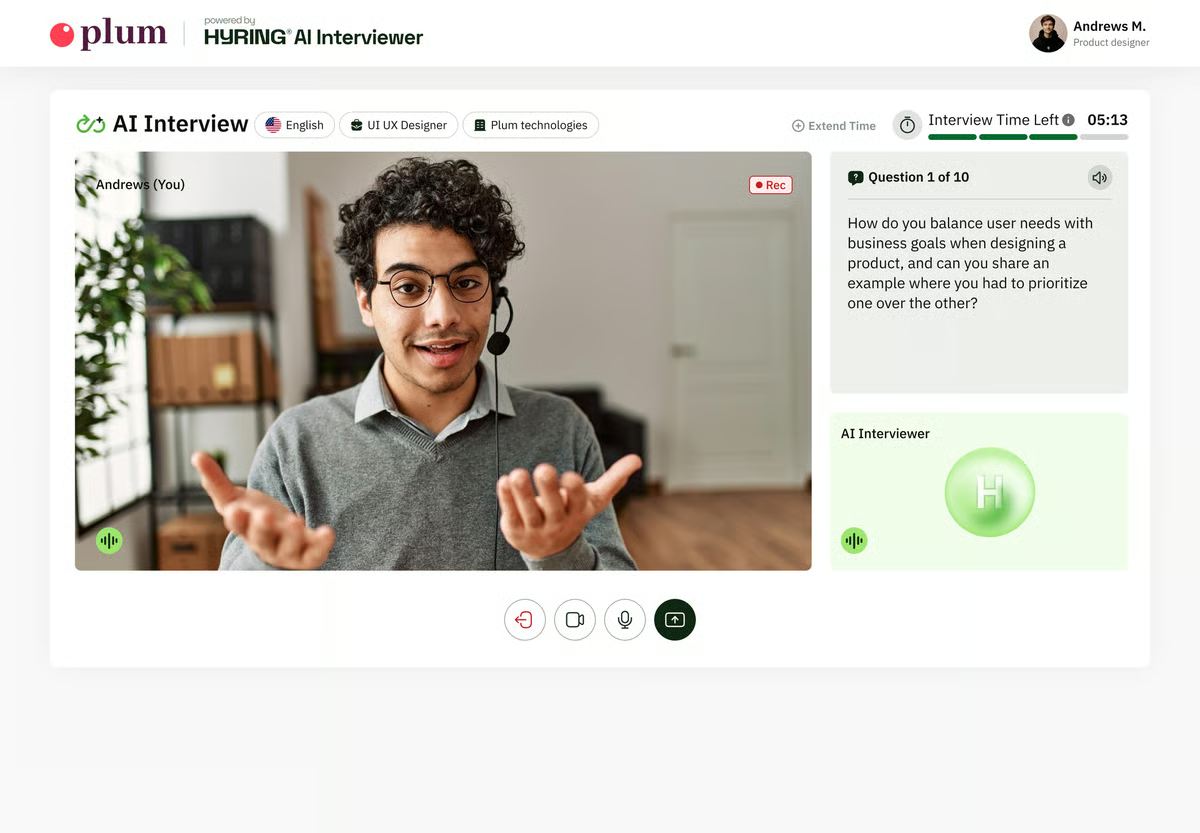
The coding assessments are another area users praise, especially with the built-in IDE, support for 20+ languages, plagiarism detection, and logic-based evaluation that feels closer to real-world problem-solving than multiple-choice quizzes.
What stands out in G2 reviews is just how thorough the fraud detection is. The platform monitors for tab switching, multiple faces or voices, eye-gaze anomalies, and background noise, and also checks specifically for AI-generated or plagiarized responses and lip-sync cheating. For high-volume or remote recruitment, this gives hiring teams meaningful confidence in the integrity of every assessment.
AI Interviewer can run 24/7, engage candidates immediately, and deliver structured insights that help hiring teams move faster. The satisfaction numbers reflect that: 98% ease of use, 99% ease of setup, and consistently high scores for quality of support. It’s no surprise that the largest user segment is small businesses (75%), followed by mid-market teams (21%), since these companies often need automation that feels both powerful and simple.
Like most AI-first platforms, the format can feel impersonal to some candidates, particularly those who expect a human on the other end. Reviewers note that the experience works best when candidates are briefed upfront about the AI format, which tends to improve engagement and the quality of responses significantly.
On the whole, I’ve found AI Interviewer especially effective for teams dealing with high applicant volumes, because the automated screenings help you get to a shortlist much faster. It’s a strong fit for small and mid-sized teams that want to speed up early-round screening, stay consistent, and give candidates a flexible, on-demand experience.
What I like about AI Interviewer:
- The AI can actually lead structured interviews, ask follow-up questions, and produce clear, actionable reports. It takes a huge amount of early-stage work off a recruiter’s plate while still giving hiring teams consistent, detailed insights.
- I appreciate how thorough the fraud detection is. From AI-generated responses and lip-sync cheating to multiple faces and screen sharing, the integrity controls give hiring teams real confidence in what they’re evaluating.
What G2 users like about AI Interviewer:
“The platform offers a wide range of features, including video interviews, phone screening, resume screening, and coding assessments with a built-in IDE that supports over 20 programming languages. The AI dynamically adapts questions in real time, rephrasing them if candidates have difficulty and probing further based on their answers. Fraud detection features are thorough, identifying multiple faces, external monitors, screen sharing, AI-generated responses, and lip-sync cheating.”
– AI Interviewer review, Filipe S.
What I dislike about AI Interviewer:
- Some reviewers note that the AI-led format can feel impersonal or robotic to candidates who are used to human interaction. Teams that set clear expectations upfront in the invitation tend to see stronger completion rates and more natural responses.
- For roles where soft skills, communication style, or cultural fit are the primary hiring signals, the AI format can make those nuances harder to read than a live conversation would. That said, most teams find that pairing first-round AI screens with a human-led interview at a later stage covers both dimensions effectively.
What G2 users dislike about AI Interviewer:
“At times, some responses felt a little robotic and repetitive. I also wished it asked more personal follow-up questions based on my answers.”
– AI Interviewer review, Arif A.
3. HackerRank Developer Skills Platform: Best for technical hiring at mid-market and enterprise scale
If you have done technical hiring, you probably know about HackerRank Developer Skills Platform already. It has a long-standing presence in the developer hiring world, and as I dug through G2 reviews and its product capabilities, it’s easy to see why it continues to lead the category.
On G2, HackerRank holds a solid 4.6/5, and nearly all reviewers scored it in the top two tiers. Most of its users are enterprise (54%) and mid-market (40%) companies, exactly the kinds of organizations that need structure, scale, and repeatability in their engineering interview process.
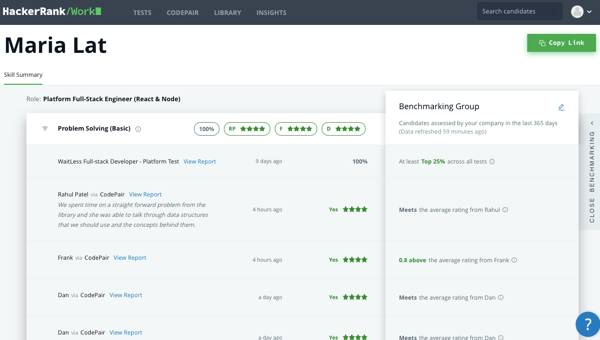
HackerRank stands out because it evaluates developers in ways that feel rooted in real engineering work. Recruiters can screen candidates through coding tests, project-based challenges, supported with AI-powered scoring, which makes early-stage filtering more accurate and efficient.
The platform doesn’t stop at coding skills either; it also evaluates AI readiness, prompting candidates to demonstrate how they work with AI tools, understand prompt engineering, or think about concepts like RAG and vector databases. Paired with its integrity stack that includes identity checks, suspicious activity detection, and proctoring controls, it gives hiring teams a lot of confidence at scale.
One thing reviewers consistently highlight is how much time the automated scoring and detailed performance reports save. Rather than manually reviewing every submission, hiring teams get standardized data on each candidate’s strengths and weaknesses, making shortlisting decisions faster and more consistent across different interviewers and roles.
Its highest-rated features, technology (90%), performance (87%), and user, role, and access management (87%), reflect a platform built for reliability and scale. And the fact that so many of its users come from IT services, software, and internet companies makes sense: HackerRank is built for environments where technical accuracy and consistency matter.
Teams with a strong preference for a streamlined, modern interface might look for more fluid navigation between test creation, candidate reports, and settings as their workflows grow. For organizations running structured, high-volume technical pipelines though, the depth of what the platform offers more than makes up for the extra clicks, and most teams find the layout becomes second nature once they’re past the initial setup.
All things considered, I’d say HackerRank is best for mid-sized and enterprise companies that want a technical interviewing platform capable of delivering realistic coding evaluations, deep integrity controls, and AI-ready assessments at scale.
What I like about HackerRank Developer Skills Platform:
- I like how the platform evaluates candidates through collaborative IDEs, project-based challenges, and structured AI-led interviews, giving hiring teams a much clearer sense of someone’s actual skill level rather than relying on resume claims alone.
- I also appreciate how much time the automated scoring and detailed performance reports save. Standardized data on each candidate’s strengths makes shortlisting faster and more consistent across roles and interviewers.
What G2 users like about HackerRank Developer Skills Platform:
“HackerRank streamlines candidate evaluation through automated pass/fail scoring for submitted solutions, saving valuable time for hiring teams. Its detailed reporting insights enable hiring teams to make data-driven decisions based on candidate performance. The live coding functionality allows real-time skill validation, further confirming the authenticity of a candidate’s technical capabilities.”
– HackerRank Developer Skills Platform Review, Agnes K.
What I dislike about HackerRank Developer Skills Platform:
- Teams that prefer a more streamlined interface might look forward to smoother navigation between test creation, reports, and settings as their workflows scale. Once past the initial learning curve though, most teams find the layout supports a reliable, repeatable hiring process.
- A few reviewers note that proctoring flags can occasionally surface false positives, which adds a small layer of manual review. That said, the integrity stack overall gives hiring teams far more confidence in assessment results than most platforms at this scale can offer.
What G2 users dislike about HackerRank Developer Skills Platform:
“Overall, the platform is robust, yet there is room for improvement in how plagiarism is managed and in the speed of reporting. Addressing these areas could make the experience even better for both users and recruiters.”
– HackerRank Developer Skills Platform review, Arun K
4. Hireflix One-Way Video Interviewing: Best for high-volume one-way screening
Hireflix is one of those platforms that shows just how simple and efficient one-way video interviewing can be. With a 5/5 G2 rating and 99% of users giving it 4 or 5 stars, it’s clear that users genuinely enjoy using it.
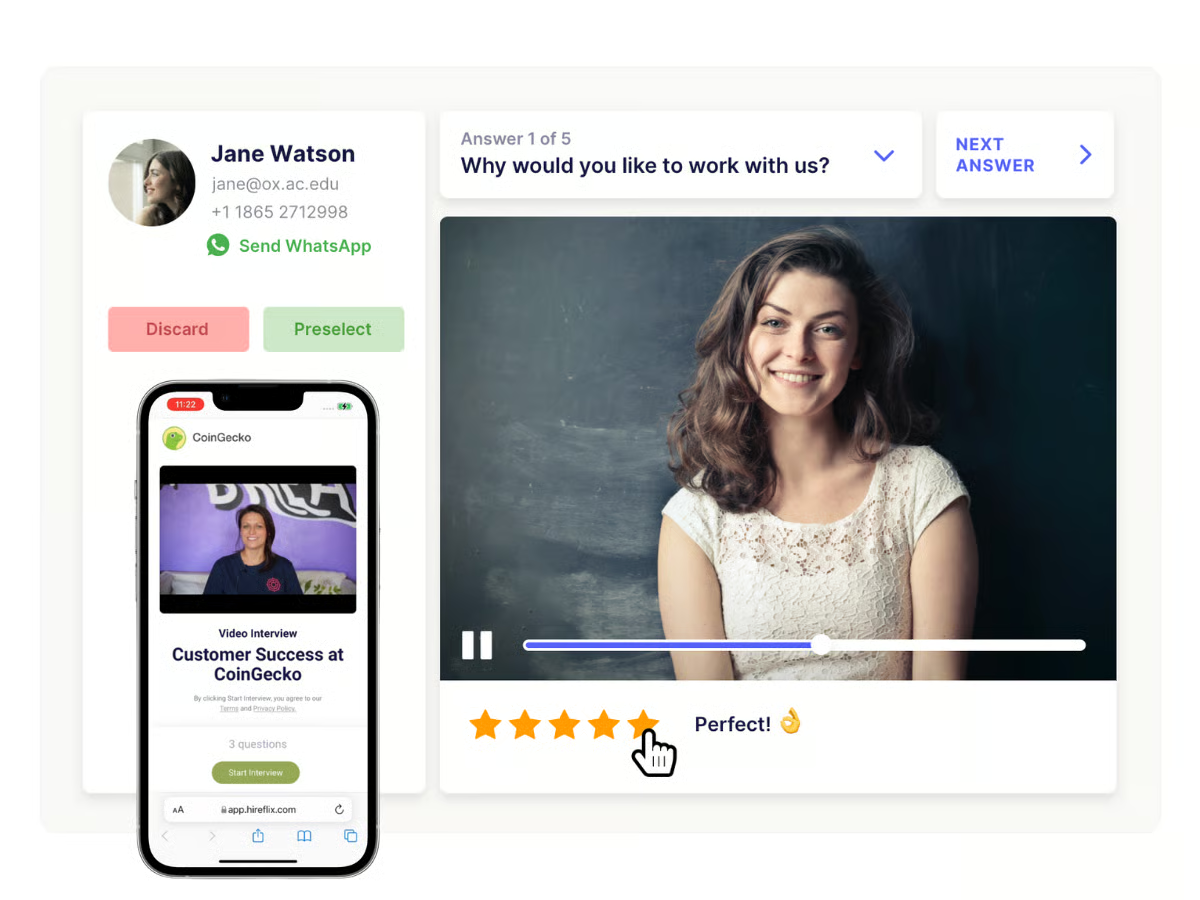
The core appeal is its simplicity of conducting one-way interviews with candidates: the recruiter records the digital interview questions once and sends them to as many candidates as needed, allowing people to respond on their schedule. There’s no need to coordinate time zones or squeeze phone screens into a packed day.
Reviewers love how Hireflix removes the back-and-forth that usually comes with screening, making it easy to evaluate candidates consistently and move top performers to the next stage. Once responses come in, users can review submissions whenever it works for them, share them with other stakeholders, and keep the entire process aligned without adding meetings to everyone’s calendars.
Something that stands out consistently in G2 reviews, and that I didn’t see as prominently with other tools in this category, is how often users single out the Hireflix support team by name. Multiple reviewers from across industries mention specific members of the team as responsive, proactive, and genuinely invested in helping them get the most out of the platform. For teams adopting a new screening tool mid-hiring-season, that kind of support makes a real difference.
And the satisfaction scores back that up. The platform scores 99% for ease of use, 99% for ease of setup, 99% for ease of admin, and a perfect 100% for quality of support, which makes sense given how popular it is among small businesses (63%) and mid-market teams (33%) that need hiring tools that don’t slow them down.Industries like staffing, software, IT services, education, and marketing rely on it heavily, and it fits beautifully into fast-moving hiring environments.
Because Hireflix is built around the one-way async format, teams may notice that candidate completion rates run slightly lower than they would with a scheduled live interview. Most teams find that a well-timed reminder and a clear, friendly invitation message close that gap considerably, and the time saved on coordination more than offsets the occasional follow-up.
For me, Hireflix really shines when you need a clean, reliable way to screen a lot of candidates without adding extra meetings or coordination. It’s a great fit for small and mid-sized teams that want an efficient, flexible screening stage that candidates can complete on their own time while keeping the entire process simple and consistent.
What I like about Hireflix One-Way Video Interviewing
- I like how simple and streamlined the entire process feels. Recording the interview once and sending it to as many candidates as needed saves a huge amount of time, and reviewers consistently mention how intuitive the platform is from day one.
- I also appreciate how consistently the support team comes up in reviews. Multiple users mention responsive, proactive help by name, which is rare and speaks to how seriously Hireflix takes the customer experience alongside the product itself.
What G2 users like about Hireflix One-Way Video Interviewing
“Using this tool must have saved us at least 75% of time in our screening process. Not only did it improve the quality of candidates that we took through to the face-to-face interviews. Also, for the candidates themselves, it meant that they can really get across who they are in a way that they can’t via a written screening process.”
– Hireflix One-Way Video Interviewing review, Kate F.
What I dislike about Hireflix One-Way Video Interviewing
- Candidate completion rates can run slightly lower with async formats than scheduled interviews. A clear invitation message and a well-timed reminder tend to close that gap for most teams.
- Teams looking for AI-generated candidate summaries or instant post-interview reports may need to handle that synthesis manually or pair Hireflix with a dedicated AI notetaking tool.
What G2 users dislike about Hireflix One-Way Video Interviewing
“The only challenges we experienced with Hireflix occurred when candidates inadvertently submitted their digital interview before it was complete. We would have preferred to return the digital interview to the candidate for completion. Unfortunately, I did not raise this concern until after we completed hiring and learned there was a way to do this. The other minor challenge we encountered was the need to view the interview in a different window rather than within JazzHR.”
– Hireflix One-Way Video Interviewing review, Kimberley S.
5. Indeed Hiring Platform: Best for reaching a large candidate pool fast
When I explored Indeed Hiring Platform as a video interviewing solution, what stood out is how naturally the interview experience sits inside a workflow most hiring teams are already using. With a 4.3/5 G2 rating, it’s used by teams across small businesses, mid-market, and enterprise as a central part of their hiring process.
What makes it relevant in this category specifically is how Indeed has built the interviewing step directly into the hiring workflow rather than treating it as a separate tool. Candidates don’t need to download anything — they join browser-based video interviews straight from the platform. Recruiters can offer multiple time slots, let candidates self-schedule from available windows, and rely on automated reminders to reduce no-shows, all without leaving the system they’re already working in.
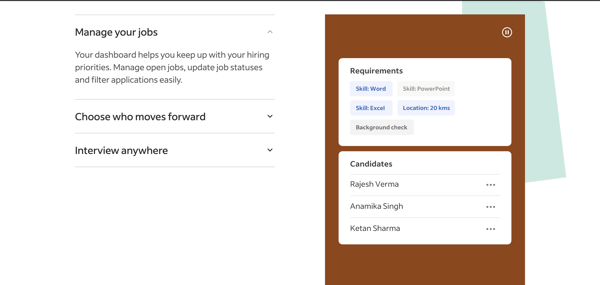
The interview scheduling feature gets specific praise in G2 reviews. Reviewers describe sending candidates a scheduling link that shows only available slots, cutting out the back-and-forth entirely and saving meaningful administrative time. The fact that it feeds directly into candidate tracking, messaging, and notes in the same platform means there’s no context switching between tools.
And the satisfaction scores reflect that streamlined experience, with users rating it 94% for ease of use and 95% for ease of setup. Its highest-rated features, AI text summarization, AI text generation, and messaging, point to the same thing: the platform is built for speed and simplicity at scale.
Where Indeed’s video interviewing genuinely stands out is in the pipeline it feeds. Because job postings and candidate sourcing live in the same system, recruiters move from identifying a candidate to scheduling and completing a video interview without any tool-switching. Reviewers consistently describe this as the biggest practical advantage over standalone video interviewing tools.
Since the platform brings in such a large applicant volume, teams handling broad or high-volume roles may want to use stronger screening questions or filters before the video interview stage to keep the pipeline focused. Even with knockout questions in place, some reviewers note that unqualified candidates still make it through. That said, the sheer volume Indeed generates means that even after filtering, most teams end up with a deeper, stronger shortlist than they’d get from most other platforms.
Altogether, Indeed Hiring Platform is a strong fit for teams that want video interviewing embedded inside their existing sourcing and screening workflow, without adding a separate tool or asking candidates to navigate a different platform entirely.
What I like about Indeed Hiring Platform:
- I like how the video interview step sits inside the same workflow as posting, screening, and messaging. Reviewers describe sending a scheduling link directly from the platform and having the interview, notes, and candidate record all in one place without switching tools.
- I also appreciate how frictionless the candidate experience is. No downloads, no separate logins, candidates join browser-based interviews directly, which reviewers say keeps completion rates high and reduces no-show friction.
What G2 users like about Indeed Hiring Platform:
“I really enjoy using the interview scheduling feature. Once I review candidates and decide whom to interview, I can send them an interview request that only shows my availability, saving a lot of time in back-and-forth scheduling. It also saves administrative time like adding events to my calendar, downloading resumes, and making phone calls.”
– Indeed Hiring Platform review, Marah C.
What I dislike about Indeed Hiring Platform:
- Even with screening questions in place before the video interview stage, unqualified candidates still make it through regularly. Tighter pre-screening filters and more specific knockout questions make a significant difference.
- A few reviewers note that the platform’s navigation can feel clunky when moving between candidate profiles, interview stages, and settings. It doesn’t disrupt the core workflow, but teams managing high volumes across multiple roles may find the extra clicks add up.
What G2 users dislike about Indeed Hiring Platform:
“It would be great if there was an option to organize better quality candidates, a way to weed out the not qualified candidates. I would suggest having more than a one click option for candidates to apply to receive more qualified candidates.”
– Indeed Hiring Platform review, Tiffany S.
6. Metaview: Best for AI-generated interview notes and structured summaries
When I first looked into Metaview, I realized quickly that it isn’t just a “video interviewing tool” in the traditional sense. Instead of giving you another platform to host interviews on, Metaview focuses on everything that happens around the interview: taking notes, structuring insights, summarizing conversations, and helping you follow up faster, like an AI meeting assistant.
With a 4.8/5 rating on G2 and 98% of users giving it 4 or 5 stars, it’s one of those tools people tend to stick with because it quietly removes work from their day rather than adding to it.
What users on G2 consistently love is how it handles AI interview notes. The tool captures the conversation in real time and automatically turns it into clean, structured notes so interviewers can stay focused on the candidate instead of scrambling to write things down. Reviewers also highlight how customizable the outputs are.
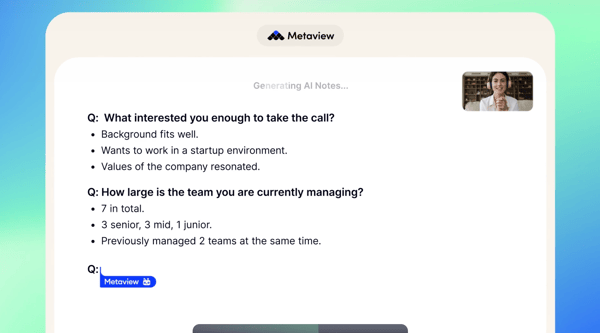
One thing I didn’t expect until I dug deeper is how broad Metaview’s AI ecosystem is. Beyond notes, it can generate one-click TLDRs, pull out specific details from conversations, suggest job post improvements based on what candidates actually talk about during interviews, and even surface insights like patterns in candidate motivations or competitive offers. The AI sourcing agent is an interesting addition, too. It proactively surfaces potential talent using your job descriptions, past candidates, and natural-language criteria.
Something else that comes up regularly is how cleanly Metaview connects with ATS systems. Reviewers mention data syncing automatically once an interview is complete, which means candidate notes and summaries land directly in the hiring workflow without any manual copying. For teams running multiple interview rounds across different hiring managers, that kind of automatic sync is a meaningful time saver.
Its highest-rated features on G2, like performance (95%), file sharing, and user, role, and access management (91%), echo this. Teams rely on it not only for interviewing, but also for managing the flow of information and collaboration around those interviews.
The AI shines brightest in clear, one-on-one conversations where the dialogue follows a predictable structure. In more complex setups, like interviews with multiple speakers, mixed languages, or strong accents, the notes may occasionally need a quick review to make sure everything lands as expected. For most teams, this is a minor consideration that rarely disrupts the workflow, and the time saved on documentation more than makes up for the occasional check.
If you’re looking for a tool that makes interviews more structured, helps you collaborate with hiring managers, and reduces the messy admin work that comes with scaling hiring, Metaview is a great choice. In my view, it’s best for teams that want AI intelligence layered on top of the video platforms they already use.
What I like about Metaview:
- I really appreciate how often reviewers mention the quality of the AI-generated notes. The summaries, structured templates, and tailored outputs make it much easier to stay focused on the candidate instead of worrying about documentation.
- I like how cleanly Metaview connects with ATS systems. Notes and summaries sync automatically after each interview, so candidate data lands where teams are already working without any manual effort.
What G2 users like about Metaview:
“Metaview significantly reduces manual note-taking during interviews, allowing recruiters and hiring managers to stay fully engaged in the conversation. I appreciate its automated transcription and structured summaries, which help streamline feedback sharing, reduce bias, and accelerate decision-making. The integration with our ATS and the ability to review interview insights asynchronously also makes it an invaluable tool for improving consistency and quality across the hiring process.”
– Metaview review, Verified User
What I dislike about Metaview:
- The AI performs best in clear, one-on-one conversations. For interviews with multiple speakers, varied accents, or mixed languages, teams may want to give the notes a quick review to make sure everything aligns with their expectations. For most teams though, this is a minor consideration that rarely disrupts the overall workflow.
- A few users mentioned wanting more integration options beyond the core ATS platforms Metaview already supports, so teams with very customized tech stacks might pair it with other tools to shape their ideal workflow.
What G2 users dislike about Metaview:
“The reporting function could be a bit easier to use but that’s very minor. It would be interesting to see what more could be done via ATS integrations”
– Metaview review, Verified User
7. Willo Video Interviewing: Best for asynchronous video interviewing
When I read through G2 reviews for Willo, what stood out immediately was how often people described it as simple, reliable, and surprisingly flexible for a one-way video interviewing platform.
With a 4.6/5 rating on G2 and 97% of users giving it 4 or 5 stars, it’s built a strong reputation among small and mid-sized teams for being reliable, easy to adopt, and genuinely candidate-friendly.
What becomes clear across G2 user reviews is how much Willo focuses on accessibility and scalability. It works on any device, runs smoothly even on low bandwidth, and is fully browser-based, no downloads needed. That matters because a lot of teams using one-way interviewing are screening internationally or across varied candidate segments.
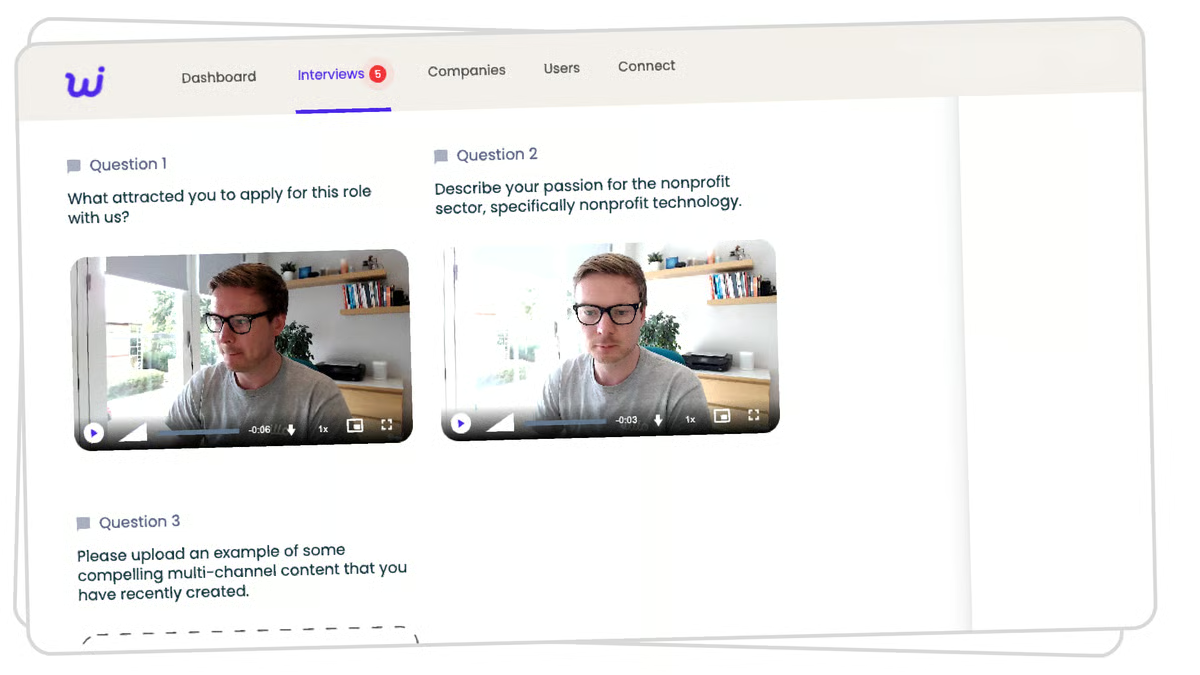
Add in features like automated email/SMS reminders, anytime access for candidates, and support for video, audio, and text answers, and the experience becomes much more inclusive. And the G2 satisfaction scores reflect this emphasis: ease of use (94%), ease of setup (95%), and ease of doing business with (96%) are all areas where users consistently rate Willo above category averages.
Beyond the basics, Willo has a surprisingly deep feature set for teams that want more structure or automation. The intelligent question generator helps create strong prompts without much effort, and the platform integrates with over 5,000 apps.
I also like how seriously it takes compliance and trust: ISO 27001 certification, GDPR alignment, two-factor authentication, digital ID verification, right-to-work checks, and anti-cheat systems mitigate deepfakes and scripted responses. And with Willo Intelligence AI summarizing interviews, surfacing skills, and identifying gaps automatically, reviewers mention it saves meaningful time during the early screening stages.
Some candidates and reviewers note that the one-way format can feel impersonal compared to a live conversation. For roles where interpersonal energy and soft skills are central to the hire, teams may want to factor in that async interviews capture responses well but give less signal on how a candidate actually shows up in the room. That said, for early-stage screening at volume, it remains one of the most consistent and bias-free formats available.
In my view, Willo is best for teams that want predictable, scalable screening without overhauling their existing hiring workflows. It handles volume effortlessly, plays well with other tools, and keeps its setup intentionally lightweight. For small and mid-sized teams that need a dependable first-round filter that candidates can complete on their own time, it’s one of the strongest options out there.
What I like about Willo Video Interviewing:
- I like how simple and intuitive Willo is to use. Reviewers repeatedly mention that setup is fast, sharing interviews is easy, and candidates can complete everything on any device without downloading anything.
- Willo’s automated workflow stands out in reviews. A single link replaces hours of scheduling and back-to-back calls, cutting early-stage screening time significantly while keeping evaluation consistent across every candidate.
What G2 users like about Willo Video Interviewing:
“With Willo, we’ve saved significant time by limiting candidate responses to 2-3 minutes per question. Willo enables later interviewers to watch the recorded videos, giving them a chance to observe candidates’ communication skills firsthand and feel more confident about who they’ll be meeting. It has allowed others to speak into hiring decisions to make a more confident hire.”
– Willo Video Interviewing review, Katrina S.
What I dislike about Willo Video Interviewing:
- Because there’s no live interaction, the format can feel impersonal to some candidates. Teams hiring for roles where personality and interpersonal energy matter most may find softer signals harder to read, though pairing Willo with a live round at a later stage tends to cover that gap well.
- As candidate volumes grow, reviewing responses one by one can become time-consuming without a stronger AI-driven ranking to surface the best fits quickly. The transcript and summary features help, and most teams find that the scheduling time saved still outweighs the manual review effort.
What G2 users dislike about Willo Video Interviewing:
“One area for improvement with Willo Video Interviewing is the assessment setup. It can feel too basic and lacks the level of structure needed for more comprehensive evaluations. For roles that require deeper screening or standardized scoring, the platform could benefit from more advanced customization options, such as structured assessment frameworks, weighted scoring, or more robust evaluation criteria.”
– Willo Video Interviewing review, Fernando G.
8. Spark Hire: Best for an all-in-one video interview tool
If you’re looking for a platform that supports every flavor of video interviewing, one-way, live, mobile-friendly, and layers in behavioral assessments, automated reference checks, interview scheduling, and even a built-in ATS, Spark Hire checks a surprising number of boxes.
Spark Hire holds a strong 4.7/5 on G2. Most Spark Hire customers fall into the mid-market (48%) and small business (31%), and its features map well to what those teams typically need: flexible one-way and live two-way video interviews, automated reference checks, AI-assisted job descriptions and question sets, and even built-in scheduling for live interviews.
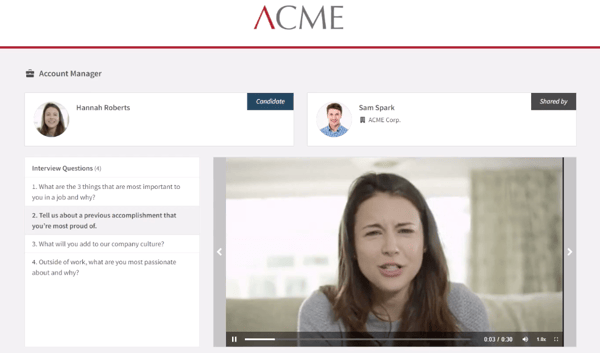
Spark Hire covers a lot of ground in one place. One-way interviews, live sessions, behavioral assessments, and automated reference checks mean recruiting teams can run the entire early screening process without stitching together multiple tools. Hiring teams can also add branded intro and outro videos, customize answer times and retake settings, and send reminders automatically, small details that make a real difference in candidate follow-through.
When reviews need to move fast, features like AI-generated scorecards, AI video review, and searchable transcripts help hiring managers zero in on the strongest candidates quickly. Teams can share candidate videos securely, leave structured feedback, and keep everyone aligned through shared rating rubrics and role-based permissions, without rounds of back-and-forth email.
What consistently comes through in 2026 reviews is how meaningfully Spark Hire reduces time at the early screening stage. Reviewers describe replacing 30-minute calls with focused 10-minute video reviews and getting meaningful hours back across entire recruiting teams each hiring cycle.
The G2 satisfaction data backs this up. Spark Hire scores over 97% on ease of use and Ease of Doing Business With, along with strong ratings for setup and support. Its highest-rated features, performance, user, role, and access management, and Technology (all 94%), reflect what I saw across reviews: it’s stable, fast, and designed for smooth collaboration.
Teams that rely heavily on reporting may find that pulling very specific or niche reports sometimes requires support assistance rather than being fully self-serve. It’s a minor friction point on an otherwise strong analytics experience, and for most teams the built-in reporting covers day-to-day hiring decisions well without needing anything custom.
On the whole, if you want a platform that saves hours of manual coordination, keeps candidates engaged, and gives hiring managers clear, consistent insights, Spark Hire is an excellent choice.
What I like about Spark Hire:
- I like how much ground it covers in one platform. One-way interviews, live sessions, reference checks, and behavioral assessments mean teams can run the full screening process without switching tools.
- I also appreciate the time savings that come through consistently in reviews. Reviewers describe replacing lengthy screening calls with focused video reviews and getting meaningful hours back each hiring cycle.
What G2 users like about Spark Hire:
“Spark Hire has helped to save so much time in our first round interviews by allowing our candidates to complete a one-way video interview when it is convenient for them, within a timeframe we have allotted. It saves us from having to schedule those interviews and meet one-on-one with candidates at this stage of our recruitment process. The structure of the platform is immensely helpful for us!”
– Spark Hire review, Sarah G.
What I dislike about Spark Hire:
- Teams with niche reporting needs may occasionally need support assistance to pull specific reports. The built-in reporting handles most day-to-day decisions well, and the support team is responsive when something more custom is needed.
- Some reviewers note that candidates who prefer traditional interactions benefit from a brief explainer in the invitation. Teams that add that context upfront tend to see stronger completion rates and more confident responses.
What G2 users dislike about Spark Hire:
“They have an AI tool that was recently introduced to the platform that gives an assessment of candidates’ video interview responses. It overwhelmingly marks candidate responses as strong, even when they aren’t, and this could be something we customize to ensure alignment and cut down our time to review.”
– Spark Hire review, Arthel H.
If you’re still exploring options, I also found it helpful to look at where other platforms sit on the G2 Grid. Here are a few worth considering depending on what you prioritize:
- Workable an all-in-one recruiting platform that combines video interviewing with sourcing, ATS, and onboarding in one place
- InCruiter combines AI screening, live video interviews with code collaboration, and a network of expert interviewers
- Testlify focused on skills-based hiring with video interviewing built into a broader talent assessment workflow
- Canvass a straightforward async video interviewing tool built for high-volume, candidate-friendly screening
- Jobma an affordable one-way and live video interviewing platform with a strong presence in mid-market hiring
Frequently asked questions on video interviewing software
Got more questions? Here are the answers.
Q1. What is the best solution for remote hiring interviews?
Spark Hire, Willo, and Hireflix are strong picks for remote hiring because they support live and one-way interviews, structured feedback, and collaborative review without requiring anyone to be in the same place.
Q2. What is the most affordable video interviewing software for SMBs?
AI Interviewer is one of the most budget-friendly options for SMBs thanks to its pay-per-interview pricing, making it ideal for high-volume screening without a large upfront commitment.
Q3. What is the top-rated video interviewing platform for enterprises?
HackerRank, Spark Hire, Willo Video Interviewing, and Metaview are top-rated choices for enterprises that want AI-powered interview notes, consistency across interviewers, and stronger interview analytics at scale.
Q4. What platform integrates video interviewing with ATS systems?
Metaview, Spark Hire, and HackerRank are commonly used alongside ATS platforms such as Greenhouse, Workday, and Lever. Braintrust AIR integrates directly with Workday and Slack, while AI Interviewer fits into existing ATS workflows through APIs or native integrations depending on your stack.
Q5. What platform provides analytics on interview performance?
Metaview is the strongest option for deep interview analytics, using AI to analyze talk-time balance, question patterns, and candidate responses. AI Interviewer also delivers structured scoring and insights, while Spark Hire and Braintrust AIR provide reporting dashboards that track activity, completion rates, and funnel performance.
Q6. Which solution supports both live and pre-recorded interviews?
Spark Hire, Willo Video Interviewing, and Indeed Hiring Platform all support both live and one-way interviews, letting recruiters send async links for early-stage screening while scheduling live sessions for later rounds. Hireflix is primarily focused on one-way async interviews.
Q7. Which tool supports multi-language video interviewing?
Willo Video Interviewing and Spark Hire are frequently chosen for global hiring because they support a broad range of languages across candidate invitations, interfaces, and workflows. Hireflix also offers localized experiences that work well for distributed teams running high-volume one-way interviews.
Q8. Which vendor offers the most secure video interview storage?
Metaview, Spark Hire, and HackerRank are typically evaluated first for security-conscious teams because they emphasize encrypted video storage, strict access controls, and compliance frameworks like SOC 2 and GDPR.
Q9. Which vendor provides AI-powered candidate scoring from interviews?
Metaview and AI Interviewer are the top choices for AI-powered candidate scoring, applying NLP and machine learning to generate structured insights and suggested scores based on predefined criteria. Braintrust AIR delivers automated candidate rankings from its AI-led interviews, while HackerRank applies AI scoring primarily to coding and technical challenges.
Q10. Which video interviewing platform offers the most advanced candidate evaluation tools?
Metaview leads on advanced evaluation by transforming interview conversations into searchable structured data with AI summaries and competency mapping. AI Interviewer automates evaluation to surface patterns and risk signals at volume, while HackerRank offers the deepest technical evaluation through coding tests and structured scorecards.
Q11. Are there any free video interviewing platforms?
Most professional-grade video interviewing platforms operate on a paid subscription model, but several offer free trials or low-cost starter plans. Spark Hire, Willo Video Interviewing, and Hireflix One-Way Video Interviewing typically provide trial access so hiring teams can test one-way and live workflows before committing.
Q12. How long does it take to implement video interviewing software?
According to G2 data, implementation time for video interviewing software can range from about 0.1 months (roughly three days) to 3.3 months, depending on complexity, integrations, and hiring volume. Companies with clear hiring workflows and defined roles usually see faster adoption across their recruiting teams.
Q13. How do I select the best video interviewing software?
Start by clarifying what you are trying to optimize: faster screening at scale, better interview quality, improved candidate experience, or deeper analytics. For end-to-end AI automation, Braintrust AIR handles candidate matching, AI-led interviews, and structured reporting in one platform. For advanced analytics and AI scoring, Metaview and AI Interviewer transform conversations into actionable insights. For flexible live and one-way interviewing, Spark Hire and Willo are well suited to general-purpose hiring. For technical recruiting, HackerRank natively combines coding assessments with video interviews, giving engineering leaders a richer signal on skills.
Interview cleared!
Here’s something I didn’t expect to find after going through all these platforms: the tools that stood out most weren’t necessarily the ones with the longest feature lists. They were the ones that made the process feel intentional, for both the recruiter and the candidate.
G2 reviewers across every platform in this list said the same thing in different ways: when candidates are given context, treated with respect, and kept informed, they show up better. That’s true whether the first touchpoint is an AI-led voice interview, a one-way video screen, or a live technical assessment. The format matters less than the experience built around it.
The right platform gives you the infrastructure. But the hiring teams getting the best results are the ones pairing that infrastructure with clear communication, a well-designed process, and genuine follow-through. That combination is what turns a screening tool into something candidates actually remember positively.
Want to see how your hiring process is performing beyond the interview stage? Explore HR analytics software to track the metrics that matter across your full recruitment funnel.
