



In real estate, money is made on the purchase, not the sale. That means every dollar you negotiate off the asking price is a dollar straight to your net worth. So you need every tool at your disposal: savvy representation, patience, a compelling offer, and yes, even publicly available data that happens to be wrong or outdated.
This isn’t about lying or fabricating anything. It’s about using the information landscape to your advantage, the same way sellers and their agents already do. As a buyer, your goal is to get the lowest price possible.
The Chart That Inspired This Post
Take a look at the Parcl Labs “Bullish vs. Bearish Housing Markets” chart below. Parcl Labs bills itself as a real-time real estate analytics company. The chart is genuinely useful for spotting trends in markets like Florida and Texas, where COVID-era booms are unwinding and supply is still elevated.
But notice the circled dot: SFO. That’s San Francisco. According to Parcl Labs, home prices here are down year-over-year.
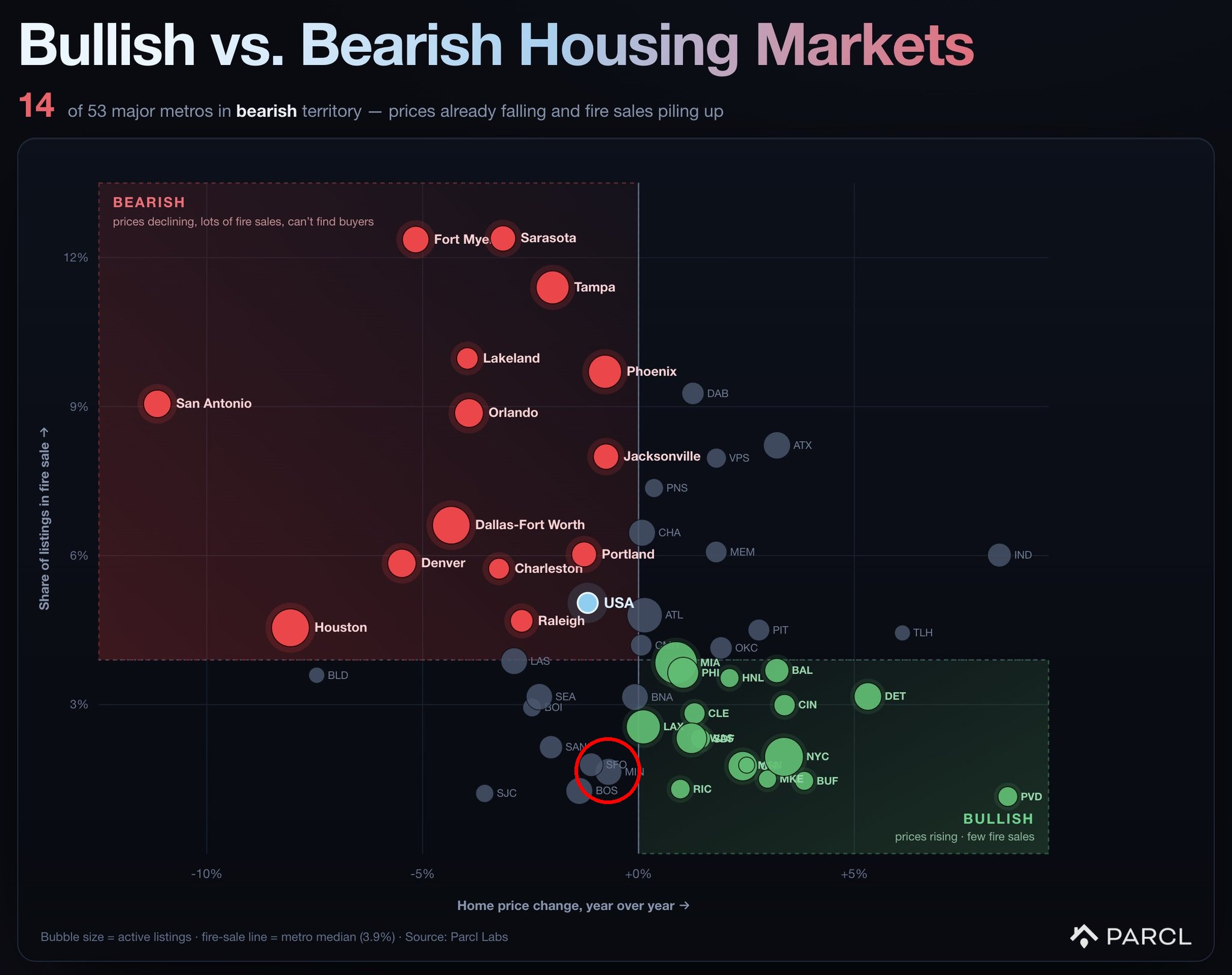
I live in San Francisco. I track dozens of properties every week. Watching offer dates, over-ask premiums, and comps has been a fanatical hobby of mine since my first purchase in 2003. Prices in San Francisco are up at least 10% year over year, not down. Properties are going for well above asking. Bidding wars are back with a vengeance. The data Parcl Labs is showing for SFO is flatly wrong.
And that’s exactly the point. The funny thing is, you don’t even need to live in San Francisco to know prices aren’t down, given all the hype surrounding AI. The amount of wealth being created in such a short amount of time has been incredible.
Two Ways to Use Erroneous Data as a Buyer
There are two ideal moments to deploy publicly available data like this.
The first is before you’re in contract. If a property has been sitting on the market, it’s likely overpriced. Pull up a chart like this one, print it out, and present it respectfully as part of your offer narrative. You’re not accusing the seller of anything. You’re just showing them what the data says. Even if the data is wrong, it introduces doubt, and doubt creates negotiating room.
The second is after you’re in escrow. This is the more powerful move. Once a seller accepts your offer, they’re emotionally and logistically committed. They’ve told their friends, their family, maybe already picked out their next place. The last thing they want is for the deal to fall apart. Any credible-looking data suggesting the market is softening gives you a reason to come back and ask for a price reduction or credit during the inspection period. As a buyer, the longer you can delay escrow, usually, the greater your concessions.
I’ve bought seven properties over 23 years and sold two. I’ve seen these dynamics play out firsthand. When we bought our current home, we got into contract in late July and didn’t close until early October. That gave us weeks to inspect, identify issues, and negotiate credits. We didn’t catch everything, but we knocked out the major items.
Fear Is the Seller’s Worst Enemy
Part of why this works is psychological. Sellers are more fearful of not being able to sell their home than buyers are of not being able to buy one.
If you’re a buyer in San Antonio, Houston, Dallas-Fort Worth, Fort Myers, Sarasota, Tampa, Orlando, Lakeland, Denver, Charleston, Raleigh, Phoenix, Portland, or Jacksonville, your goal is to use the chart above and come up with the most doomsday scenario possible for the seller.
You can talk about how home price declines will likely accelerate as rising inflation zaps consumers of their spending power. Four months later, the war in Iran is still going on! You can remind them about the never-ending supply of land that can be built upon. You could also bring up potential tax policies, like a mansion tax or a property tax hike, that would hurt homebuyers.
The goal is to instill FEAR in the sellers’ hearts and get them to sell at a discount, all while you know the worst won’t come to pass.
My Own Fear Got Me To Sell At An Inopportune Time
I sold one of my own properties in 2025 partly because the Southern California fires spooked me. Without warning, entire neighborhoods of multi-million dollar homes burned to the ground. Further, a major home insurance company had pulled out of the area right before.
At the time, I had four rental properties in San Francisco and suddenly couldn’t stop imagining one or all of them burning down. 22 years of sweat equity gone in an instant. So when the tenants gave their notice, I sold instead of looking for new ones. The move cost me at least 10% in further gains. Fear is expensive.
As a buyer in San Francisco, you can channel that same fear productively. Show a chart suggesting prices are declining. Throw in a few headlines about tech layoffs at Meta, Block, Google, and others. Make a case that a tech sector correction could put pressure on housing demand. None of that is fabricated, it’s all real noise from real sources. You’re just curating it toward a conclusion that helps you.
On a $2.1 million median home price in San Francisco, talking a seller down just 1-5% saves you $21,000 to $105,000. That’s a meaningful number worth 30 minutes of prep work.
Look at the ALL CAPS headline used to market the data. Fear sells online and in real life. The media uses it to its advantage, so can you when buying a home or anything expensive for that matter.
Perception Is Reality, Especially in Real Estate
The same dynamic that let savvy buyers pick up San Francisco properties at relative value in 2023 and 2024 during the so-called doom loop narrative is available to you right now.
The internet is full of real estate data that is stale, aggregated wrong, or simply miscalibrated for local conditions. You don’t have to create any of it. You just have to know where to look and how to present it.
The bigger the gap between perception and reality, the more opportunity there is for a patient, informed buyer.
Readers, have you ever used publicly available data, whether accurate or not, to negotiate a lower price on a home or a major purchase? How did it go? Where is the ethical line between using publicly available data strategically and misleading a seller? Is there one? What other negotiation tactics have worked for you when buying real estate?
Interested in Investing in These Beaten-Down Markets?
If the Sunbelt data has you intrigued rather than scared, you’re thinking like an investor. Markets like Texas and Florida are experiencing exactly the kind of price correction and excess supply that historically precedes a rebound. The question is how to get exposure without buying a rental property, dealing with tenants, or flying to San Antonio to kick the tires on a duplex.
That’s where Fundrise comes in.
Fundrise is one of the easiest ways to start dollar-cost averaging into real estate markets across the country, including the Sunbelt markets showing up in the bearish quadrant of that Parcl Labs chart. Instead of going all-in on one property in one zip code, you get diversified exposure across dozens of markets and property types, managed by a professional team that does the due diligence for you.
You can start with as little as $10. There are no tenants to manage, no surprise repair bills, and no escrow drama. Just steady, automatic investing into real estate at whatever cadence works for your budget.
Fundrise is a long-time sponsor of Financial Samurai and Financial Samurai is an investor in Fundrise products. All opinions are my own. If you want to achieve FIRE sooner, join 60,000+ readers and subscribe to my free weekly newsletter.
