



The financial services industry comprises investment, banking, financial technology, accounting, and taxation consulting, which is projected to attract over $2.8 billion in revenue by 2029. Amid contributing the most to the global economy, this industry also holds the highest customer base. With the growing trend of technology, the sector is actively investing in automation, embedded finance, cybersecurity, open banking, and digital transformation. To ensure stability and regulate transactions, whether it’s banking or insurance institutions, they require CRM software for financial services industry to build a centralized platform to support operations, sales & marketing, and build long-term loyalty.
Before the founders and administration team went to hunt for the best CRM software development solutions, it was critical to assess their core benefits, use cases, future trends, and how it was transforming the overall industry. Let’s explore these details in the blog.
Introduction to CRM Software in Financial Services
Customers are the centre of focus for the financial service sector, and without implementing CRM software, it would be difficult to handle regular transactions. Unlike traditional practices, CRM software integrates the system for contact tracking, pipeline management, and activity logging, with a layer of security, risk profiling, and regulatory reporting.
So, this CRM software is the core industry demand to serve for risk controls, consistent services, and compliance with complex compliance obligations. Amid the choices in the market, businesses should select the ideal software or the right CRM software development company to develop customized software. By using updated data for CRM software, companies can deliver improved and personalised services that make every customer feel more valued.
What is CRM Software and Why Does It Matter for Finance?
Customer Relationship Management software acts as the centre hub for organising and storing customer data, which turns customer data into insights. CRM simplifies customer tracking through automation that updates real-time key data, including live chats, social media, email, and phone calls. Using the best CRM software for financial services industry, companies can find new leads, improve the sales process, and provide the best experience to existing customers.
CRM software for finance provides a centralized customer database that helps banks, insurance companies, and wealth management firms to offer the right financial products to customers. Different CRM platforms driven by AI make it easier to track customer data, generating leads, customer service, sales, and marketing for overall management.
CRM matters in finance as this effectively helps institutions to analyse and manage customer interaction through data throughout the customer lifecycle. Besides data capturing, this software tracks data and insights to understand financial needs. Here are the reasons why it is important for financial companies:
- CRM helps institutions to generate qualified leads, funnel tracking, and follow-ups with customers to nurture leads.
- It offers a comprehensive view of customers’ transactions and their preferences through tailored services in finance and banking.
- Automate the customer onboarding process to sell financial products through digital dashboards, eliminating paperwork.
- Using attributes, this eases the cross-selling and upselling to increase their sales and long-term loyalty for customers.
- CRM can integrate a large volume of customer data through an organised service and make it accessible.
- CRM software helps financial advisors build long-term relationships with clients and provide more reliable consultations.
The Growing Role of CRM in the Financial Sector
Generic CRM software for financial services industry were trained to track leads and contacts; however, they lack security, logic, and in-depth features. With technological innovation, financial CRM software upgrades are being developed to meet the growing demand for engagement, compliance, and operational needs. Within these years, the role of CRM software is widely growing to offer structured client onboarding, multi-product mapping, contact sync from multiple channels, real-time alerts, and compliance triggers to transform the capabilities of the record.
As the financial sector undergoes a dynamic transformation and raises concerns over cyberattacks, CRM is coming up as an industry-specific process. It handles customers’ confidential data under controls while integrating core financial systems for portfolio management, core banking systems, and loan originating systems.
Under the financial sector, institutions and firms are looking for personalised services to customers, quick responses, automated functions, and improved digital experience. CRM software supports the financial team to integrate AI and predictive analytics to project cross-selling opportunities, assess credit risk, and anticipate client needs. This way, CRM supports other departments like sales, compliance, support, and advisory for administrative tasks.
Have a Look…
How to Calculate the True CRM Software Cost for Your Business?
Key Benefits of CRM Software for Financial Institutions
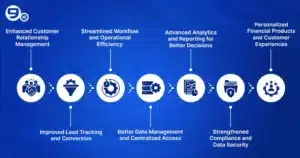
From financial advisors, fintech firms, to banking institutions, CRM software offers different benefits to handle all key aspects of business and keep the data secure. It transforms the way customer interaction takes place, leads generation, improves user experience, security controls, and others. Here is the list of benefits for CRM software:
1. Enhanced Customer Relationship Management
Top studies suggest that more than 50% of financial advisors need CRM tools to manage their client relationships and are ready to invest in them. Nowadays, the financial sector uses different channels to promote its products and generate leads, via social media, email marketing, and phone calls. CRM software is useful to support customer relationship management and establish communication across departments. It creates a centralized database that is accessible across branches and shares updated information for customers to manage long-term relationships.
JP Morgan has adopted Salesforce Financial Service Cloud for unified data to handle its diverse product portfolio for private banking, retail, and wealth management.
2. Improved Lead Tracking and Conversion
Lead generation has been an integral part of the financial service sector, and the team prefers qualified leads instead of quantity. When it comes to finances, customers as well as service providers aim to build a long-term relationship for better future returns. So, they prefer to attract quality leads that can convert into long-term clients. CRM software can analyse customer preferences and automate lead tracking to sell the right product to the right set of customers. A CRM system can provide insights to understand how unqualified leads are nurtured to ensure stability and long-term loyalty.
HDFC has collaborated with Adobe to adopt its cloud software with CRM that eases access for mobile logins and tracks leads from online campaigns.
3. Streamlined Workflow and Operational Efficiency
Efficiency is the key driver for financial services as confidential data of customers is involved, and there is a significant risk for errors and delays, damaging client management. CRM software for financial services industry eliminates bottlenecks like duplication and data redundancy through automated follow-ups, customer onboarding, and scheduling. This effectively manages the entire sales funnel to acquire new leads and final conversions. It creates more transparency to ensure that customer data cannot be compromised, and engages with the department at the right time.
AXA Insurance is implementing Microsoft Dynamics 365 CRM to automate its core processes of agent workflows, policy renewals, and claims tracking.
4. Better Data Management and Centralized Access
The financial sector is dealing with a vast amount of sensitive client data that requires storing, managing, and analyzing for personalized services. Also, this sector is regulated under strict laws that need to be complied with, and protection from data breaches. Traditional practices like Excel spreadsheets are not able to handle scattered data; rather, CRM systems can account for flexible storage, security protocols, backup data, and encryption for effective data management. This software is customized to meet legal obligations, with centralised access for transparency without compromising security.
Morgan Stangle aims to manage their customer data centrally and has adopted Salesforce Einstein Analytics for their wealth management and advisory branches.
5. Advanced Analytics and Reporting for Better Decisions
Financial companies deal with a huge amount of data related to investment decisions, liabilities, and financial products. For precise reporting and analytics, it should measure real-time data that reduces the risk of inaccurate calculations and financial loss. CRM software for financial services industry empowered with advanced analytical tools and reporting dashboards to allow financial companies to manage sales, client acquisition, and product performance. Further, it can filter for demographics and budget range to develop a personalized investment model for easy scheduling.
American Express is implementing AI-driven CRM analytics to track customer spending and predict cross-selling opportunities.
6. Strengthened Compliance and Data Security
Big financial decisions should be backed with secure access and control protocols that CRM software provides to keep them regulated through laws and policies. Using automation, these systems can check for compliance, conduct regular audits, and generate reports for data management. It helps to safeguard sensitive customer data and use analytics to identify trends and patterns to highlight risks and send alerts for fraud activity to overcome operational inefficiencies.
A popular banking institution, namely Barclays Bank, integrates Oracle Financial Services Analytical Applications (OFSAA) with CRM to handle compliance and track potential risks.
7. Personalized Financial Products and Customer Experiences
Customers of the financial service industry come with flexible demand, and providers are bound to offer personalisation to meet demand. CRM software is an ideal choice for companies to offer a personalized customer experience as it can gather data through different channels and analyze it using customer financial history, preferences, and previous interactions. It encourages improving customer experiences and pushing existing ones for repeat purchases.
PayTM Money is using its custom-built CRM driven by Salesforce APIs to analyse for risk assessment and tracking over investment patterns.
How CRM Software Transforms Financial Operations?
CRM software development companies aim to deliver what the client expects, but every financial institution or firm follows its specific operations for internal or external management. This software transforms core operations through managing profiles, automated workflows, customer segmentation, compliance, and reporting. Here are the ways through which CRM is upgrading to deliver for financial operations:
Automating Client Onboarding and KYC Processes
In traditional practices, customers have to wait a long time for the KYC process and verification, which might result in delays and the loss of valuable customers. CRM software creates faster client onboarding, automated verification, approvals for workflows, and reduces manual intervention. It not only eases customer conversions but also minimizes risk and complies with regulatory standards.
Integrating CRM with Core Banking and Financial Tools
CRM resolves the issues for connecting with third-party tools for comprehensive management. It can integrate with analytical software, payment gateways, and core banking software. Relationship managers can access real-time customer data, transaction histories to prepare a comparison chart to attract firms and customers, resulting in improved decision-making.
Enhancing Collaboration Between Sales, Support, and Advisors
Using specialised CRM software for financial services industry streamlines operations that bridges the gap for communication across the departments. Integrating different departments, like the sales team, uses the software to track leads, offer sales support, and share advice to suggest financial recommendations. Through this interconnected system, it improves client satisfaction, customer retention, better coordination, and optimizes workflows.
Use Cases of CRM Software in the Financial Sector

CRM software acts as the key tool in the modern financial sectors to improve services, streamline operations, and make data-centric decisions. While standard CRM manages customer relationships, advanced CRM tools can deliver for overall wealth management and customer segmentation. Here are the use cases of CRM software for the financial sector in different domains:
CRM in Banking
CRM software in the banking industry helps to break down complex data, supporting omni-channel, and streamlining daily operations. CRM fosters team collaboration and coordinates for improving sales, customer support, and marketing. Banking companies operate through over 100+ branches across the country, which requires unified operations to track customer performance, automate marketing, and generate quotes. Using the CRM software, this support helps relationship managers to strategise for upselling and cross-selling opportunities, data management, and increase customer retention.
CRM for Wealth and Asset Management
The wealth and asset management sector is quickly adopting technology trends, where relationship management with customers is crucial for sales. CRM software improves collaboration and coordination through scheduled financial reviews, exploring portfolios, and tracking client preferences. Advanced CRM solutions help to deliver real-time insights to monitor for investment performance and integrate with financial planning tools, along with risk assessment. Wealth managers also coordinate with different clients using CRM software and provide consulting for strategic asset allocations.
CRM in Insurance Services
The insurance sector deals with 1000+ financial products with strict law and policy management measures, with CRM adoption, and it is impossible to establish streamlined operations. It effectively works to develop a centralized hub for data, where brokers and agents can access the records to claim for settlement and review policy histories. Modern CRM accounts to automate for automating premium reminders, claim tracking, and policy renewal to minimise human errors. It helps insurance firms to make informed decisions and smart investment planning.
Choosing the Right CRM Software for Financial Services

While selecting the right CRM software for financial services industry, multiple factors need to be considered. From estimating the budget to reviewing CRM software development services, it is essential to analyse factors to decide which solution aligns with specific needs. So, there are the points to consider before selecting the right CRM software:
Essential Features to Look For
Different sectors like banking, insurance, and wealth management look for specific features depending on their core functionalities. Banking support for features like credit tracking, customer onboarding, and loan management, insurance requires features of claims tracking, renewal reminders, policy management, while wealth management forms look for investment analytics, portfolio tracking for making effective financial decisions. Also, select the CRM software that integrates with AI and automates workflows to enhance operations and better client management.
Customization and Scalability Options
Scalability is non-negotiable for financial services as it will expand gradually in multiple ways. Instead of one-size-fits-all, customisation improves service delivery to provide for a personalised dashboard, scale with a growing number of users, additional modules, and a large volume of data without any performance issues. Investing in scalable and customised CRM saves institutions and firms from expensive replacement in the future.
Integration Capabilities with Existing Systems
CRM software aligns with other systems for marketing, accounting, and finance to provide the best results for the company. With the help of a centralised data repository, it reduces data duplication and improves transparency and accurate estimates. This supports API connections for enabling real-time data sync and automating routine tasks. So, it is crucial to select the software with flexible integration that allows other core systems to connect and improve client experience, and reduce the chance of errors and system failures.
Future of CRM in Financial Services

AI and other innovative tech like ML, chatbots, and blockchain are transforming to deliver exceptional customer experiences (CX), identifying fraud for prevention, credit scoring, or algorithm trading, and others. From implementing GenAI, LLM models to headless CRM, the future of CRM in financial services accounts for tech and innovations.
Role of AI and Automation in Next-Gen CRM
The next-gen CRM is powered by Artificial intelligence that improves customer relationships and offers predictive insights for personalised services. An advanced algorithm of AI is implementing chatbots and virtual assistants to answer queries and provide 24-hour customer support. Leveling up, AI also accounts for sentiment analysis to meet customer expectations and gather feedback. Automation not only optimises workflows but also extends convenient support to handle routine inquiries by sharing prompt responses.
Predictive Analytics for Customer Retention
CRM software acts as an analytical tool to predict financial projects by studying the historical patterns and identifying opportunities to retain high-value customers. Financial managers can take data-driven decisions and vouch for churn predictions to target for engaging campaigns. To recommend tailored financial products, these analytical tools analyse investment patterns and spending goals to automatically create a timeline for investing.
The Rise of Cloud-Based and Mobile CRM Solutions
The world is heading toward anything that works with a tap; traditional wallets are getting replaced with debit and credit cards, and investment can be easily done through mobile apps. Cloud-based CRMs are accessible and improve responsiveness by allowing client information to be accessed from anywhere. Cloud storage helps to update with the latest features, better compliance management, and security patches. It significantly reduces infrastructure setup costs for businesses that scale without any high investment.
Conclusion
For the financial service industry, CRM software becomes a game-changer to automate repetitive manual tasks and implement workflow automation. It also integrates with other third-party systems to support financial institutions in developing a centralized system. Modern-day CRM uses AI and ML to scale faster, support mobile optimisation, offer lead scoring, email integration, pipeline, and lead management to stand out from traditional software. Many companies are adopting CRM software for flexible operation, security controls, through no-code development, omnichannel communication, 360 customer overview, and integration capabilities.
