



The gold price experienced strong volatility in the second quarter of 2026.
It traded in a range of US$3,960 to US$4,850 per ounce during a period that saw the Iran war drag on longer than the Trump administration had expected, and the US Federal Reserve enter a new era under Chair Kevin Warsh.
As Q3 begins, Iran still has its trump card — the Strait of Hormuz, through which about 20 percent of global oil flows. Even if a peace deal is reached soon, the Fed will have to grapple with sticky inflation.
Is gold a safe-haven asset investors turn to when times are tough, or is the precious metal serving another role in a tumultuous macroeconomic environment? Does it have enough runway in the remainder of the year to retake all-time highs? Or will we see gold slide further beyond the US$4,000 floor of support?
The Investing News Network (INN) turned to gold market experts to answer these questions and gain insight into what moved the yellow metal’s price in the second quarter.
What happened to the gold price in Q2?
“(Gold) had a difficult second quarter after a strong start to the year,” Eugenia Mykuliak, founder and executive director of B2PRIME Group, told INN via email. “The main driver has been a stronger US dollar combined with persistently elevated treasury yields, which reduced the appeal of non-yielding assets and prompted investors to unwind some of the enthusiasm that had built up during the first quarter.”
Gold began Q2 with a close of US$4,699.55 on April 1, and reached its peak daily close on April 14 at US$4,840.
For much of the period, gold was impacted by the belief that an end to the US-Iran war was on the horizon. On April 8, the Trump administration made plenty of fanfare about its proposed two week ceasefire arrangement, which involved Iran agreeing to allow safe passage for ships through the Strait of Hormuz.
At the same time, lower-than-expected producer price index (PPI) data for March gave gold a boost. Since producer costs are passed on to consumers, PPI is an important inflationary signal to the Fed.
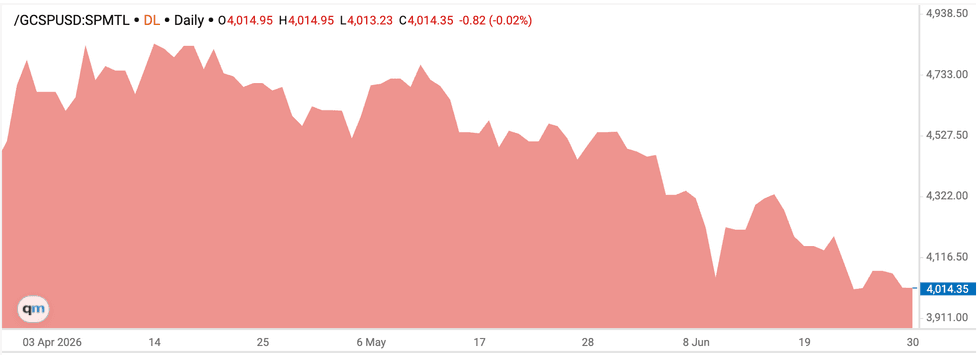
Gold price, Q2 2026.
Chart via the Investing News Network.
Gold’s upward trajectory didn’t last long, however, and the second half of April was much more volatile.
On April 20, Iran threatened retaliation following reports that the US Navy had seized an Iranian cargo ship in the Strait of Hormuz. The resulting surge in oil prices benefited both treasury yields and the US dollar at the expense of non-yielding gold. Alongside the high-stakes US-Iran conflict, the confirmation hearing for Warsh signaled a hawkish shift at the Fed. By the next day, gold had slipped to a close of US$4,720.56.
The following week, hopes of a peace deal had evaporated, and the Fed had decided to hold interest rates steady. On April 29, the price of gold fell as low as US$4,510.62 in morning trade. Gold continued to test the US$4,500 floor of support in early May with a close of US$4,519. 53 on the fourth day of the month.
Battling through the volatility of shifting US-Iran tensions, Trump’s social media posts, cooling energy prices and sticky inflation data, the yellow metal experienced a brief rally beginning on May 5; it peaked on May 11 at a close of US$4,768.39. From there, the second half of May saw gold fighting to maintain the psychological US$4,500 support level amid a broader global market selloff. Gold found some support on rumors that the US had offered Iran a possible temporary waiver on oil sanctions in return for ending the blockade in the Strait of Hormuz.
Hopes of a more lasting peace quickly faded once again, and the threat of higher oil prices continued to stoke fears of higher inflation. By May 27, the metal had sunk to a close of US$4,447.74.
The gold price suffered a dramatic slide in the first half of June as a fresh batch of US economic data revealed that elevated energy prices were beginning to speed up inflation.
The precious metal fell to its lowest close of the quarter at US$4,071.38 on June 11.
A wave of short selling gave gold a technical boost, and it also benefited from reports of the Trump administration’s proposed US-Iran accord. Gold had rebounded back above the US$4,300 level by June 17.
Speaking to INN in a mid-June interview, Jeffrey Christian, managing partner at CPM Group, said he was surprised Trump’s peace deal announcements can carry so much weight for gold investors at this point in the conflict.
“I’ve been shocked at the extent to which precious metals market participants and others in equity and bond markets have paid any attention to what this guy says,” said Christian, who discussed how this latest peace agreement is bound to fall apart, adding that the Iranians have Trump over a barrel (of oil) given the upcoming midterm elections.
The price of gold was soon pushed back down to close at US$4,209.80 on June 18 after the Fed, led by new Chair Warsh, held rates steady yet again. Continuing on down, the yellow metal breached the key support level of US$4,000 in morning trade on June 24, going below that point for first time since November 2025.
Gold also faced pressure as tech stocks took a hit on uncertainty concerning the massive costs of artificial intelligence infrastructure and whether this spending will generate actual profits.
The price of gold closed out the quarter on June 30 at US$4,007.69, a loss of nearly 15 percent from April 1.
Gold, Iran and US monetary policy
In Q2, the most notable drivers of the gold price were the impact of the Iran war, the rising inflation that has complicated the Fed’s path forward and the resulting strength in the US dollar and treasury yields.
Gold’s role as a safe-haven asset came into question during the quarter — instead of rising, the precious metal didn’t react favorably to tensions in the oil-rich Middle East.
“Typically, gold does act as a hedge against geopolitical risk, a hedge against uncertainty, but I think what made this war unique is that obviously it’s tied to oil prices and energy prices, and so … the idea that energy prices are going to continue to stay higher for longer, that puts pressure on the Federal Reserve to not cut interest rates,” explained David Nicholas, co-founder of XFunds, in a mid-June interview with INN.
“The odds of a rate cut happening this year actually completely reversed after oil prices headed higher, and that led to a stronger dollar. And so all of that really put pressure on gold,” he added.
Has the Iran war permanently reversed the course of gold’s bull market? Ronald-Peter Stoeferle, fund manager at Incrementum and co-author of the “In Gold We Trust” report, doesn’t think so. While the conflict’s escalation into a stalemate has caused the yellow metal to reverse course, Stoeferle believes the gold market was due for a healthy correction, and this latest downturn is a normal part of a structural bull market and represents a buying opportunity.
“I think the market was looking for an excuse, and I think that the whole Iran war was basically an excuse for that, for taking profits,” he told INN in a late May interview.
“My view is that after this big run up, we have to find some sort of a new price equilibrium. I think for gold it’s between US$4,000 to US$4,300. That’s where we want to be aggressive buyers.”
In the last few weeks of the quarter, the focus for gold buyers has shifted from the changing battle lines of the Iran war to the direction of central bank monetary policy.
“Gold itself turned away from geopolitics per se and started looking at everything through the prism of rising interest rates, and that’s been the most recent factor to keep it under pressure,” Rhona O’Connell, StoneX’s head of market analysis, EMEA and Asia, explained in an INN interview in late June.
O’Connell understands why a fall from more than US$5,500 to around US$4,000 would have gold market watchers “scratching their heads.” She believes there are several pieces to the puzzle. One is simply that by early in the first quarter of the year, the gold market had become “too crowded,” with buying “way overdone,” so once the price did start coming down there were many speculators with stop loss orders who had to exit.
Another factor she discussed was “the meltdown in equities” as the looming threat of higher-for-longer interest rates and rising bond yields pressured the broader stock market.
O’Connell also attributed gold’s steep fall this quarter to a shift in the metal’s role as a safe-haven asset for uncertain times to an easily liquidated means for mitigating risk in other areas of an investor’s portfolio.
“The question that I and my peer group have to parry on a regular basis is, if (gold is) a safe haven, why isn’t it going up when everything else is in trouble? And the answer is because it’s an insurance policy,” she said.
“It’s the one asset which is no one else’s liability, or at least the one currency that is no one else’s liability, because it’s international and it’s not issued by a specific central bank. It’s very liquid.”
Gold ETF outflows slow from previous quarter
Investors stepped away from gold exchange-traded funds (ETFs) in March as the price fell, and while their flight continued into the second quarter, it didn’t happen at the same pace.
Kelvin Wong, senior market analyst at OANDA, shared data from the World Gold Council (WGC) with INN via email, outlining that cumulative net flows from North American and European gold ETFs totaled -94.44 metric tons this past March. While the month of April saw net cumulative inflows of 32.91 metric tons, the decline began again in May, resulting in cumulative net outflows of -7.31 metric tons, driven primarily by North America.
At the same time, WGC data shows that China and India experienced record-setting inflows during the first four months of 2026; however, both nations reversed into sharp, profit-taking outflows in May.
Joshua Rotbart, founder of global precious metals bullion firm J. Rotbart & Co., told INN via email correspondence that global gold ETF net outflows in March were valued at US$12 billion.
This figure includes US$13 billion that exited North American funds.
While renewed demand from North America and Europe helped push global gold ETF to net inflows of US$6.6 billion in April, the following month posted around US$2 billion in global net outflows.
“So far, Q2 looks more mixed than one-directional, likely influenced by the uncertainties in the gulf, and their implications for global energy and supply chains,” said Rotbart.
“So the better reading is that Q1 was a sharp reset, while Q2 has so far looked more like a recalibration. ETF demand remains sensitive to bond yields, the US dollar and expectations for interest rates.”
CPM Group’s Christian explained that the yellow metal’s falling price was one of the reasons North American gold ETF holders liquidated their positions in the first two quarters of this year.
“(A) lot of these ETF investors are not traditional buy-and-hold physical gold and silver buyers. They are more opportunistic,” he said. “They saw the gold price rising after August (2025) and through January (2026), and they bought ETFs. They bought an enormous amount of ETFs in that five month period, and then since February, they’ve been just selling, and they accelerated their sales pace over the last two weeks, partly because the price was falling, partly because the stock market was rising and partly because the economy looked better than they had expected.”
The gold market’s east/west divide
The east/west divide in the gold market is mostly cultural and extends beyond ETFs into bars, coins and jewelry.
“The growing east-west divide in gold demand is primarily driven by differing perceptions of gold’s role in wealth preservation,” Wong told INN. “In Asia, particularly in China and India, gold is widely viewed as both money and a long-term store of value, driving strong demand for physical bars and coins amid concerns over currency depreciation, economic uncertainty, property market weakness and geopolitical risks.”
Rotbart echoed that sentiment, explaining that across the east, including much of Southeast Asia and the Middle East, there are “cultural legacy reasons” for owning gold.
“Asians have bought gold for decades, whether to protect their money, or as gifts and heirlooms. When uncertainty rises, buyers take the metal home: physical bars and coins, held for years,” he told INN.
As for western investors, both precious metals experts agree that their tendency is to treat gold as a financial asset or a liquid position to trade. North American investors in particular are more focused on gaining exposure to gold via exchange-traded products, futures and mining stocks. In this way, interest rates, US dollar strength, equities performance and market sentiment have a larger impact on investor decisions to buy or sell.
As an example, Rotbart pointed to Q1 2026 data from the WGC that shows global bar and coin demand rose 42 percent year-on-year to 474 metric tons, with Mainland China up 67 percent to a record 207 metric tons, and India pulling off its strongest first quarter since 2013 with a 34 percent bump to 62 metric tons.
In comparison, US-listed gold ETFs recorded record outflows of 85 metric tons in March, erasing the 69 metric tons that flowed in earlier in the first quarter. As Rotbart commented, “Same metal, same price, opposite decisions: Asian savers accumulating physical gold, western funds trimming paper.”
Wong demonstrated the east/west divide further by highlighting regional trends in central bank gold reserve accumulation. “In addition, aggressive gold purchases by emerging market central banks have reinforced physical demand in the east, resulting in a structural shift where Asian consumers and central banks are becoming the dominant drivers of global gold demand and price trends,” he explained.
Central bank gold purchases
Which driver for the gold price was the most unexpected this past quarter?
Rotbart told INN that he was most surprised by the yellow metal’s resilience.
“It stayed well supported despite a stronger dollar and higher bond yields, two conditions that would normally weigh on the price. That suggests structural demand is now carrying more weight than short-term rate moves alone,” he said.
Rotbart sees central bank demand as a major factor of gold’s resilience. “The clearest signal came from the (European Central Bank’s) June 2026 report, which showed gold accounting for 27 percent of total official foreign reserves at the end of 2025, ahead of US treasuries at 22 percent,” he said. “While that shift reflects both central bank buying and gold’s higher market value, it reinforces gold’s growing role as a strategic reserve asset.”
In response to global financial and geopolitical uncertainty, central banks have steadily transitioned to net-buyers. Over the past four years, the WGC estimates that central bank gold accumulation has averaged 1,000 metric tons annually. That’s double the average annual purchases over the preceding decade.
According to the WGC’s Central Bank Gold Reserves survey, released in June, 45 percent of the record 76 reserve manager respondents expect their institution’s gold reserves to increase over the next 12 months.
Central banks, in particular those representing emerging markets and developing economies (EMDEs), have developed a strong desire to add gold to their reserve portfolios as an alternative to holding US dollars and treasuries.
Gold provides a reserve asset alternative that allows EMDEs to break their reliance on the US dollar, guard against sanctions and protect financial sovereignty.
“I think a bigger raft of countries now are concerned about the US dollar, about the United States, and to a lesser extent, perhaps Europe, trying to weaponize currencies in terms of pursuing their foreign policy goals,” Philip Klapwijk, Metals Focus’ chief consultant for Hong Kong and Spain, explained at an event in Toronto in early June.
“Gold now accounts for 26 percent of global central bank reserves. The US dollar stood in first place at 39 percent, but gold is eating away at the dollar’s share, and also eating away somewhat at the euro’s share,” added Klapwijk.
“I think in the future we’re going to see gold become ever more prominent in terms of foreign exchange and central bank reserve holds, and it’s interesting to note that this has happened at a time when the official sector is basically not increasing its exposure to US treasuries.”
Gold price forecast for 2026
What’s ahead for the gold price in the second half of 2026?
Most of the experts INN has spoken to in recent weeks share the view that the yellow metal’s outlook for the remainder of this year will be marked by volatility and resilience. Gold is not likely to test its previous record high again in 2026, but of all the precious metals it is also unlikely to lose too much more of the ground it gained in 2025.
“Looking ahead, sovereign debt concerns, geopolitical strain, policy uncertainty and continued central bank interest should remain supportive through the rest of 2026, even if prices remain volatile,” stated Rotbart.
Mykuliakm agrees. “Gold remains the most fundamentally supported metal. Central bank purchases, as well as global reserve diversification trends and persistent geopolitical uncertainty, continue to provide a solid long-term outlook,” she told INN. “However, after its powerful rally earlier in the year, gold appears to be entering a consolidation phase. Unless markets begin pricing in a more aggressive Fed easing cycle (which is extremely unlikely in the current macro environment), price gains are likely to be more muted through the rest of 2026.”
So is US$6,000 gold still a possibility by year’s end? Is US$4,000 a safe floor of support for gold?
“No, there is now a growing risk that spot gold (XAU/USD) is likely to face further weakness after it broke down below its key 200 day moving average at the start of June 2026,” explained Wong.
“(That’s) a potential major technical deterioration of its prior major uptrend phase from the October 2023 low, supported by firmer US treasury yields and the US dollar that increases the opportunity cost of holding gold.”
Wong noted that the US Dollar Index broke above major 12 month resistance of 100.54 after the June 18 Fed rate decision made under hawkish new leader Warsh. A stronger greenback makes purchasing gold more expensive for non-US buyers as the yellow metal is globally priced in US dollars.
Christian also sees the potential for the gold price to fall further in the short term.
“We’ve been saying that we thought that the price would consolidate in a very volatile range between April and through August, and the range so far has been US$4,065 (for the week of June 8), and say US$4,900,” he said.
“The potential is for it to spike down and actually touch US$4,000, or even go down to US$3,800, which is where a lot of technical people are looking,” he explained, adding he views that as “a reasonable bottom.”
Christian said CPM Group believes the gold price will move sideways for much of the summer months before moving higher in the last four months of the year: “These are very volatile markets and very volatile and economically uncertain times, and investors are flopping around back and forth.”
Various factors are at play that could take gold back up to US$5,000 in 2026, he said, including the possibility of a US recession later in the year. However, investors will most likely be taking cues from the Fed as we move deeper into 2026. As of June 30, CME Group’s (NASDAQ:CME) FedWatch tool showed analysts factoring in a 67 percent probability that the Fed will raise rates as early as the September 15 to 16 meeting.
Don’t forget to follow us @INN_Resource for real-time updates!
Securities Disclosure: I, Melissa Pistilli, hold no direct investment interest in any company mentioned in this article.
Editorial Disclosure: The Investing News Network does not guarantee the accuracy or thoroughness of the information reported in the interviews it conducts. The opinions expressed in these interviews do not reflect the opinions of the Investing News Network and do not constitute investment advice. All readers are encouraged to perform their own due diligence.
From Your Site Articles
Related Articles Around the Web
