



NICE CXone and Genesys Cloud CX are two big names in the contact center software industry. But with both offering several similar features, how do you decide which platform is the right fit for your business? Choosing the wrong solution can be costly, both in terms of budget and lost productivity.
The ideal choice depends on your needs. Do you require deep, complex integrations? Are you prioritizing a fully cloud-based architecture?
In this article, we’ll compare NICE vs Genesys Cloud head-to-head, examining their features, pricing, and overall capabilities. We’ll also introduce a top alternative to see how it stacks up against these industry giants.
Genesys vs NICE at a Glance
Choose NICE CXone if:
- You prioritize sophisticated workforce management, detailed analytics, and extensive customization capabilities.
- You want precise control over your feature set and only want to pay for exactly what you need.
Choose Genesys Cloud CX if:
- Cloud flexibility, AI-powered customer journey orchestration, and user-friendly interfaces are your primary concerns.
- You prefer a more bundled approach with predictable pricing and simpler administration.
Quick glance comparison table
| Factor | NICE CXone | Genesys Cloud CX |
|---|---|---|
| Pricing Model | Highly modular with a la carte additions | Structured tiers with some optional add-ons |
| Entry Point | Lower starting price but can scale up quickly with add-ons | Higher initial investment with more bundled features |
| Customization | Granular control over specific features | Less flexibility but simpler decision-making |
| Cost Management | More cost-effective when selectively choosing features | More predictable pricing but may include features you don’t need |
| Budgeting | Can be complex to forecast with multiple add-ons | Tiered structure simplifies financial planning |
How we compared NICE CXone vs Genesys Cloud
Before diving into the specifics, let’s outline the key factors we’ll use to compare NICE CXone and Genesys Cloud CX:
- Core contact center features: What foundational capabilities does each platform offer, such as omnichannel routing, IVR, dialers, and channel coverage?
- AI and automation: How does each platform leverage AI to power virtual agents, intelligent routing, real-time coaching, and automated workflows?
- Workforce engagement and analytics: How robust are the WFM, quality monitoring, and analytics tools for both agents and supervisors?
- Pricing and total cost: How do the pricing structures compare, and what level of investment is required as teams scale?
- Integrations and extensibility: How well does each platform connect with CRMs, third-party apps, and custom-built systems?
- Security, compliance, and scalability: What enterprise-grade protections are in place, and how well does each platform handle global or high-volume deployments?
- Implementation and support: How straightforward is onboarding, and what ongoing support does each vendor provide?
NICE CXone Overview
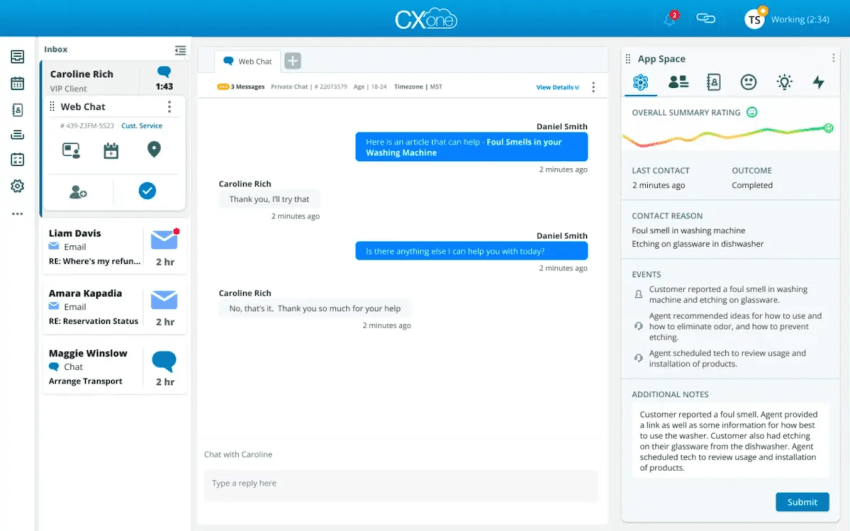
NICE is a leader in AI-powered self-service and human agent-assisted contact center platforms.
Strengths
- Omnichannel customer engagement. NICE CXone excels at omnichannel customer experiences, unifying customer interactions across digital channels (over 30), including email, live chat, social media, and mobile apps. It provides a 360-degree view of the customer journey, enabling personalized interactions and preventing issues from falling through the cracks.
- Extensive features. NICE offers robust features to enhance contact center efficiency, including advanced call routing (skills-based routing to connect customers with the best-suited agent), interactive voice response (IVR), and powerful analytics dashboards.
- AI Integration. The contact center platform uses AI to automate tasks and improve performance, including AI-powered intelligent virtual agents for self-service and employee virtual attendants to streamline internal communication and enhance agent productivity.
Weaknesses
- User experience challenges. While powerful, NICE’s user interface can be complex and challenging to navigate, particularly for new users. Some users report a steep learning curve. While it integrates with many CRM tools, its integration capabilities with third-party systems like customer data platforms are somewhat limited.
- Cost. Pricing is a big consideration with NICE CXone. The platform’s starting price point ($110/user/month is a barrier for smaller businesses or those with tight budgets. Costs can quickly escalate with larger teams and additional features.
Genesys Cloud CX Overview
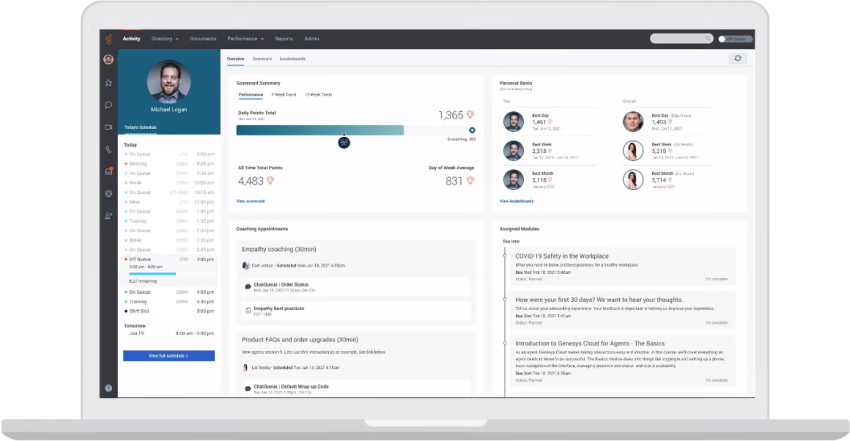
Genesys offers a robust customer experience platform, combining several digital channels in one app.
Strengths
- Intuitive user interface. Many users praise Genesys Cloud CX for its sleek and user-friendly interface. This simplifies agent onboarding and allows for quick adoption of the platform’s features. Deployment is also generally straightforward, often requiring minimal technical assistance.
- AI integration. Genesys incorporates AI extensively to enhance various aspects of contact center operations. The features include predictive engagement, intelligent routing, workforce scheduling and management, and optimized outbound campaigns. The platform also provides self-service options through IVR, voicebots, and chatbots.
- Open cloud-based platform. Genesys Cloud CX’s cloud-native architecture offers several advantages. Agents can access the platform from anywhere with an internet connection, facilitating remote work and flexible staffing models. Cloud infrastructure also provides inherent redundancy and data backups, minimizing the risk of downtime.
Weaknesses
- Email client limitations. While the agent interface is generally well-regarded, the integrated email client has limitations. Some users report that it can obscure important information, requiring agents to navigate away from the main interface during customer interactions.
- Limited capabilities. Although Genesys offers a wide range of features, some users find that certain functionalities are not fully developed. For example, the reporting feature may lack advanced customization options or the ability to display extensive historical data (e.g., longest wait times).
Feature Comparison: NICE vs Genesys Cloud
Quick look comparison table.
| Feature | NICE CXone | Genesys Cloud CX |
|---|---|---|
| Omnichannel | Broad voice + digital support | Unified channels with journey orchestration |
| Routing and IVR | AI routing + customizable IVR | Predictive routing + speech-enabled IVR |
| Workforce Management | Deep WFM and adherence tools | Streamlined cloud-native WFM |
| Analytics and Reporting | Real-time dashboards + rich reporting | Built-in analytics with AI insights |
| AI Capabilities | Enlighten AI for agents and self-service | Embedded AI for routing, WEM, and engagement |
| Integrations and APIs | REST APIs + strong enterprise integrations | REST APIs + pre-built app integrations |
| Outbound / Proactive Engagement | Omnichannel outbound automation | AI-powered proactive outreach |
Omnichannel
- NICE CXone: Supports a broad range of digital and voice channels, with context-aware routing built around real-time interaction data.
- Genesys Cloud CX: Offers unified omnichannel engagement with built-in routing and journey orchestration across channels, designed to keep context across touchpoints.
Routing and IVR
- NICE CXone: Provides AI omnichannel routing and customizable IVR flows through its Studio tool, including real-time predictive routing and intent-based decisions.
- Genesys Cloud CX: Includes call routing, speech-enabled IVR, and predictive routing, with flow-based orchestration tools for building journeys.
Workforce Management
- NICE CXone: Offers a deep WFM suite with forecasting, scheduling, intraday management, and adherence tracking to help optimize staffing.
- Genesys Cloud CX: Includes WFM tools for forecasting, scheduling, and adherence, with a more streamlined cloud-native approach.
Analytics and Reporting
- NICE CXone: Offers advanced reporting, dashboards, real-time insights, and API access for historical and calculated data.
- Genesys Cloud CX: Includes analytics and reporting in its platform bundle, with AI-powered analytics across Workforce Engagement Management and journey data.
AI Capabilities
- NICE CXone: Offers Enlighten AI, which applies predictive and behavioral models to enhance agent performance, sentiment scoring, and self-service interactions.
- Genesys Cloud CX: Built with embedded AI (Genesys Cloud AI) for routing, WEM, and virtual agents, with AI-powered experience orchestration as a core platform theme.
Integrations and APIs
- NICE CXone: Extensive third-party integrations and REST APIs support enterprise customization, CRMs, and UC platforms like Microsoft Teams and Salesforce.
- Genesys Cloud CX: Provides REST APIs and pre-built integrations for tools such as Salesforce and Zendesk, enabling faster deployment and extensibility.
Outbound/Proactive Engagement
- NICE CXone: Supports proactive outbound engagement through Personal Connection and Outbound Engagement, with omnichannel campaign automation.
- Genesys Cloud CX: Includes AI-powered outbound campaigns and predictive engagement for proactive customer outreach, using real-time journey data.
NICE CXone stands out for deeper workforce management, advanced analytics, and customization, while Genesys Cloud CX is stronger for cloud flexibility, AI-driven journey orchestration, and ease of use, as well as advanced analytics.
Pricing & Plans Comparison
Both platforms offer structured pricing models with different approaches to packaging and selling their contact center solutions.
NICE CXone pricing: Suite-based packaging
NICE’s pricing model is designed around bundled suites and configurable platform capabilities rather than the simpler, more transparent tier structure Genesys uses.
They offer five CXone suite tiers:
- Omnichannel Suite: $110/agent/month. Entry-level omnichannel package for core contact center operations.
- Essential Suite: $135/agent/month. Adds more advanced customer experience and platform capabilities beyond the base omnichannel package.
- Core Suite: $169/agent/month. Adds workforce-related tools and broader operational capabilities.
- Complete Suite: $209/agent/month. Adds more advanced analytics and broader CX functionality.
- Ultimate Suite: $249/agent/month or $0.25/session. Highest-tier package, positioned around proactive engagement, automation, and AI-driven experiences.
NICE’s pricing can increase beyond the base suite price if you need optional capabilities such as knowledge, agent assist, or virtual agent tools. Its modular packaging gives buyers flexibility, but it can also make total cost harder to estimate upfront.
Genesys Cloud pricing: Streamlined tiers
Genesys Cloud CX offers a more streamlined tiered pricing structure with four main plans:
- CX 1: $75/user/month (annual billing). For voice contact centers; includes voice, call routing, speech-enabled IVR, and outbound campaigns.
- CX 2: $115/user/month (annual billing). Adds digital channels, omnichannel routing, virtual agents, and quality assurance capabilities.
- CX 3: $155/user/month (annual billing). Adds full Workforce Engagement Management capabilities, including employee performance, forecasting, and scheduling.
- CX 4: $240/user/month (annual billing). Highest tier for organizations that want more advanced AI experience and broader value from a robust platform.
Genesys publishes clearer base pricing, but costs can still climb with usage-based charges, different license models, and AI Experience token consumption tied to some advanced AI features. Optional add-ons and digital-only plans can also change the final price depending on your setup.
Which solution offers better pricing?
The better option depends entirely on your contact center’s requirements.
Choose NICE if you want more flexibility in how capabilities are packaged and you are comfortable building a solution from modular components, especially if workforce management is a priority.
Choose Genesys if you prefer more transparent public pricing, clearer tier comparisons, and flexible licensing options such as named, concurrent, or hourly interacting users. Keep in mind that usage-based charges and AI token consumption can still affect total cost.
Watch for extra costs: NICE pricing can rise with optional tools such as knowledge, agent assist, and virtual agents, while Genesys costs can increase through usage-based charges, license-model differences, AI Experience tokens, and optional add-ons.
| Vendor | Plans | Pricing range | Positioning |
|---|---|---|---|
| NICE CXone | Omnichannel, Essential, Core, Complete, Ultimate | $110–$249/agent/month | Suite-based packaging with configurable capabilities |
| Genesys Cloud CX | CX 1, CX 2, CX 3, CX 4 | $75–$240/user/month | More streamlined tiered pricing with clearer upfront costs |
User Experience and Administration
Agent experience
- Genesys Cloud CX stands out for its intuitive interface. Agents can quickly adapt to the platform, reducing the learning curve and allowing them to focus on customer interactions rather than wrestling with complicated software.
- NICE CXone offers robust functionality but at the cost of simplicity. Users often need more time to navigate its interface effectively, requiring a deeper commitment to training and onboarding.
NICE receives more varied feedback—some appreciate its power, but many find themselves challenged by its complexity—while Genesys consistently earns positive reviews for its straightforward approach.
Admin experience
- NICE CXone gives administrators a high degree of control, especially for routing, workflows, reporting, and role-based visibility. Its routing is fully customizable, and its dashboards and reporting tools can be tailored by role, which is a plus for complex contact centers. The tradeoff is that this depth can make administration feel heavier for teams that want faster, simpler setup.
- Genesys Cloud CX generally offers a more streamlined admin experience. Genesys positions the platform as a unified SaaS architecture on a single codebase, and its admin tools are designed to provision, deploy, and monitor applications from a web-based interface. That can make administration feel more centralized and easier to manage, especially for organizations that prioritize simplicity and cloud flexibility.
NICE offers deeper administrative control and customization, while Genesys stands out for a more streamlined, centralized admin experience.
Security, Compliance, and Enterprise Readiness
- NiCE positions CXone as an enterprise-grade platform with a dedicated Trust Office, strong compliance governance, and support for standards such as SOC 2, ISO/IEC 27001, PCI, HIPAA, GDPR, and FedRAMP Moderate. It also emphasizes security-driven compliance, a 99.99% uptime SLA, and data protection across the platform.
- Genesys Cloud CX similarly focuses on large enterprise security and compliance, with a Trust Center that highlights support for regulations and standards such as GDPR, HIPAA, PCI DSS, FedRAMP, and accessibility requirements. It also emphasizes audited controls for AI governance and compliance readiness, global cloud reach, a privacy-by-design approach, and broad international compliance coverage.
NICE is stronger for public-sector credibility and formal compliance assurances, while Genesys stands out for global cloud reach and broader international compliance coverage.
Integrations and Customization
CRM and third-party ecosystem
- NICE CXone offers a structured integration approach with well-established connections to major CRM platforms like Salesforce, Microsoft Dynamics, and Zendesk. While these core integrations are robust, its ecosystem beyond mainstream CRMs may require more custom development work. The platform provides APIs and development tools, but organizations with niche third-party systems may face integration challenges.
- Genesys Cloud CX delivers a more extensive integration marketplace with pre-built connectors spanning CRMs, workforce management tools, ticketing systems, and business intelligence platforms. Its open API architecture and AppFoundry marketplace make it particularly adaptable for organizations with diverse technology stacks, offering greater flexibility for connecting specialized applications.
Customization capabilities
- NICE provides customization through its development framework and scripting tools. Advanced customizations typically require technical expertise or professional services. The platform offers tailored reporting and analytics customization but may require more resources for complex workflow modifications.
- Genesys emphasizes low-code/no-code customization with its Designer tool, allowing business users to create and modify workflows without extensive development skills. This approach enables faster implementations and updates while reducing dependency on specialized technical resources for routine customizations.
Both platforms support enterprise-grade customization needs, but Genesys typically offers a more accessible path for business users to implement and maintain customizations independently.
Implementation and onboarding
- NICE CXone: NICE puts a lot of emphasis on guided onboarding and formal support coverage, with dedicated project managers and professional services for ACD/IVR, WFM, and training. Its Global Education and Onboarding team supports customers from kickoff through implementation, and its support organization offers 24/7/365 omnichannel technical support, a single point of contact, and SLA-backed service.
- Genesys Cloud CX: Provides Customer Success onboarding via email support, embedded learning modules from Genesys Beyond for agent training, PRINCE2-aligned stages from initiation to handover, and self-service resources for rapid setup.
NICE offers a more structured, service-led approach to implementation and support, while Genesys stands out for cloud-focused onboarding, training, and ongoing enablement.
Customer Support Comparison
Service models & access
- NICE CXone implements a tiered support structure with different service levels based on contract type. Enterprise clients receive dedicated account managers and technical resources, while standard support includes 24/7 emergency assistance. Their support portal offers comprehensive documentation, but some users report challenges getting timely customer support.
- Genesys Cloud CX provides a more unified support approach with standard access to their technical support assistance center across all tiers. Their support infrastructure includes an intuitive self-service portal with guided troubleshooting, video tutorials, and an active community forum where customers share solutions. Premium support options add dedicated technical account managers and enhanced SLAs.
Customer experience reality
- NICE CXone: Some customer feedback indicates that NICE excels in complex technical issue resolution but sometimes faces longer initial response times. Their specialized support teams demonstrate deep product knowledge but may require case escalation for certain issues.
- Genesys Cloud CX consistently earns praise for responsive initial engagement and clear communication throughout issue resolution. Their support team focuses on practical solutions and root-cause analysis. However, some customers note occasional variability with more complex implementation challenges.
NICE offers more specialized, tiered support for complex enterprise needs, while Genesys stands out for more consistent day-to-day accessibility, responsiveness, and self-service support resources.
Genesys vs NICE: Which Platform Is Best for Your Business?
The optimal platform depends on your business context, including your:
- Operational complexity and scale
- Digital transformation timeline
- Agent and supervisor technical proficiency
- Current technology ecosystem
- Budget framework and ROI expectations
When to choose NICE
Choose NICE CXone if your business needs:
- Comprehensive workforce management capabilities for complex staffing models
- Sophisticated analytics and business intelligence for data-driven decision-making
- Extensive customization options for unique business processes
- Robust compliance features for highly regulated industries
- Depth of functionality that justifies a potentially higher investment
NICE CXone excels in environments where analytical precision and operational complexity require advanced toolsets, particularly for established enterprises with specialized requirements.
When to choose Genesys
Choose Genesys Cloud CX if your business values:
- Intuitive interfaces that accelerate agent productivity and reduce training time
- Cloud-native architecture offering deployment flexibility and simplified management
- AI-powered customer journey orchestration across channels
- Streamlined implementation and faster time-to-value
- Scalable framework that grows efficiently with your business
Genesys Cloud CX delivers exceptional value for organizations prioritizing customer experience innovation, operational agility, and technological accessibility.
Get demos focused on your most critical use cases to directly compare how each platform addresses your requirements. Both solutions continue to evolve their capabilities, making current evaluations essential for informed decision-making.
NICE and Genesys are strong enterprise platforms, but Nextiva is a strong alternative for businesses that want solid contact center capabilities without as much complexity.
With Nextiva, you get:
- Transparent pricing: More predictable costs with less pricing complexity.
- Faster implementation: Quicker deployment and easier setup than more services-heavy platforms.
- Unified communications + contact center: A strong UC foundation that connects customer-facing teams with the rest of the business.
- Accessible support: A more hands-on support experience with personalized onboarding and ongoing guidance.
Nextiva is a strong fit for:
- Small to mid-sized businesses that want enterprise-grade features without enterprise-level complexity
- Organizations that value UC and contact center integration
- Teams with limited technical resources
- Businesses that prefer more personalized support
NICE and Genesys may be better for certain enterprise use cases, but Nextiva is worth considering if you want a more balanced mix of functionality, usability, and predictable value.
Your AI-Powered Contact Center
Create amazing customer experiences with AI-powered contact center software. Scalable contact center platform built for omnichannel customer conversations.
