



Key Takeaways
- Manual dispatch is an architecture failure, not a process problem. Spreadsheets and phone trees are a missing coordination layer, and no amount of hiring fixes a system that lacks one.
- Detention and underutilization are the quantifiable cost of inaction. ATRI puts industry losses at $15.1 billion annually, and most fleets cannot even bill for the delay — 94.5% charge detention fees, but fewer than half collect.
- A modern load assignment platform is a four-layer stack: a telemetry layer, an assignment intelligence engine, a compliance governance layer, and an integration fabric tying ERP and TMS together.
- AI-powered driver-load matching scores every assignment against location, hours-of-service eligibility, equipment, cost, and service commitment — not gut feel.
- Hours-of-Service compliance must be engineered into the assignment engine, not bolted on afterward, because an assignment that breaks the 11-hour or 14-hour rule is a liability the moment it is issued.
- The Dispatch Intelligence Maturity Model (DIMM) moves a fleet through five stages: Manual Coordination → Reactive Digital → Proactive Assignment → Autonomous Dispatch → AI-Orchestrated Fleet Intelligence.
- A 90-day implementation path exists that takes an operation from WhatsApp-and-spreadsheet coordination to autonomous assignment without halting the freight.
Manual dispatch is no longer a productivity nuisance. For enterprise fleets, it has become a structural constraint on growth, margin, and compliance — and most operations leaders are treating it as a staffing problem when it is actually an architecture problem. A single experienced dispatcher juggling load boards, spreadsheets, phone calls, and a wall of driver text messages can coordinate only so many trucks before decision quality collapses. Every freight surge then exposes the same fault line: the coordination layer does not scale.
An intelligent load assignment platform is an operational system that automates how freight is matched to drivers, validates regulatory eligibility in real time, and coordinates fleet movements across a unified visibility layer — replacing the dispatch board, the spreadsheet, and the after-hours phone tree with a single orchestration engine. That shift matters now because the economics have turned hostile. The trucking sector loses an estimated $15.1 billion a year to driver detention according to the American Transportation Research Institute, the American Trucking Associations projects the driver shortage will exceed 160,000 by 2028, and MIT Freight Lab research finds drivers average only about 6.5 of their 11 available driving hours actually on the road. When trucks move 71.4% of U.S. freight tonnage, every hour lost to coordination friction compounds across the entire supply chain.
This article maps the architecture, the assignment logic, the compliance model, and the integration backbone enterprises need — and introduces the Dispatch Intelligence Maturity Model (DIMM), a five-stage framework for diagnosing where your fleet stands and what the next move should be.
Why Manual Dispatch Is an Operational Architecture Failure, Not a Process Problem
Manual dispatch fails because the coordination logic lives inside a human head instead of inside a system. That is the root cause, and it explains why every attempted fix — more dispatchers, longer shifts, a shared spreadsheet — produces diminishing returns. You are scaling headcount against a problem that needs an orchestration layer.
The Symptom Most Leaders Misread
Operations leaders usually frame the problem as “we need another dispatcher.” The symptom is real: assignment quality degrades as load volume climbs, after-hours coverage gets thin, and a single absence creates a coordination blackout. The misread is in the diagnosis. Adding a dispatcher adds another isolated decision node, each one working from a partial view of truck positions, driver hours, and customer commitments. Decision fragmentation is the disease; headcount is a temporary anesthetic.
Root Cause: A Missing Coordination Layer
Dispatch sits at the intersection of four live data streams — vehicle location, driver hours-of-service status, equipment availability, and customer service windows. Manual operations reconcile those streams through memory, phone calls, and tribal knowledge. No system holds the authoritative state, so the same load can be promised twice, a driver can be assigned past their legal hours, and an empty backhaul can sit unbooked because nobody had visibility into it. Legacy carriers compound this with data silos: the ELD vendor, the TMS, and the accounting system each hold a fragment, and none of them talk.
Business Impact: The Quantified Cost of Inaction
The financial bleed is measurable and large. ATRI’s analysis attributes $11.5 billion in lost productivity and $3.6 billion in added expense to detention alone, which translates to roughly $11,000 to $19,000 in lost revenue per driver per year. Underutilization stacks on top: when drivers run 6.5 of 11 legal hours, you are paying for capacity you never deploy. Detention costs ripple far beyond the dock, and reducing them is one of the clearest returns available across detention costs in the supply chain. Add the 90–95% annual driver turnover that large truckload carriers report, and the cost of a chaotic dispatch experience shows up in recruiting budgets too.
The takeaway for executives is blunt: manual dispatch is not inefficient, it is unscalable, and the cost grows non-linearly with fleet size.
Pro tip: Before evaluating any platform, instrument your current state. Measure assignment latency (load tendered → driver confirmed), detention hours per week, and deadhead percentage. Those three numbers are your baseline and your business case.
The Dispatch Intelligence Stack: Components of a Modern Load Assignment Platform
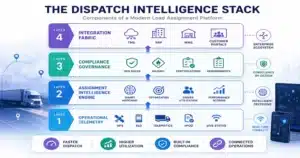
A modern dispatch platform is best understood as a four-layer reference architecture — the Dispatch Intelligence Stack — where each layer solves a distinct failure mode of manual coordination. Treating it as a single “app” is the mistake that produces brittle point solutions; treating it as a layered stack is what makes the system extensible.
Layer 1 — The Operational Telemetry Layer
The foundation is real-time visibility. Vehicle telematics, ELD feeds, GPS position, and electronic proof-of-delivery stream into a single telemetry infrastructure that holds the authoritative state of the fleet. Without this layer, every higher function is guessing. This is the layer that turns “where is truck 47” from a phone call into a query.
Layer 2 — The Assignment Intelligence Engine
Above telemetry sits the decision core: the engine that matches loads to drivers. It ingests the live state from Layer 1 and applies a scoring model across cost, service, compliance, and utilization constraints. This is where rules-based dispatch management software evolves into genuine intelligence, and it is the layer most operators underbuild.
Layer 3 — The Compliance Governance Layer
A dedicated governance layer validates every candidate assignment against hours-of-service rules, hazmat endorsements, equipment certifications, and customer-specific requirements before the assignment is ever offered. Compliance is a gate, not a report. An assignment that the engine cannot legally fulfill should never reach a driver’s screen.
Layer 4 — The Integration Fabric
The top layer connects dispatch to the rest of the enterprise: the TMS for order and rate data, the ERP for billing and settlement, the WMS for dock scheduling, and customer portals for visibility. This fabric is what prevents the platform from becoming yet another silo.
| Stack Layer | Function | Failure Mode It Eliminates |
|---|---|---|
| Operational Telemetry | Authoritative real-time fleet state | “Where is the truck?” blind spots |
| Assignment Intelligence | Scored load-to-driver matching | Gut-feel, double-booked loads |
| Compliance Governance | Pre-assignment rule validation | HOS violations, certification gaps |
| Integration Fabric | ERP / TMS / WMS / portal connectivity | Data silos, manual re-entry |
Pro tip: Build the telemetry layer first even if you intend to keep manual assignment for a quarter. Visibility alone typically recovers measurable utilization before any automation goes live. The stack model gives executives a procurement vocabulary: you are not buying an app, you are commissioning an operational platform with defined layers, each with its own integration and governance requirements.
AI-Powered Driver-Load Matching: How the Assignment Engine Works
The assignment engine works by scoring every viable driver-load pairing against a weighted set of operational constraints, then surfacing the optimal match — or executing it automatically when confidence is high enough. The shift from manual matching to a scored model is the single highest-leverage move in the entire transformation, because it replaces one person’s intuition with a repeatable, auditable decision process.
What does the Matching Engine Actually Evaluate?
A production assignment engine evaluates each candidate pairing across several dimensions at once:
- Proximity and positioning — current location, projected location at pickup time, and deadhead distance.
- Hours-of-service eligibility — whether the driver can legally complete the load inside their remaining 11-hour and 14-hour windows.
- Equipment and endorsement fit — trailer type, hazmat or refrigerated certification, weight limits.
- Cost-to-serve — fuel, deadhead, and detention risk modeled against the load’s revenue.
- Service commitment — appointment windows and the customer’s on-time history requirements.
- Driver preference and equity — home-time rules, preferred lanes, and fair distribution of desirable loads, which directly supports retention.
The engine assigns a composite score to each pairing and ranks them. Where the score clears a confidence threshold, the platform can auto-assign; below it, the system presents the dispatcher a ranked shortlist with the reasoning attached. That human-in-the-loop design is deliberate — it builds trust before it removes oversight.
How is this different from route optimization?
Route optimization answers “what is the best path for this truck,” while the assignment engine answers “which truck should take this load at all.” The two are complementary layers: matching decides the pairing, then logistics route optimization sequences the execution. Conflating them is a common scoping error that leaves the higher-value decision — the assignment itself — still manual.
Where AI Changes the Economics
Predictive models extend the engine beyond the present moment. Demand forecasting positions capacity ahead of freight surges, detention-risk scoring flags facilities likely to delay a driver, and continuous learning improves match quality with every completed load. McKinsey research cited across the sector suggests AI in supply chain operations can cut logistics costs by 5 to 20 percent, and dispatch is where much of that gain concentrates. Mature deployments increasingly lean on AI in fleet management to push assignment from reactive to predictive.
The defensible conclusion: a scored, learning assignment engine does not just dispatch faster — it dispatches better, and the quality gap widens every quarter it runs.
HOS Compliance Integration: Building Regulatory Intelligence into Dispatch
Hours-of-Service compliance must be engineered into the assignment engine as a hard constraint, because an assignment that violates federal driving limits is a liability the instant it is issued — not a problem to catch in an audit later. Building regulatory intelligence into dispatch is what separates an enterprise-grade platform from a glorified load board.
The Rules the Engine Must Enforce
Federal Motor Carrier Safety Administration rules set the boundaries every assignment lives inside. A property-carrying driver may drive up to 11 hours within a 14-hour on-duty window after 10 consecutive hours off duty, must take a 30-minute break before crossing 8 cumulative driving hours, and is capped at 60 hours over 7 days or 70 over 8. The 14-hour clock includes loading, fueling, and inspections, and under standard rules it cannot be paused. An assignment engine that does not model these limits will eventually issue an illegal dispatch.
Why Compliance has to be Predictive, not Reactive
Checking a driver’s hours at the moment of assignment is necessary but insufficient. The engine must project hours forward: will the driver still be legal at the delivery appointment, accounting for drive time, the 30-minute break, and likely detention? Detention makes this acute — when a driver burns two hours at a dock, the 14-hour window keeps running, and a load that was legal at tender becomes impossible to complete legally. The FMCSA’s 2025 Split Duty Period pilot program signals regulators are aware detention distorts the clock, but until rules change, the platform must plan around it.
Turning Compliance Data into Protection
ELD data is also a governance asset. Timestamped arrival and departure records turn detention from an unbillable nuisance into a documented, invoiceable event — directly relevant given that most fleets fail to collect on detention they are owed. A platform that captures clean ELD-backed records improves both safety posture and revenue recovery.
Pro tip: Treat the compliance layer as your insurance and audit-defense system, not just an operational filter. Clean, automated HOS records are the difference between a defensible safety program and a punitive-damages exposure after an incident. For decision-makers, the rule is simple: compliance is a design requirement of the assignment engine, and any platform that treats it as a downstream report is structurally unsafe.
ERP and TMS Integration Architecture for Dispatch Platforms
A dispatch platform delivers enterprise value only when it is wired into the systems that already run the business — the TMS that holds orders and rates, and the ERP that handles settlement and finance. Integration architecture is therefore not a technical afterthought; it is the difference between a platform that eliminates manual work and one that simply relocates it.
The Integration Anti-Pattern to Avoid
The most common failure is the standalone dispatch tool that becomes its own data island. Dispatchers re-key orders from the TMS, re-enter completed loads into the ERP for billing, and reconcile mismatches by hand. The platform automated the assignment but created two new manual handoffs. Real modernization eliminates re-entry; it does not move it downstream.
A Practical Integration Model
Enterprise integration typically follows a layered pattern:
- System-of-record sync — orders, customers, and rates flow from the TMS into dispatch; completed-load and settlement data flow back to the ERP. This is usually API-based, event-driven where possible.
- Real-time event streaming — status changes (assigned, in-transit, delivered, detained) publish to subscribers so customer portals and finance see the same state the dispatcher does.
- Master data governance — a single source of truth for drivers, equipment, and customers prevents the conflicting-record problem that breaks scoring logic.
- Legacy adaptation — older TMS and ERP platforms rarely expose clean APIs, so a middleware or integration-fabric layer translates between modern event streams and legacy interfaces.
How to Phase Integration without Halting Operations
You do not integrate everything at once. A staged approach connects the highest-value system first (usually the TMS for order intake), proves the data flow, then extends to ERP settlement and customer-facing visibility. This sequencing keeps freight moving while the integration hardens. For organizations modernizing legacy estates, this is the heart of disciplined logistics software development — the platform is only as valuable as the systems it can speak to.
The architectural takeaway: integration depth, not feature count, is the truest predictor of whether a dispatch platform will actually reduce headcount-per-truck.
The Dispatch Intelligence Maturity Model (DIMM): Where Is Your Fleet?
The Dispatch Intelligence Maturity Model (DIMM) is a five-stage framework, introduced by The NineHertz, for diagnosing how advanced a fleet’s coordination capability is and what the next investment should unlock. Most enterprise fleets sit between Stage 2 and Stage 3, and the value of the model is that it turns a vague ambition (“we should use more AI”) into a specific, sequenced roadmap.
| Stage | Name | How Decisions Are Made | Defining Technology | Characteristic Outcome |
|---|---|---|---|---|
| 1 | Manual Coordination | Human memory, phone, spreadsheets, WhatsApp | None / consumer messaging | Unscalable; quality collapses under volume |
| 2 | Reactive Digital | Humans, aided by load board and GPS | TMS + ELD, siloed | Visibility exists, decisions stay manual |
| 3 | Proactive Assignment | Engine recommends, human approves | Scored matching, integrated telemetry | Faster, consistent, fewer compliance misses |
| 4 | Autonomous Dispatch | Engine auto-assigns; humans handle exceptions | AI matching + predictive HOS + integration | Dispatcher-to-truck ratio expands sharply |
| 5 | AI-Orchestrated Fleet Intelligence | System self-optimizes; humans set policy | Agentic AI, predictive demand, learning | Capacity positioned ahead of demand |
How to Read Your Current Stage
Stage placement is determined by where dispatch decisions are actually made, not by which tools you have purchased. A fleet with an expensive TMS that still assigns loads by phone is at Stage 2, not Stage 4 — owning telemetry is not the same as acting on it. The honest diagnostic question is: who or what makes the assignment decision, and on what information?
What Each Transition Unlocks
Moving from Stage 2 to Stage 3 captures the biggest single jump in assignment quality, because it replaces intuition with a scored, auditable model while keeping human judgment in the loop. The Stage 4 transition is where the labor economics change — autonomous assignment within confidence thresholds expands how many trucks one coordinator can oversee. Stage 5 is where agentic AI for enterprise lets the network position capacity ahead of demand rather than reacting to it.
Pro tip: Do not target Stage 5 from Stage 2. Each stage builds the data foundation the next one requires, and skipping the proactive-assignment stage starves the autonomous engine of the training signal it needs to be trustworthy.
For executives, DIMM converts a technology conversation into an investment-sequencing decision: name your current stage, name your target stage, and the gap between them is your roadmap.
Implementation Roadmap: From WhatsApp to Autonomous Dispatch in 90 Days
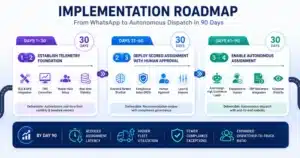
A disciplined 90-day program can move a fleet from informal, message-based coordination to a working autonomous-assignment capability — provided the sequence respects the maturity model and does not attempt to leap stages. The roadmap below is the implementation blueprint, and it is built to keep freight moving the entire time.
Days 1–30: Establish the telemetry foundation (Stage 1 → 2)
The first month builds visibility and the data backbone. Integrate ELD and GPS feeds into a single telemetry layer, connect the TMS for order intake, and establish master data for drivers and equipment. Keep assignment manual during this window. The deliverable is an authoritative, real-time picture of the fleet and a clean baseline of your three core metrics: assignment latency, detention hours, and deadhead percentage.
Days 31–60: Deploy Scored Assignment with Human Approval (Stage 2 → 3)
The second month introduces the assignment engine in recommendation mode. Every load gets a scored, ranked shortlist with the reasoning exposed, and dispatchers approve or override. This is where compliance governance goes live: the engine enforces HOS eligibility as a hard gate. The override data is valuable — it shows where the model needs tuning and where dispatcher knowledge encodes something the engine has not yet learned.
Days 61–90: Enable Autonomous Assignment within Thresholds (Stage 3 → 4)
The final month activates auto-assignment for high-confidence pairings while routing exceptions to humans. ERP settlement integration closes the loop so completed loads bill automatically, and customer-facing visibility goes live. The measurable outcomes by day 90 typically include reduced assignment latency, recovered utilization, fewer compliance exceptions, and an expanded dispatcher-to-truck ratio.
| Phase | Days | Maturity Shift | Primary Deliverable |
|---|---|---|---|
| Foundation | 1–30 | Stage 1 → 2 | Unified telemetry + TMS intake |
| Augmentation | 31–60 | Stage 2 → 3 | Scored assignment + HOS governance live |
| Autonomy | 61–90 | Stage 3 → 4 | Auto-assignment + ERP settlement loop |
Readiness Indicators and Investment Thresholds
Not every fleet should start this program tomorrow. Strong readiness indicators include a fleet large enough that coordination is a real constraint (typically 25+ power units), existing ELD adoption, and executive sponsorship for process change. The investment case is clearest where detention, deadhead, and turnover costs are already quantified — those three numbers usually justify the platform on their own.
Pro tip: Resource the change-management effort as seriously as the technology. The platform succeeds or fails on whether dispatchers trust the engine, and trust is earned in the recommendation phase, not mandated in the autonomous one.
The executive guidance is to sequence, not sprint: a fleet that respects the maturity stages reaches durable autonomy faster than one that buys the most advanced platform and skips the foundation.
Frequently Asked Questions About Dispatch Intelligence Platforms
What is the difference between a dispatch management system and an intelligent load assignment platform?
A dispatch management system digitizes coordination — it gives you a digital load board, GPS visibility, and status tracking, but the assignment decision stays with a human. An intelligent load assignment platform adds a scoring engine that evaluates and ranks driver-load pairings against cost, compliance, and service constraints, and can execute high-confidence assignments automatically. The distinction maps directly to DIMM Stage 2 versus Stages 3–4.
How does an AI Dispatch Platform Handle Hours-of-Service Compliance?
A well-architected platform treats HOS as a hard constraint inside the assignment engine. Before any load is offered, the engine validates that the driver can legally complete it within their remaining 11-hour and 14-hour windows, accounting for the 30-minute break and projected detention. Compliance is enforced at assignment time, not audited afterward, and timestamped ELD records are captured for both safety defense and detention billing.
Will a Dispatch Automation Platform Replace Human Dispatchers?
In most enterprise deployments, no — it changes what dispatchers do. Autonomous assignment handles routine, high-confidence pairings, which frees experienced coordinators to manage exceptions, customer relationships, and edge cases the engine routes to them. The practical effect is that one coordinator oversees far more trucks, which directly addresses the labor shortage rather than eliminating the role.
How Long does it Take to Implement Intelligent Dispatch?
A focused program can reach autonomous assignment for high-confidence loads in roughly 90 days, phased as telemetry foundation (month one), scored assignment with human approval (month two), and threshold-based autonomy (month three). Timelines extend with the complexity of legacy TMS and ERP integration, which is usually the critical path rather than the assignment logic itself.
What ROI hould an enterprise fleet expect?
The clearest returns come from recovered utilization, reduced detention exposure, and an expanded dispatcher-to-truck ratio. With ATRI quantifying detention losses at $11,000–$19,000 per driver per year and McKinsey citing 5–20% logistics cost reduction from AI, the business case is typically anchored on those measurable figures rather than on speculative gains.
What This Means for Decision-Makers
Manual dispatch is a structural ceiling on enterprise fleet growth, and the organizations pulling ahead are the ones that stopped treating it as a hiring problem and started treating it as an architecture decision. The path is clear and sequenced: establish a real-time telemetry layer, add a scored assignment engine with compliance built in as a hard constraint, integrate the TMS and ERP so manual re-entry disappears, and advance through the DIMM stages rather than leaping them. The numbers — billions in detention losses, a deepening driver shortage, and trucks running barely half their legal hours — make the cost of standing still the most expensive option on the table.
The NineHertz is an AI-native engineering firm that provides a comprehensive suite of services focused on the Build, Run, and Evolve framework. By integrating advanced generative and agentic AI into the development lifecycle, the company delivers significantly increased velocity and operational transparency for ISVs, digital natives, and enterprise clients. Its offerings span mobile app development, IoT solutions, and cloud architecture, alongside specialized AI transformation services. Operating across healthcare, finance, logistics, and other sectors, the firm leverages its proprietary ContinuumAI framework to modernize legacy systems and deploy autonomous workflows — acting as a long-term technology partner that helps businesses achieve competitive advantage through intelligent automation and scalable digital products.
Ready to find your fleet’s position on the Dispatch Intelligence Maturity Model and map the 90-day path forward? Talk to The NineHertz logistics engineering team for an architecture-level assessment of your dispatch operation — and turn coordination from your biggest constraint into your competitive advantage.
