



Key Takeaways
- The cost to develop inventory management software can range from $30,000 to $200,000 and even more.
- Hiring the right logistics software development company is highly important to build a custom product that aligns with real time business needs.
- The exact development cost depends heavily on factors like project complexity, hiring model, technology integration, project timeline, and more.
- Key tactics like MVP development, right hiring model, easy navigation, etc. can help to save inventory management software cost.
Running a business on spreadsheets in 2026 is like navigating a highway with a paper map. It works, until it doesn’t. And when it fails, it fails expensively: stockouts, excess inventory, delayed orders, and a finance team that can’t get accurate numbers fast enough to act on them.
Inventory management software cost ranges from roughly $25/month for a basic cloud subscription to $500,000 for a custom enterprise build. That’s a wide gap, and where your business falls in it depends on size, workflow complexity, and whether you choose to buy off-the-shelf or partner with an inventory management software development company to build something purpose-built.
The urgency here is real. The global inventory management software market was valued at $3.58 billion in 2024 and is heading toward $7.14 billion by 2033, per Grand View Research. More telling: Capterra data shows entry-level plans average $262/month while enterprise plans average $2,181/month, yet 55% of buyers say they’re budgeting $150 or less per user per month. Someone’s math isn’t working out.
So, let’s understand how much does inventory management software cost, what are the affecting factors, and the things that you should take care of during the development process.
Average Cost of Inventory Management Software
Let’s get to the direct costs first, no preamble about what inventory management is or why it matters. You know that already.
Pricing by Business Size: Off-the-Shelf SaaS
Small businesses with straightforward needs, stock tracking, barcode scanning, basic reorder alerts, can get cloud tools from $25 to $300/month. At this range, you’re typically capped on users, SKUs, and integrations. Fine for a single-location shop. Frustrating the moment you open a second warehouse.
Mid-market businesses sit in the $300 to $1,500/month band. Multi-location support, POS and accounting integrations, demand-side reporting, these start showing up here. Still subscription-based. Still not yours.
Enterprise SaaS can run $2,000 to $10,000+ per month just for the platform license. Add implementation, user training, and custom integrations and your first-year bill looks nothing like what the vendor’s pricing page suggested.
| Business Size | Monthly Cost | Typical Users | What You’re Getting |
|---|---|---|---|
| Small Business | $25 – $300/mo | 1–5 | Stock tracking, barcode scan, basic reports |
| Mid-Market | $300 – $1,500/mo | 5–50 | Multi-location, POS + accounting sync |
| Enterprise SaaS | $1,500 – $10,000+/mo | 50+ | ERP integration, forecasting, analytics |
| Custom Build (MVP) | $20K – $80K one-time | Flexible | Purpose-built, no recurring license |
| Custom Build (Enterprise) | $100K – $500K+ one-time | Unlimited | AI, IoT, ERP/WMS, full ownership |
The number that doesn’t show up in that table: the cumulative SaaS spend. A business paying $2,500/month has handed over $150,000 in five years, and owns nothing. That context matters when you’re evaluating the custom development route.
Key Factors That Influence Inventory Management Software Cost
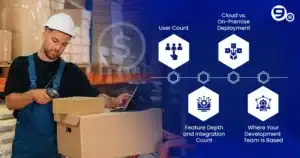
Pricing isn’t arbitrary. These are the variables that move the needle most:
User Count
Per-seat pricing is common, and it compounds. Five users at $50/seat is $250/month. Fifty users is $2,500. That math accelerates faster than most growing businesses plan for. Always model your three-year headcount before signing a per-user contract.
Cloud vs. On-Premise Deployment
Cloud solutions are cheaper to start. On-premise licenses run $10,000 to $50,000+ upfront, plus hardware, IT overhead, and maintenance. Over a five-year window, those totals often converge, sometimes flip. A good logistics software development company can model both scenarios against your actual operation before you commit to either.
Feature Depth and Integration Count
Basic tracking modules cost less than AI-powered demand forecasting. Every layer, RFID, multi-warehouse sync, ERP connectors, adds to the bill. Custom API integrations can run $5,000 to $25,000 each. That’s per connection.
Where Your Development Team Is Based
Geography is a real pricing lever. North American developers bill $100–$200/hour. Experienced offshore teams in South Asia or Eastern Europe deliver equivalent quality at $30–$80/hour. A $150,000 project in the US can come in at $50,000–$70,000 with the right partner. The key word: right partner.
How Much Does It Cost to Build Custom Inventory Management Software?
When off-the-shelf tools stop fitting, custom development is the answer. The inventory management software development cost varies sharply by scope, here’s how the tiers break down, drawing on current market data from APPWRK and CISIN.
MVP Tier: $20,000 – $80,000
Core features only, real-time stock tracking, basic order management, barcode/QR scanning, role-based access, a reporting dashboard. Ideal for SMBs that need more control than any off-the-shelf tool offers. Timeline: 3 to 5 months. This is your proof-of-concept before you invest in the full build.
Mid-Range: $80,000 – $200,000
Multi-warehouse management, demand forecasting, ERP/accounting integrations, mobile access, and advanced analytics. Most growing mid-market businesses land here. Expect 5 to 9 months to go live. Also see the detailed cost to develop supply chain software breakdown for how this fits into a broader logistics tech investment.
Enterprise: $200,000 – $500,000+
AI/ML demand forecasting, IoT device integration, regulatory compliance modules, multi-region support, deep ERP and WMS connectivity. These builds take 9 to 18 months. Annual maintenance runs 15 to 20% of the original development cost, budget for that from the start, not as an afterthought.
| Tier | Cost Range | Timeline | Best Fit |
|---|---|---|---|
| MVP | $20K – $80K | 3–5 months | Startups and SMBs needing custom control |
| Mid-Range | $80K – $200K | 5–9 months | Growth-stage businesses, ERP integration |
| Enterprise | $200K – $500K+ | 9–18 months | Complex ops, AI/IoT, multi-region |
| Annual Maintenance | 15–20% of build | Ongoing | All custom builds post-launch |
What Features Actually Drive Inventory Management Software Pricing?
Not all features are equal, some move the cost needle dramatically, others barely register. Here’s the breakdown:
Core Features (Table Stakes)
• Real-time stock visibility across locations
• Barcode and QR code scanning
• Purchase order creation and management
• Low-stock alerts and auto-reorder triggers
• Role-based user access controls
• Basic dashboard and reporting
Advanced Features (Where Cost Climbs)
• AI demand forecasting, McKinsey data shows automated systems hit 90% accuracy vs. 60% manually. That gap pays for itself.
• Multi-warehouse inventory sync
• RFID and IoT device integration
• Predictive safety stock and reorder calculation
• Business intelligence and custom analytics
• Lot, batch, and serial number tracking
Industry-Specific Add-Ons
• Pharma: batch recall, FDA/GxP compliance
• Food & Beverage: FIFO/FEFO, expiry management, cold chain monitoring
• Manufacturing: Bill of Materials, work-in-progress tracking
• Retail/eComm: multi-channel sync, 3PL integration, returns management
For a full feature comparison between open-source and custom builds, this guide on open-source inventory management software features covers the trade-offs clearly.
Inventory Management Software Pricing Models
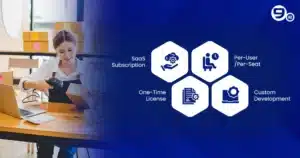
The pricing structure your vendor uses shapes your long-term costs as much as the monthly rate itself.
SaaS Subscription
Monthly or annual. Low barrier to entry. Easy to get started. The downside? You’re renting, indefinitely. Annual billing typically saves 15 to 20%. Still, every year you subscribe is a year you get no equity in the tool you’re relying on.
Per-User / Per-Seat
Works cleanly for small teams. Gets expensive fast at scale. Always negotiate a user-band ceiling before signing, lock in a headcount range so growth doesn’t automatically trigger a tier upgrade mid-year.
One-Time License (On-Premise)
Perpetual license, hosted on your infrastructure. $10,000 to $50,000 upfront, before hardware and IT staffing. Over five years, this often equals or exceeds what you’d pay for SaaS, but you do own the software. That’s worth something.
Custom Development (No License, Ever)
You own the software. Annual costs = maintenance and feature additions, usually 15 to 20% of the build cost. For businesses currently spending $30,000+ per year on SaaS licenses, the math on custom development almost always improves beyond year three.
Industry-Specific Inventory Management Software Costs
Your industry shapes what you need, and what you’ll pay. Manufacturing leads adoption at 25.58% market share in 2026, per Fortune Business Insights. Here’s how costs break by vertical:
Retail & eCommerce
Multi-channel sync and returns management are non-negotiable here. SaaS: $100 to $1,500/month. Custom builds for omnichannel retail start around $80,000 and scale with channel and warehouse count.
Manufacturing & Supply Chain
BOM management, WIP tracking, ERP integration. Complex builds, typically $150,000 to $400,000 for enterprise-grade custom solutions. The supply chain software development company you partner with matters here; manufacturing is not a vertical for generalists.
Healthcare & Life Sciences
FDA and GxP compliance requirements push development costs to $100,000–$300,000 for custom medical inventory systems. Annual compliance update cycles add 10 to 15% ongoing.
Food, Beverage & Logistics
Cold chain, FIFO/FEFO, expiry tracking, these are operational necessities, not optional extras. SaaS tools with these capabilities start around $300/month. Custom builds from a specialist logistics software development company typically run $80,000 to $250,000.
What Are the Hidden Costs of Inventory Management Software?
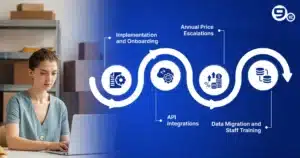
This is where a lot of budgets quietly fall apart. The subscription fee is just the entry ticket.
Implementation and Onboarding
Basic setups: $15,000 to $30,000. Multi-location with custom workflows: $40,000 to $75,000. Complex ERP implementations (NetSuite, Acumatica) can breach $100,000 when data migration is included, according to Concentrus. And that’s before your team has touched the system.
API Integrations
Each external system your IMS needs to talk to costs money to connect. Pre-built connectors: $50–$200/month each. Custom API integrations: $5,000 to $25,000 per connection. Some platforms charge per API call, $0.01 to $0.05 per transaction, which adds up to hundreds of dollars monthly on active multi-channel syncing.
Annual Price Escalations
Most contracts include 3% to 7% annual price increases. A $2,500/month plan at 5% annual escalation costs $2,888/month by year four, nearly $5,000 more per year with nothing new to show for it. Negotiate a cap before you sign, not after.
Moving your historical records into the new system: $2,000 to $15,000 depending on volume and complexity. Staff training for enterprise rollouts: $1,000 to $10,000. These line items disappear from demo conversations and reappear in project invoices.
How to Reduce Inventory Management Software Development Costs
You don’t control everything, but you control more than you think.
Start with an MVP
Build only what solves your top three operational problems. Launch. Validate. Then invest in the next layer. This isn’t corner-cutting, it’s sensible product development that protects budget and surfaces real user needs before you commit to expensive features.
Work with a Specialist Development Partner
A team that has built logistics and supply chain systems before moves faster, makes fewer costly architecture mistakes, and doesn’t need to learn your domain on your budget. Offshore teams in South Asia and Eastern Europe, when properly vetted, cut software development costs by 40 to 60% compared to North American rates, without sacrificing quality.
Prioritize Modular Architecture
Design the core system to accept plug-in modules over time. RFID, AI forecasting, multi-region support, add them when you need them, not upfront. This keeps your initial build lean and makes future enhancements predictable in cost and timeline.
How Do You Choose the Right Inventory Management Software?
Before you talk to a single vendor, document your workflows. Where does inventory data go missing? Where do stockouts originate? What manual processes are burning the most time? Your answers define the requirements. And the requirements determine whether any off-the-shelf tool can actually solve your problem.
SaaS vs. Custom: The Honest Comparison
| Factor | Go SaaS If… | Go Custom If… |
|---|---|---|
| Budget | Prefer low upfront OpEx | Ready to invest for long-term CapEx savings |
| Timeline | Need to launch in 4–8 weeks | Can allow 3–9 months for development |
| Workflow Fit | Standard processes, generic needs | Unique workflows that don’t fit templates |
| Scale | Under 50 users, single location | 50+ users, multi-site or global ops |
| Integration Depth | Standard connectors are enough | Deep ERP/WMS/IoT integration required |
Questions Worth Asking Every Vendor
1. What does total cost of ownership look like over five years, including implementation and support?
2. How many API calls are included monthly, and what do overages cost?
3. What’s in the annual price escalation clause?
4. Who handles data migration, and what’s the cost?
5. What happens to our data if we cancel?
Why Businesses Choose Custom Inventory Management Software Development

Generic software is built for the median business. Yours isn’t median, it has specific workflows, specific compliance requirements, specific integration needs. That’s the core case for custom. You can see it in practice through cases like this advanced inventory management software transformation, where a purpose-built system reshaped operations in ways no off-the-shelf product could.
You Own It
No licensing fees. No annual escalations. No dependency on a vendor’s roadmap. A business spending $3,000/month on SaaS spends $180,000 over five years. A well-scoped custom build at $100,000 breaks even before year three, and every dollar of savings after that is pure ROI.
It Scales the Way You Scale
New warehouse? New sales channel? New compliance requirement? These are configuration changes in custom software, not tier upgrades. You’re not waiting for a vendor’s next release cycle. You build what you need, when you need it.
Better Accuracy, Better Decisions
Per Cleveroad’s analysis citing McKinsey research, automated demand forecasting in custom systems achieves around 90% accuracy. Manual processes average 60%. That 30-point gap translates directly into reduced overstock, fewer stockouts, and tighter working capital, measurable returns that stack up year over year.
Conclusion
There’s no single answer to how much inventory management software costs, because there’s no single type of business asking. Small operations can solve their problems for $50/month. Enterprise-scale companies might justify a $400,000 custom build. The right question isn’t “what’s the cheapest option?“, it’s “what’s the most cost-effective solution for where this business is going?”
Hidden costs matter. Five-year TCO matters. Ownership of the software matters. Get those numbers on the table before you sign anything.
The NineHertz is a trusted inventory management software development company with deep expertise in supply chain, logistics, and warehouse systems. Whether you’re mapping out a custom build or benchmarking your current SaaS spend, reach out for a free consultation, and let’s build something that actually fits.
What This Means for Decision-Makers
Buying SaaS is renting. It’s fast, flexible, and fine at small scale. Building custom software is buying. Higher upfront, but you end up with an asset you own, one built around your workflows, not the vendor’s template. If you’re already spending over $2,000/month on a system that still doesn’t fit, it’s time to run the five-year numbers on a custom build.
Frequently Asked Questions
What is the average cost of inventory management software?
Off-the-shelf SaaS tools range from $25 to $300/month for small businesses, $300 to $2,000/month for mid-market companies, and $2,000 to $10,000+ per month at the enterprise level. Custom development starts around $20,000 for an MVP and climbs to $500,000 or more for enterprise-grade systems with AI, IoT, and ERP integration.
What factors affect inventory management software cost?
The biggest drivers are: business size and user count, deployment model (cloud vs. on-premise), feature scope and integration complexity, industry compliance requirements, and where your development partner is based. Don’t forget the hidden costs, implementation, data migration, training, and annual price escalations regularly add 50 to 100% on top of the advertised subscription price.
Is cloud-based inventory software cheaper than on-premise?
Lower upfront, yes. Over five-plus years, not always. Cloud SaaS starts at $25/month vs. $10,000–$50,000+ for an on-premise license. But add escalating subscription fees over a five-year period and the gap narrows, or reverses. Cloud suits businesses prioritising flexibility and fast deployment. On-premise or custom development tends to win on long-term ROI at mid-to-large scale.
How long does custom inventory management software development take?
An MVP takes 3 to 5 months. A mid-range build with ERP integration runs 5 to 9 months. Enterprise-grade systems, AI, IoT, multi-region, take 9 to 18 months. The variable that matters most isn’t the build itself; it’s the quality of the requirements brief you go in with. Ambiguous scope is where timelines and budgets quietly spiral.
