


Key Takeaways
- Customers today expect speed and accuracy, whether they’re buying your products online or through a distributor. And logistics are becoming more and more fragmented with more carriers and partners.
- The global supply chain visibility software is expected to grow up to $10.9 billion in 2034 at a rate of 13.4%.
- Real-time tracking of a supply chain is the process of monitoring shipments and assets across every stage by providing live data about goods and their condition.
- The best supply chain visibility software will reduce costs with fewer delays and smarter routing. But it is even more beneficial in reducing inventory costs.
Introduction to Supply Chain Visibility and Real-Time Tracking Software
Imagine your supply chain is a traffic system during rush hour. Do you think getting a traffic report every few hours will help you solve your problems on time? No, because the situation had already changed between knowing there’s a problem and trying to fix it. That’s why you need a system that gives you live updates and turn-by-turn visibility into your supply chain.
The global supply chain visibility software is expected to grow up to $10.9 billion in 2034 at a CAGR of 13.4%. Customers today expect same-day deliveries and transparency, whether they’re buying your products online or through a distributor. At the same time, logistics networks are becoming more complex with multiple carriers and partners.
In such an environment, even a small issue could turn into a big mess. Disruptions such as port congestion and supplier delays are no longer inevitable in the supply chain. Having visibility into it means you identify issues beforehand and have a plan to fix supply chain delays even before your customer notices. This is where real-time supply chain visibility becomes essential.
In this blog, we will see what challenges are there in a traditional supply chain and how to improve supply chain visibility with real-time tracking software.
What is Real-Time Tracking in Supply Chain Management?
Real-time tracking of a supply chain is the process of monitoring shipments and assets across every stage by providing live data about goods and their condition. It allows your logistics team to track your shipments in real time and help them flag if there are any deviations from planned schedules or routes. More than that, it gives automatic alerts the moment something goes wrong so that your team can respond before a delay becomes a customer problem.
This situation eliminates any blind spots and enables you to make decisions quickly that are necessary for providing better service to customers. Data from sources like IoT sensors and carrier APIs is processed in a centralized platform. This unified platform is accessible to all stakeholders, giving a clear picture of the supply chain of your network.
AI and machine learning provide ETA (Estimated Time of Arrival) after considering real-time weather conditions and live traffic.
Key Challenges in Traditional Supply Chain Visibility
Before understanding the importance of real-time visibility, you need to know what are the challenges you face in a traditional supply chain visibility. Most of the time, problems in supply chain management don’t arise because of a lack of information, but because of information that arrives too late and cannot be trusted.
Here are a few challenges that traditional methods fail to solve.
- Checkpoint-only tracking creates blind spots: The traditional supply chain depends on status updates at fixed points. For example, you will only receive information when a shipment leaves a warehouse and reaches the customer, but not about what happens in between.
- No proper supply chain management: You will come to know about a problem only after it happens, making shipments vulnerable to delays and damage. So you are no longer managing the supply chain but documenting what went wrong.
- Disconnected systems create data silos: Warehouse management systems and the systems used by logistics providers are not in sync with each other. Therefore, you will be making decisions based on incomplete information without knowing what information is missing.
- Inconsistent data formats slow down operations: Logistics managers receive information in PDFs and EDI feeds from vendors who use different data standards. Because of this, logistics managers spend more time reconciling different data forms, instead of taking action.
Core features of real-time tracking software
If you’re a supply chain manager, you know how it feels to look at data that is six hours old and wonder what happened to the shipment that left the warehouse but hasn’t reached the customer. The real-time tracking software with the right features improves supply chain visibility by addressing this problem and the other challenges we have discussed before.
Live Location Tracking and GPS Integration:
The best supply chain visibility software will give you continuous updates about the location of a shipment using GPS. Whether it’s a truck crossing state borders or information about a container waiting at port, you know exactly where it is and how far it is from its actual destination. According to industry surveys, most of the supply chain executives prefer real-time tracking to improve visibility.
Real-Time Alerts:
When you have good real time tracking software by your side, you don’t have to keep watching your dashboards. Because it should be able to provide automated alerts whenever the system flags any deviations.
Collaborative Tools and Stakeholder Visibility:
One of the biggest failures in supply chain management is the lack of transparency. This happens when your logistics team knows something your supplier or customer doesn’t know. Collaborative tools of the software solve this issue by giving a role-based view into the same data for everyone involved.
Integration of IoT sensors:
GPS shows you where your shipment is, but IoT sensors tell you what condition it is in. This feature is very important for products that can be damaged or stolen in transit. IoT sensors attached to containers or packaging continuously track information about temperature and light exposure.
Cloud-based accessibility:
Almost 68% of supply chain visibility software deployments are based on cloud technology, as it offers accessibility to data irrespective of your location. Your logistics team in one country and supplier in another can access the same live data from all browsers without VPNs. Manufacturing companies that have adopted cloud transformation have seen a 34% improvement in supply chain visibility.
How Real-Time Data Enhances End-to-End Supply Chain Visibility
If there’s a lack of visibility, even at one point in the supply chain, you lose sight of what’s moving and where it is. And due to this, you lose your ability to respond to a problem when it occurs. This is where real-time tracking software enters and improves the supply chain visibility across every part of your network.
Traditional supply chain management works with periodic updates and manual check-ins, which are no longer sufficient. But with supply chain visibility software, real-time tracking, you work with live data that flows across all components.
For example, when a shipment is delayed at customs, you know about it immediately, not when the supplier mails you after 24 hours. When the inventory levels at a distribution center go below the threshold, your replenishment process will start automatically.
You will be able to manage expectations of your customer before they make a complaint when an order is delayed due to weather or unfavorable conditions.
This is the impact of improved inventory visibility on supply chain efficiency that most organizations miss.
Global supply chain visibility software improves this further by eliminating data silos and managing supply chains across different time zones and countries through a single operational dashboard.
Most of the companies fail to understand that you cannot improve supply chain visibility by collecting more data, but by ensuring that the right data reaches the right people when it is necessary.
Role of IoT, GPS, and AI in Real-Time Tracking
Today, real-time tracking is one of the terms that almost every company uses to get your attention. But do you know what real-time tracking looks like in practice? There are three important technologies that work together to make supply chain visibility software solutions that were difficult to build five years ago.
Let’s understand how IoT and GPS work together with AI to improve real-time visibility.
IoT:
Smart sensors are attached to shipping containers or refrigerated trucks to collect information such as temperature, vibration, frequency, shock, and tampering continuously to know the condition of the inventory.
For example, a sensor will send alerts when a pharmaceutical shipment shifts two degrees above the threshold value so that the concerned person will take action immediately. This is how all leading logistics operations run today, with a detailed view of every stage of the supply chain.
GPS:
GPS has been the foundation of the shipment tracking functions. But now, GPS-enabled sensors allow logistics teams to reroute the shipment if there are any disruptions due to weather or peak traffic. As GPS is integrated into a centralized platform, the operations team has full visibility across the entire supply chain.
AI:
GPS provides the location of a shipment, and IoT sensors let you know the condition. AI gathers all the information from IoT and GPS. Then it compares the current trends with past data to provide useful insights that helps you make the right decision. AI and machine learning algorithms consider external conditions like weather and traffic, and analyse the social media trends to predict disruptions before they actually happen. Companies using predictive analytics are able to identify disruptions weeks in advance, reducing operating costs by 30%.
Benefits of Implementing Real-Time Tracking Software
Only 6% of organizations have full visibility across their supply chain? That means most companies are making consequential decisions about inventory and customer demands with incomplete information. And that gap shows up in your costs and your customer relationships like missed delivery timelines.
So, let us see what changes with real-time tracking software.
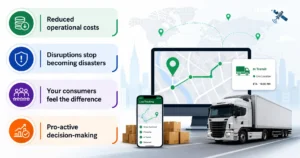
Reduced operational costs
The best supply chain visibility software will reduce costs with fewer delays and smarter routing. But it is even more beneficial in reducing inventory costs. Companies with real-time supply chain visibility reduce logistics costs by 20%. When you exactly know where the stock is at every point in the chain, you stop overordering commodities out of uncertainty.
Disruptions stop becoming disasters
Every supply chain gets hit by disruptions sometimes or other. The difference between companies that absorb disruptions and those that get derailed by them depends on the response time.
Organizations with real-time visibility are 2.5 times more operational than their competitors, who depend on fragmented or delayed information. For example, when a carrier reroutes unexpectedly, teams using the supply chain visibility software with real-time tracking capabilities get informed immediately rather than waiting till the issue becomes a crisis.
Your consumers feel the difference
This is where the impact of supply chain visibility is beyond question. About 65% of customers leave a retailer after 2 to 3 late deliveries, and they won’t come back in most cases. Real-time tracking helps you deliver orders on time and, at the same time, gives confidence to your customer-facing teams with the live data they need to communicate to customers if something goes wrong. Most companies don’t understand the fact that transparency about delay builds more trust than being silent about it.
Pro-active decision-making
The most underrated benefit of supply chain visibility software solutions is their ability to support informed decision-making. When data is live and accessible to all teams, they don’t have to make decisions based on their gut instincts or yesterday’s reports. When a visibility platform is intelligent enough to monitor current operations and prescribe specific actions to optimize future outcomes, it converts the supply chain to an asset rather than a liability. If you’re a company thinking seriously about how to improve supply chain visibility, then you no longer should question if the investment really pays off. You should think about how quickly it will pay off and where you have to start.
Impact of Improved Inventory Visibility on Supply Chain Efficiency
Let’s be honest about something that most organizations ignore. The real loss due to poor supply chain visibility doesn’t lie in your logistics budget. It’s buried in the profit and loss statement and in ways that are easy to miss, like a customer churn out after a stockout or a warehouse space occupied by dead cost.
Here’s what changes when you fix supply chain visibility and how its impact on efficiency is measurable.
Avoid stockouts and overstocks:
A study found that only 9% of businesses have full visibility into their inventory. At the same time, 63% of companies are still struggling with limited visibility that leads to revenue loss and inefficiencies.
Im many cases, this gap comes down to what’s happening inside the company is and where it wants to be depends on the situation of its warehouse.
Your reorder triggers are now driven by actual stock levels and demand signals. Research shows that after implementing real-time inventory systems, stockout rates fell from 12% to 7% across all industries.
Inventory carrying costs reduce
The carrying costs that look manageable in isolation have a devastating effect when they aggregate. Inefficient inventory management costs up to $1.1 trillion every year.
When supply chain visibility improves, the first thing that changes is your safety stock calculation. Instead of having excess inventory, now you have real-time data that lets you hold enough stock while maintaining or improving service levels.
Improves demand forecasting:
Bad visibility creates a feedback loop as you can’t trust your numbers. So you overorder commodities, which leads to inaccurate forecasting.
Companies that apply predictive analytics in inventory planning have 2-3 times more chance to achieve above-average visibility and efficiency. When your inventory data is accurate and connected to demand planning tools, your forecast starts being decisions backed by information.
Improvement in supplier coordination:
Shared visibility across the supply chain ensures that all stakeholders work on the same information. This is where the operational efficiency goes to the next level.
When a supplier sees the actual inventory position and demand forecast, they plan their production more accurately.
Cross-functional efficiency gains:
The impact of visibility improvement in inventory just doesn’t stay there. Companies that adopted AI in supply chain management noticed that inventory levels reduced by 35% and efficiency increased by 65%. The effect of these improvements can be seen in customer response times and in the confidence of the sales team. That’s why investing in supply chain visibility software with real-time tracking at the inventory level has benefits beyond the logistics team.
Use Cases of Real-Time Tracking Across Supply Chain Operations
Real-time tracking isn’t a single solution that works the same way for all industries. How you use it and what problem it solves for your business depends on the industry you’re in.
A pharmaceutical company and a grocery retailer both need cold chain monitoring, but the product lifecycle differs from one to another. That’s why understanding use cases of real-time monitoring is important because the capabilities of global supply chain visibility software change across every vertical.
Retail and E-commerce:
Customers today expect transparency and faster delivery from retailers. You cannot fulfill the expectations of your customers just by improving your carrier reporting. That’s where you need real-time tracking software to get visibility from your warehouse to the customer’s door.
Real-time tracking provides accurate ETAs to customer-facing teams and flags at-risk shipments before they breach SLA windows.
The global cross-border e-commerce logistics market is expected to rise to $1 trillion by 2034, and managing that volume isn’t possible without real-time visibility.
Pharmaceuticals:
For pharma companies, a tracking failure becomes a regulatory violation before it becomes a customer service problem. That’s why real-time tracking is more important to the pharmaceutical industry than in any other industry.
Pfizer established a 24/7 supply chain control tower to monitor shipments in transit and take action immediately if there’s any route disruption or temperature excursion. Digital temperature logs confirm that continuous compliance is one of the biggest ROI of real-time tracking software in the pharma industry.
Food and Beverage Industry:
Food supply chains operate under a combination of product sensitivity and regulatory mandates. One contamination incident that’s caught late can cost a brand’s reputation and shut down distribution operations.
The best supply chain visibility software implemented in the food and beverage industry enables traceability from farm to shelf. It acts as a backbone for sustainability reporting and carbon footprint tracking per shipment.
Manufacturing:
In the manufacturing industry, real-time tracking improves supply chain visibility by monitoring raw materials and finished goods.
Almost 82% of manufacturing executives now consider AI as an important factor for their growth. You cannot implement predictive analytics with stale data, and this is where how to improve supply chain visibility becomes a question of tier depth.
Only 43% of companies have visibility beyond tier 1, which shows that the majority of them have no idea about risks that occur in two or three tiers in the supply chain network.
How to Choose the Right Real-Time Tracking Software
The supply chain visibility software market is crowded and growing fast. The mistake most businesses make when choosing the best supply chain software development company is selecting one with features they don’t need.
Here are the steps to follow for finding the best software with ease of use, integration capabilities, and scalability.
Define Your Business Requirements:
Before you start searching for real-time tracking software, it is crucial to address your business needs and challenges relating to your operations.
Compare Pricing Models and ROI:
Next, an important component is considering the cost by comparing different pricing models. Whether you choose one-time upfront costs or a subscription model with recurring costs, it will directly affect the estimated Return on Investment (ROI).
Check Vendor Support and Training:
The best supply chain visibility software should be backed by effective training and support. So, look for vendors who provide guiding manuals, training videos, and 24/7 customer support for effective implementation.
Consider Customization and Future Upgrades:
Every business has a unique operating style, and adopting standalone software doesn’t fit the requirements. Software that is more customisable for workflows and dashboards brings more flexibility. So choose software that is customizable and can be upgraded easily.
Best Practices for Implementing Real-Time Tracking Solutions
Selecting the software is only half the work. The implementation phase is where most projects go wrong, and most of the time, this is not a technology problem.
Here are the best practices you need to follow while implementing real-time tracking software:
- Before integrating or onboarding a carrier, define the specific metrics you would like to achieve after implementing the software.
- Audit the data quality that is coming from all systems before integrating them with the platform. You have to identify gaps and resolve them before the software goes live.
- Explain what data you need from your carriers and in what format. For carriers that don’t have API connectivity, work with your vendor to find alternative methods.
- Train your team to interpret and act on real-time data. If you want to improve supply chain visibility, then you have to build a team that knows what to do when the platform surfaces an exception.
Building a Transparent and Resilient Supply Chain
If there’s one thing the supply chain disruptions in the past have made clear, it is that visibility as an afterthought is no longer useful. Real-time tracking is the operational process that makes visibility and faster decision-making possible.
Building a supply chain with resilience and transparency isn’t a project that comes with an end date. It is a capability that you have to build continuously by improving data quality and expanding visibility beyond tier-1 suppliers. The question for businesses looking to improve supply chain visibility is not if they can invest in real-time tracking software. But it should be whether they can afford to operate without one.
Frequently Asked Questions
How to improve visibility in the supply chain?
You can start by connecting existing systems for data to flow between without operating in silos. Then implement real-time tracking tools to monitor where your goods are and their condition at every stage. A centralized platform will enable your teams to get a full picture of the data and spot issues before they escalate.
What does real-time order tracking improve in supply chains?
Real-time tracking software improves various things in the supply chain. It gives your team the data to catch delays and reroute shipments. On the inventory side, real-time tracking allows you to adjust stock levels to avoid stockouts or overstocking.
What technologies are used in real-time supply chain tracking?
Three important technologies, AI, IoT, and GPS, work together to develop supply chain visibility software solutions that were difficult to build five years ago. GPS provides the location of a shipment, and IoT sensors let you know the condition.
AI gathers all this information and compares it with past data to provide insights that help you make the right decision. AI and machine learning algorithms consider external conditions like weather and traffic, and analyse the social media trends to predict disruptions before they actually happen.
How does poor supply chain visibility affect costs?
The real loss due to poor supply chain visibility doesn’t lie in your logistics budget. It gets buried in the profit and loss statement and in ways that go unnoticed, like a customer churning out after a stockout or warehouse space occupied by dead cost.
