


Today, almost everyone knows about Canva, a user-centric, freemium graphic design platform trusted by millions worldwide for their creative needs.
People often search the internet for answers to the question, “How did Canva become zero-to-hero? “While Melanie Perkins and Cliff Obrecht’s efforts are remarkable and contribute to Canva’s success, another key factor is SaaS application development.
Other brands also exist, utilizing SaaS(Software-as-a-service) technology in full spectrum, reflecting how SaaS-based applications have helped them grow and become brands.
The market graph of SaaS apps is rising high, and in a report, experts predict that the global SaaS market size will be $1251.35 billion by 2034, and in terms of revenue, it will be $1130.52 billion by 2033 at a CAGR(2024-2033) of 13.61%. The key trends in the Saas Market are multi-cloud and hybrid cloud strategies and integration of technologies such as AI, Quantum Computing, and Blockchain.
Considering all these facts, SaaS app development is game-changing for diverse industries, and with strategic planning and implementation, real-time results can be achieved. Partnering with an experienced SaaS development company can further streamline the process and ensure your product meets business goals effectively. To help you profoundly understand, we have created a guide that’ll walk you through all crucial aspects..
Let’s continue with the blog!
What is SaaS?

SaaS stands for Software-as-a-Service, a cloud-based software delivery mode in which users, such as individuals, companies, or organizations, access cloud applications rather than installing them on their devices. Service providers’ vendors ensure the smooth running of these applications on the user side by maintaining infrastructure, security, and updates.
These browser-based applications remain lightweight and function with lightning-fast speed. SaaS operates in subscription mode, and as the need grows, end-users can upgrade their subscription level. Its key benefits include cost-effectiveness, ease of access, faster execution, and workforce mobility.
Here, you might have a question: How does SaaS work?
Thus, when customers subscribe to SaaS apps like Netflix, Dropbox, or others, they log in through their credentials using a web browser. The app runs flawlessly on the service provider’s servers and manages all processing and data storage requirements.
Consumers may easily access the program from any device with an internet connection, allowing them unmatched mobility and freedom. The service provider handles software maintenance, guaranteeing seamless updates, security policies, and backups so customers can enjoy the most recent features and security improvements without problems.
Types of SaaS applications

On average, companies use 275 SaaS products, and if we go specifically, then organizations that are 10,000+ use approximately 660 apps. Due to the rising graph of SaaS application development, there is a SaaS app for every purpose, and diverse industries use it for mission-critical purposes. Here are some of the most common types of SaaS applications:
1. CRM (Customer Relationship Management)
SaaS-based CRMs are cost-effective and help businesses maintain healthy relationships with their customers. These CMS SaaS apps offer features like customer data management, marketing automation, and more.
2. HRM (Human Resource Management)
Using HRM SaaS applications, organizations have complete control over their human resource management, utilizing features such as record keeping, performance management, payroll, and more.
3. Accounting SaaS
Looking to manage your accounts most cost-effectively? Accounting SaaS is the solution. You can use apps like Xero, Zoho, or QuickBooks efficiently.
4. Enterprise Resource Planning
ERP SaaS is the best option compared to conventional ERPs. These solutions allow organizations to plan resources better and manage core business processes without investing in infrastructure and hardware.
5. Supply Chain Management
Supply chain SaaS apps help organizations streamline the management of their supply chain operations, including sourcing, inventory, logistics, and process management.
6. MES(Manufacturing Execution System)
MES SaaS solutions make it easy for manufacturers to manage their operations without a significant investment in technology infrastructure and resources.
7. Project Management SaaS Apps
Have you heard about apps like Asana, Jira, or Trello? These are the top examples of project management SaaS apps. These apps help companies with better project management and on-time delivery.
8. Communication SaaS Apps
These apps are trending, especially for professional communication among local and global companies, making communication seamless for them. Most of these apps are free, and there is a nominal subscription fee for advanced features.
9. Marketing Automation
Marketing automation SaaS apps help businesses optimize and automate their marketing efforts, from creating personalized emails to optimizing their social media campaigns.
10. Billing SaaS Applications
Accurate billing and invoices are among the biggest challenges for businesses, but not with SaaS billing applications. These apps offer great flexibility to manage the billing process efficiently, including security.
Benefits of SaaS development

There are three major cloud-computing categories – PaaS(Platform-as-a-Service), IaaS(Infrastructure-as-a-Service), and SaaS(Software-as-a-Service), where SaaS is most popular due to its versatile use cases and applicability for all industries.
Offering a myriad of benefits sets SaaS application development apart from traditional software development solutions. Some of its key advantages are affordability, scalability, and quick configuration.
Let’s explore the benefits in detail!
Cost Efficiency
One of the most significant advantages of SaaS development is the reduced upfront and maintenance costs. The organization does need to invest in infrastructure, hardware, and software, and service providers handle the maintenance.
Scalability
Pay as you go and scale easily using SaaS applications. Custom SaaS applications scale without dependency on physical resources as your business grows. Additionally, scaling, managing, and allocating one’s resources is no roadblock to a company.
Easy Accessibility
SaaS applications operate on cloud-based access, facilitating users to access the applications from anywhere-anytime using internet-based devices.
Seamless Updates
SaaS applications remain updated and support quick upgrades, ensuring seamless execution at the user’s end.
Real-Time Collaboration
Another key benefit of SaaS cloud application development is real-time collaboration. Teams can simultaneously work on a single project and share documents, resources, data, and information using collaboration tools.
Security and Compliance
Almost all SaaS service providers heavily invest in security and comply with regulations that ensure trust, transparency, and security.
Faster Deployment
SaaS applications require minimal configuration and setup and can be deployed faster than conventional apps or software solutions.
Easy Integration
SaaS applications support seamless API and third-party software solutions, expanding functionality and offering the best user experiences.
Enhanced Focus
The SaaS app development frees an organization from any IT burden or IT management, so businesses can focus on their core operations, rather than managing their time in application management.
Industry Focused Solutions
SaaS supports almost all industry needs. No matter what industry you belong to, with the help of SaaS application developers, you can develop solutions targeting your business needs.
Key Components of SaaS Applications

The SaaS application has transformed the way businesses operate and deliver their services. The success of Software-as-a-service depends on several key components, such as:
1. Application Layer
The application layer is the core functional layer that handles server-side logic, data workflow, and data management. This layer manages data creation, processes user input, and handles updates. It utilizes programming tools like the Python framework Django and programming languages like Python, Ruby, and JavaScript.
2. Infrastructure Layer
The infrastructure layer hosts the application on cloud platforms like Microsoft Azure, Amazon AWS, or Google Cloud. It guarantees availability, scalability, and redundancy and integrates security elements, including firewalls and encryption.
3. User Interface
The SaaS application user interface facilitates users to interact with the platform and perform actions. Using HTML, CSS, and JavaScript frameworks—e.g., React or Vue.js—emphasises user experience (UX) concepts to ensure simple navigation and responsiveness.
4. Multi-Tenancy Architecture
The multi-tenancy architecture refers to the software version that serves multiple users simultaneously, keeping data separate and secure for each user. It also helps with easy scaling and maintenance.
5. Subscription-based Billing Model
Users access SaaS applications through monthly or annual subscription billing cycles. They can upgrade or downgrade their subscription plans according to their needs.
6. Automated Provisioning
Automated provisioning simplifies the service delivery process, making it easier to add new customers. It also lets you quickly apply fixes, updates, and upgrades without doing anything by hand, making operations run more smoothly.
7. Security Measures
Security measures protect user data and make sure that privacy rules are followed. Some key measures are identity management systems (like OAuth or SAML), data encryption, and following rules like GDPR or HIPAA.
8. Analytics & Reporting
Most SaaS applications include analytics tools for monitoring performance and strategically improving customer experiences.
9. User Authentication
The user authentication component manages logins, roles, permissions, and sessions. It typically uses OAuth, JWT, or SSO for secure login, and utilizes password encryption and two-factor authentication.
10. Monitoring & Maintenance
The monitoring and maintenance components ensure that apps run smoothly, send alerts for errors and downtime, and detect unusual behavior.
SaaS App Development Process: 8 Key steps for success
With a SaaS app solution, you don’t need any infrastructure, an enterprise backup solution, a security mechanism, configuring an in-house server, or anything else. Everything is fine until you develop a custom SaaS app for business.
Successful customization requires a well-planned strategy and effort if you have a question about how, no worries!
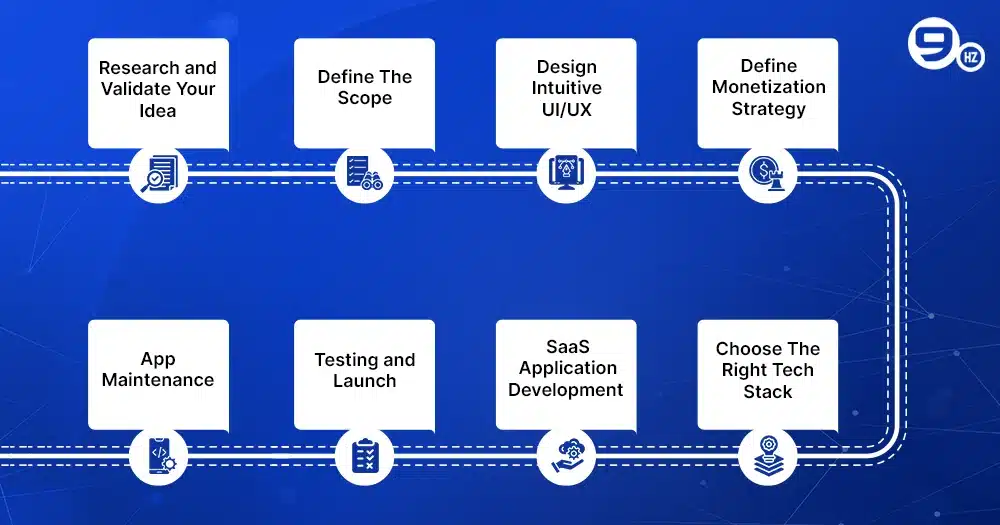
Here are the eight key steps for a successful SaaS app development. What you need to do is-
1. Research and Validate Your Idea
The advancements we are witnessing in this world result from research, and developing a SaaS application is not a luxury. Start with research to gain insights about your target market and customers, and then delve deeper into user personas to create a perfect development plan.
An idea doesn’t guarantee success until it is validated on real grounds, like whether it solves real-world problems or is just another hypothetical theory. So, research deeply and validate your idea first.
Pro-tip: Conduct surveys, fake door tests, create a landing page, gather users’ interest through a waitlist, and release a demo video. All will help in validating your idea.
2. Define The Scope
Defining project scope is one of the most crucial steps. It involves outlining and documenting all the things (such as feature prioritization, objectives, etc.) needed to develop a successful SaaS app.
Pro tip: The MoSCoW method is the best for defining the project scope. It is also used to categorize requirements as Must-have, Should-have, Could-have, and Will-Have.
3. Design Intuitive UI/UX
The sole objective of any app development is to create an unparalleled user experience. Thus, to enhance user experience, an intuitive user interface and responsive design should be designed. The UI/UX must be engaging to ensure that users can navigate to the features and access them simply.
Pro-tip: Prioritize mobile-first design implementation, as most users prefer to access the apps through mobile conveniently, anytime-anywhere.
4. Define Monetization Strategy
Defining a monetization strategy is also a crucial step for business success. Simply put, it refers to how you will earn through your SaaS app—whether through a freemium model, pay per use, pay per user, subscription, or hybrid monetization model.
When defining pricing or monetization strategy, don’t go too low. It will affect your revenue, and if the price is high, it might scare your potential customers.
Pro-tip: The best approach is to test pricing early and provide a tier-based plan, such as a starter, pro, or enterprise plan.
5. Choose The Right Tech Stack
The next step is to choose the right tech stack for robust SaaS cloud application development. This stack builds a solid foundation for the app’s architecture, sustainability, security, and scalability. You need to choose technology for the front end, back end, cloud infrastructure, and database.
Pro-tip: The best idea is to choose the latest tech stack to help you develop scalable and trendy SaaS apps. For better results, make a smart decision to consult and develop your app with the help of the best SaaS development company, which has a proven track record in delivering custom software solutions.
6. SaaS Application Development
This is the most crucial step: the SaaS developers you’ve hired will code your app. While developing the app, focus on your app’s and business objectives. The right idea is to develop an MVP with all essential features rather than launching a full version. Integrate all crucial APIs, payment gateways, and software (if required) to extend the app’s functionality.
Pro tip: Launch an MVP first, with the help of experienced SaaS application developers. Then, after receiving feedback and implementing necessary changes, you can improve user experiences.
7. Testing and Launch
Testing is more crucial than development because a bug can expose security vulnerabilities and compromise sensitive data. Test your SaaS application until you find and eliminate the last bug. Once you’ve done this, launch your app and make it public for your users.
Pro-tip: Before launch, test your app again for a security audit, perform load testing, and consider beta feedback.
8. App Maintenance
Regular maintenance and updates are crucial for maintaining a SaaS application. Businesses should monitor app performance, gather user feedback, and make necessary improvements. Ongoing maintenance ensures users access the latest features, making the overall experience more engaging and valuable.
Challenges of SaaS App Development

There are some specific challenges associated with SaaS application development. So, let’s have a look at what these are:
User Adoption
Although SaaS apps are in trend, user adoption is still low due to the existence of traditional solutions, resistance to change, and skepticism about the product’s value. As a solution, user education is a must.
Product Experience
It is necessary to keep the SaaS application easy to use and provide all user-preferred features. However, maintaining the balance can be tricky sometimes. The solution to this challenge is strategically improving core components in steps.
Security Concerns
SaaS apps hold users’ sensitive information; breaches can happen, especially if security settings and updates are ignored. The only solution is to apply robust security measures and encryption and comply with regulations.
Integration Complexity
Compatibility and inconsistent data formats can create challenges when integrating SaaS applications with legacy systems.If somehow forcefully integrated, it might worsen the user experience. Careful planning, the use of middleware solutions, and a consistent data standard are the only solutions.
Continuous Update
Regular updates for bug fixes, feature enhancements, and security improvements in SaaS applications can be a logistical challenge, causing disruptions or downtime for users.
Downtime Challenges
Downtime tampers with the trust, and keeping 100% uptime is impossible for any application, including SaaS apps. The perfect solution is a robust architecture and implementation of a failover mechanism.
Real Examples of SaaS Development
The graph of SaaS application development is exponentially rising, and some apps have already taken over the market, offering outstanding features. Here are some of the top real examples of SaaS applications.
| SaaS Product | What It Does | Founded | Revenue Model | USP |
|---|---|---|---|---|
| Dropbox | Cloud storage | 2008 | Freemium | Seamless file sync across devices |
| Netflix | Video streaming service | 2007 | Subscription | Personalized recommendations and original content |
| Slack | Team messaging & collaboration | 2013 | Freemium | Real-time chat with deep app integrations |
| Monday.com | Work operating system | 2014 | Subscription | Customizable workflows for any team or project |
| Trello | Task & project management | 2011 | Freemium | Visual Kanban boards for simple planning |
| Salesforce | SaaS CRM platform | 1999 | Subscription | Sales automation and lead management |
| Canva | Online design tool | 2013 | Freemium | Drag-and-drop design for non-designers |
| Shopify | Online store builder | 2006 | Subscription | Launch an e-commerce store without coding |
| Zoom | Video conferencing platform | 2011 | Freemium | Large-scale video and audio conferencing |
| Mailchimp | Email marketing platform | 2001 | Freemium | All-in-one marketing with automation & analytics |
Tech Stack Used in SaaS Development
Choosing a tech stack for SaaS cloud application development depends on the project’s specific needs, such as robustness, scalability, security, etc. Here is the generalized tech stack that a SaaS developer uses.
| Category | Technologies/Tools |
|---|---|
| Frontend |
Languages: HTML, CSS, JavaScript Frameworks: React.js, Angular.js, Vue.js Design Tools: Figma, Adobe XD etc. |
| Backend |
Languages: Node.js, Python, Ruby, Java, C# Frameworks: PHP, Laravel, Symphony, JavaScript |
| Server | Apache, Nginx, IIS |
| Cloud Computing Services | Microsoft Azure, AWS, Google Cloud |
| Database | MySQL, NoSQL, Redis, MongoDB, PostgreSQL |
| DevOps Tools | Kubernetes, Terraform, Docker, Ansible, etc. |
| Analytics Tools | Analytics tools provided by Google, AWS, and Azure |
Cost of SaaS Application Development
The average SaaS development cost varies between $40,000 and $150,000+, depending on several factors such as project requirements, complexity, features, tech stack, and the location of the SaaS development team..
In terms of complexity, suppose you want to develop a Micro SaaS application. It may cost you $10,000-$15,000. However, if you need an enterprise-grade application, it may cost you $150,000- $250,000+.
While estimating the cost, consider key components such as planning, market research, wireframing, UI/UX design, development, quality assurance, and maintenance. The cost will rise with advancements. For an exact cost estimation, it would be better to consult with a trusted Cloud Computing service provider like NineHertz.
How Ninehertz can help you with SaaS application development?
The NineHertz is a leading software development company and one of the top names if you are looking for state-of-the-art SaaS application development services. When providing the solution, we focus on three aspects: Scalability, Seamless Integration, and Enhanced Security. With years of experience in the industry, developing cost-effective SaaS solutions is our prime expertise.
Our skilled team of Cloud Computing experts and SaaS developers is experienced in using the latest tech stack to deliver quality solutions. Their expertise lies in delivering projects under clients’ timelines without compromising quality.
Serving diverse industries, we can provide you with a seamless SaaS application to solve your industry challenges and mission-critical problems and cover your business needs.
Conclusion
So, you’ve decided to develop a SaaS application for your business. Now, you are on the right track. By 2026, public cloud spending will exceed that of other enterprise solutions by 45%. That seems like a big picture about SaaS apps. While developing your SaaS app, a perfect plan and the right tech partner as a SaaS development company are enough to achieve the desired results.
Before you step forward, be prepared with your project’s requirements, scope of the project, and an answer to the question about what you want to solve with your SaaS app. The rest of the things, the NineHertz will make effortless for you. The businesses are rapidly moving forward with SaaS apps; the next turn will be yours. Thus, when are you planning?
Frequently Asked Questions
What is an example of SaaS development?
There are myriads of the best examples of SaaS development, such as Slack, Canva, Netflix, Salesforce, and others. All of these SaaS-based apps offer unique features and streamlined user experiences.
How long does it take to develop a SaaS application?
The time it takes to build a SaaS application depends on its complexity, the number of features, and integrations such as payments, analytics, APIs, among others. For example, developing a SaaS MVP takes 3-4 months, compared to developing SaaS-based enterprise solutions(12+ months).
Is SaaS development expensive?
There is no standard answer because requirements and complexity play crucial roles in estimating the cost. Basic solutions require less cost, but highly complex SaaS apps are really expensive as multiple technical resources are required to implement the advanced features.
Can I migrate my existing app to SaaS?
Yes, of course! The NineHertz, a top SaaS development company, is ready to assist you with all your requirements, from consultation to migrating your existing app to a SaaS platform. You can share your requirements with us anytime, and we’ll get back to you with a detailed plan.
