


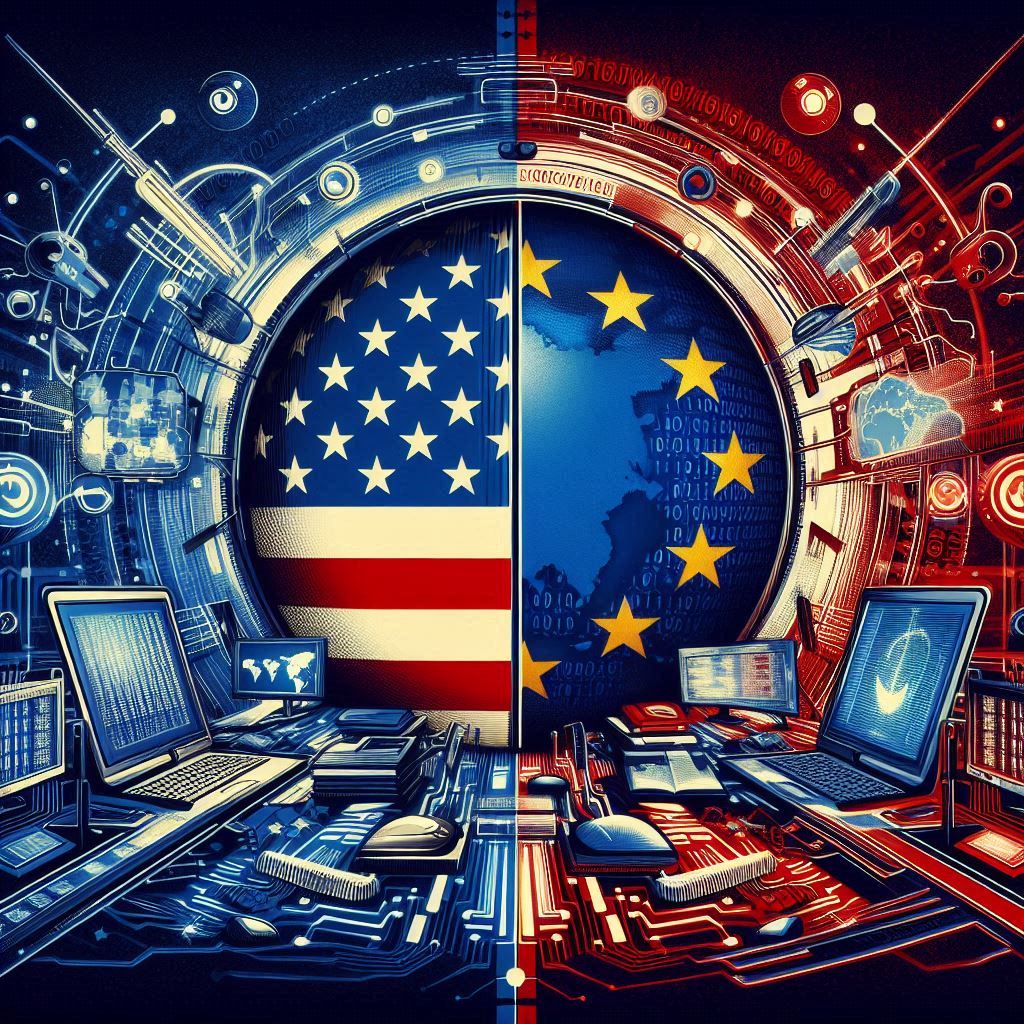
Last month, the Federal Trade Commission (FTC) did something shocking.
It warned America’s biggest tech companies not to comply with new European regulations.
This warning was limited to cases where European rules clashed with America’s protections for free speech or data privacy. But it was still highly unusual.

Why would the U.S. government tell its own companies not to follow foreign law?
Because this isn’t just about regulation.
I believe it’s a sign that we’re entering a new kind of Cold War.
But instead of being about nuclear weapons or political ideology, this new Cold War will be about online speech and who gets to set the rules for the next generation of the internet.
And Europe and the U.S. are already on opposite sides.
Innovation vs. Stagnation
To understand what’s happening, you need to know about the Digital Services Act (DSA).
The DSA is a law passed by the European Union (EU) in 2022. It was designed to clean up the online world by forcing “Very Large Online Platforms” like Facebook, YouTube and X to police illegal content.
The goal was to make these companies more transparent about their algorithms and to reduce harmful content like misinformation.
And on paper, this sounds reasonable. After all, who doesn’t want safer online platforms?
But there’s a catch…
The DSA gives European regulators the power to decide what counts as “harmful” or “illegal.”
And it doesn’t just apply to European companies. It also applies to any U.S. company operating in Europe.

That’s why the FTC stepped in.
FTC Chair Andrew Ferguson warned U.S. companies that if they weaken encryption, censor speech or alter their data practices to fit European rules, they could face penalties here at home.
But I believe this warning was more for Brussels’ sake than Big Tech’s.
It was a clear message to Europe that they won’t be allowed to write the rules for America’s internet.
Because what’s at stake here goes well beyond corporate compliance.
You see, the U.S. has long taken a lighter regulatory touch with Big Tech. And this hands-off approach has fueled enormous innovation.
It’s why most of the world’s leading platforms — Google (Nasdaq: GOOGL), Meta (Nasdaq: META), Apple (Nasdaq: AAPL), Amazon (Nasdaq: AMZN) and Microsoft (Nasdaq: MSFT) — are American.
Europe, on the other hand, has focused more on regulation than innovation. The DSA is just the latest example, following earlier rules like the General Data Protection Regulation (GDPR), which put strict limits on how companies could collect and use personal data.
Because of this, Washington sees the DSA not as a simple regulatory rulebook, but as a weapon in a much larger economic conflict.
The battle comes down to two very different philosophies.
The U.S. sees technology as a force for growth and freedom. Which means the FTC’s warning was less about protecting profits and more about protecting the open internet and the innovation it enables.
But Europe sees technology as something that must be contained, tightly managed and constantly supervised.
While that might reduce certain risks, it also risks strangling innovation before it begins.
That’s why the U.S. isn’t willing to let European regulators set the global standard.
Because history suggests that America’s approach works better. From the personal computer revolution to the rise of smartphones and now artificial intelligence, U.S. companies have consistently set the pace for the rest of the world.
Europe has produced very few global tech champions in the last two decades. And overregulation is a big reason why.
Now this overregulation has crossed over into trade.
President Trump has threatened tariffs and trade penalties against countries that impose digital taxes or discriminatory rules targeting U.S. tech giants. In fact, he’s doubled down by vowing to retaliate further if Europe continues to squeeze American companies.

Which puts us on the brink of a digital Cold War with Europe that could reshape global markets.
And for the companies themselves, this is a nightmare scenario.
Apple has already been fined €500 million under Europe’s Digital Markets Act. Meta was hit with a €200 million penalty and still faces scrutiny over its “pay or consent” ad model. Amazon is bracing for a probe into whether it favors its own brands on its marketplace. And Google just got slammed with a record €2.95 billion fine for abusing its ad-tech dominance.
The FTC’s warning shows that the U.S. views these fines as an attack on its most valuable industry.
Here’s My Take
The truth is, U.S. companies are being forced into an impossible position.
They can either comply with Europe and risk big penalties here, or defy Europe and face massive fines over there.
And what looks like a lose-lose situation for Big Tech could soon become a losing battle for consumers too.
Because unlike past trade wars over steel or agriculture, this one involves digital platforms that billions of people use every single day.
Meaning, this Cold War could change how all of us experience the internet.
Personally, I believe U.S. companies should stand firm.
Europe’s heavy-handed regulations might look good on paper, but they risk killing the kind of innovation that drives progress.
That’s why I believe the FTC is right to push back, and why Washington is right to treat this as more than a legal dispute.
It’s a battle over the future of the internet.
And innovation wins if America wins.
Regards,

Ian King
Chief Strategist, Banyan Hill Publishing
Editor’s Note: We’d love to hear from you!
If you want to share your thoughts or suggestions about the Daily Disruptor, or if there are any specific topics you’d like us to cover, just send an email to dailydisruptor@banyanhill.com.
Don’t worry, we won’t reveal your full name in the event we publish a response. So feel free to comment away!
