



Developing software can solve real problems—this is true! Dropbox developed an MVP as a 90-second demo video that converted more than 70,000+ waitlists overnight. This approach helped Dropbox secure early VC funding, and in 2024, the company generated over $2.5 billion.
We live in a world where there is an overflow of apps and digital tools, from personal to professional purposes, you will find software with integrated features. But what is the key factor that makes developed software stand out? It’s the ability to solve the real problem. Slack is solving communication problems, Grammarly for solving writing errors, Mint is fixing personal finance issues, and Uber for transport problems.
Can you observe the pattern? Every software is solving a real problem, so whether you are a developer, a startup owner, or a product team researching how to create software, it’s time to shift to a problem-solving approach. Leveraging the right software development services can help you bridge the gap between a raw idea and a market-ready solution.
Here is the essential guide blog. We will outline the practical steps of developing software to turn simple ideas into functional solutions.
What is Software Development?

It is a comprehensive process that involves designing, developing, deploying, testing, and maintaining software. Building scalable, secure, and reliable software that solves real business problems requires different stages, standards, and techniques. With a specific goal in mind, developers and software engineers can code specialised software to meet enterprise and user requirements.
Generative AI and Artificial Intelligence-powered tools support the software development team in testing code. In the modern era, enterprises are following the agile methodology and the DevOps model with a set of protocols, practices, and technologies to deliver feature-rich and quality software.
Advanced software development follows more steps than mastering programming languages; it requires assessing algorithms, design patterns, and data structures to write the best code aligned with the right frameworks for the problem to be solved.
Types of Software
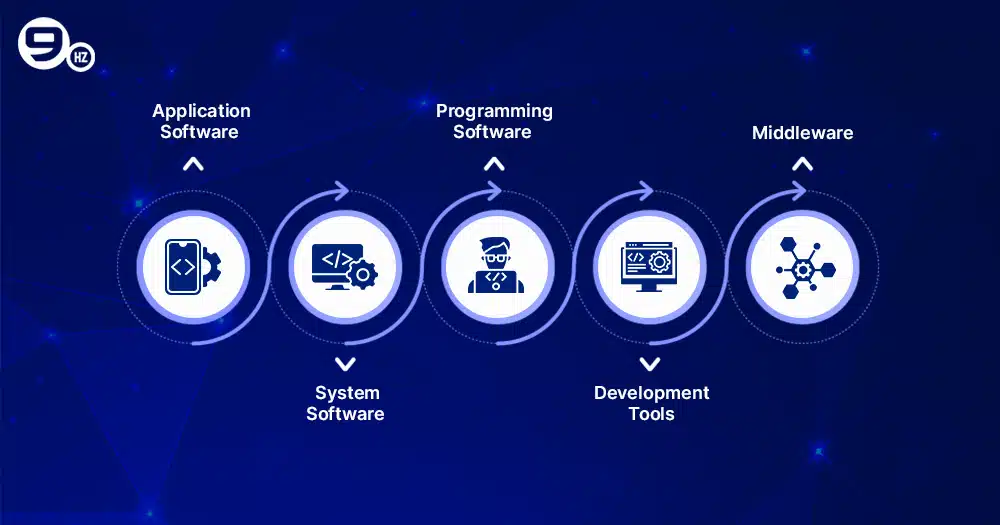
Whether you are a software developer, front-end or back-end developer, explore categories of frameworks, software development tools, and programming languages to develop the best-fit product. Here is the list of software usually used in software for creation, deployment, application, and system maintenance:
Application Software
These are specifically designed for direct end-user interactions. It is written using high-level programming languages like Python, C#, JAVA for system software to function. Unlike system software, this operates in the background to manage the business.
Examples: Business applications as SAP, Salesforce, and word processors like MS Word.
System Software
These are a core set of programs that create a platform and manage hardware that support the running of other software. They are usually pre-installed on devices, including Linux, MacOS, or Windows, and facilitate the smooth operation of all other software.
Examples: Operating Systems, Device Drivers like printers and graphics cards.
Programming Software
These software help developers find the right tools to test, write, and debug code. It comprises text editors, compilers, debuggers, and interpreters that are used to build other types of software.
Examples: Sublime Text, GCC, Ruby, Python, and Eclipse are examples of programming software.
Development Tools
These software tools support the overall development lifecycle, enabling easy collaboration among teams and developers. They comprise version control systems, project management tools, CI/CD tools, and testing frameworks to ensure code is well written, tested, and deployed.
Examples: GitHub, GitLab, Trello, Jira, Jenkins, Selenium, and JUnit.
Middleware
It acts as the bridge between system, database, or application software to enable communication and data management. It is one of the essential parts of modern software architecture, designed for enterprise systems or microservices to connect multiple components.
Examples: API gateways, Application servers like JBoss or WebLogic and message brokers like Apache Kafka.
Process to Develop Software
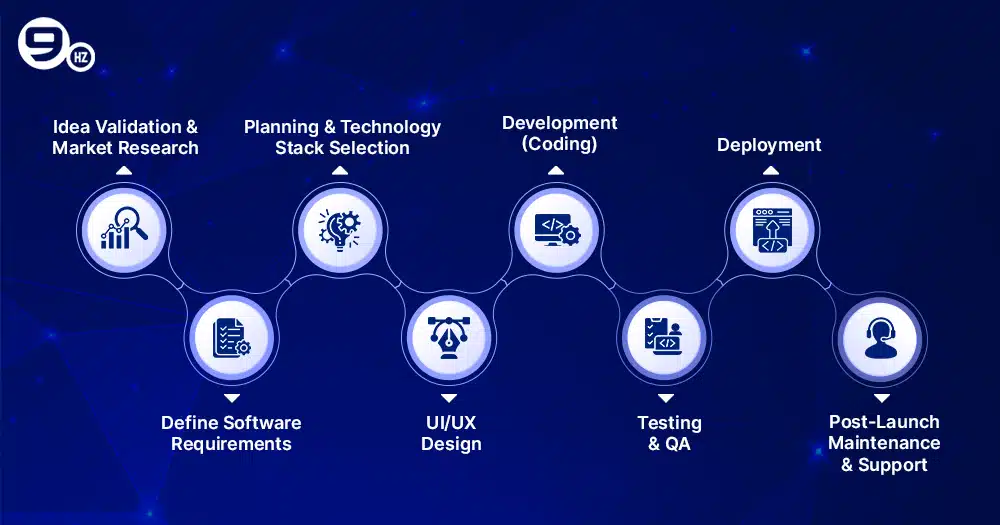
To answer the question “how to develop software,” it is essential to assess the exact software development process. This is not just a technical process but an iterative logical process that aims to develop with the right business goals, processes, and objectives.
Following the right and systematic process for developing software will account for performance testing, detect issues, timely modification, and ease deployments. This is where partnering with a specialized software development outsourcing company can significantly streamline the entire lifecycle. Leveraging their expertise can provide access to a global talent pool, advanced methodologies, and cost efficiencies that might be difficult to achieve in-house. They often bring a wealth of experience across diverse projects, ensuring that the development aligns perfectly with your strategic vision.
Here is the step-by-step process for software development:
Step 1: Idea Validation & Market Research
The first step of software development is to research ideas and conduct a market analysis to understand the project’s goals and requirements. The analysis specifies what the user needs, features integration, functionalities, and before- or after-deployment challenges.
Before deploying Airbnb software, founders conducted interviews with travellers and hosts to address their frustrations to use insights for the platform’s core requirements.
Step 2: Define Software Requirements
Next, to understand how to create software, it is required to study the users’ functional and non-functional requirements. This will act as a blueprint for the developing team to design and initiate the development process. It outlines functionalities and defines software constraints to support its operations.
Like for Google Classroom, they specified functional requirements to integrate features such as tracking grades, uploading assignments, notifications, and integration with Google Drive.
Step 3: Planning & Technology Stack Selection
Here comes the step for brainstorming and planning for software development to discuss project scope, resources, timelines and potential risks. It helps to create a task list, complete cost estimations, types of software and specify roles and responsibilities. Also, selecting the right set of tech, frameworks, and APIs to ease the development process.
Before launching WhatsApp Business, the team planned for its distinct features, like labels and automated replies, to understand how it could scale securely across different regions.
Step 4: UI/UX Design
How your software looks plays a major role in driving more engagement for end users. It creates a collaborative methodology for the designing and engineering team for system design, software architecture design, and UI/UX design to select the right fonts, colours and layout.
For instance, Notion has followed a minimalist UI design with a simple drag-and-drop pattern that allows users to customise. This helps users and the team create more flexibility and clean navigation.
Step 5: Development (Coding)
After finalising the design, developers move to writing the code. The team uses different technologies and programming languages to deploy the best software solution. Developers program the code based on design specifications, converting product-based documents into functional software components.
For example, Robinhood is a trading app focused on developing backend infrastructure for supporting real-time stock trading, optimised for both iOS and Android.
Step 6: Testing & QA
One crucial stage of software development after writing code is identifying bugs or issues, ensuring that functionalities are met while meeting the standard quality. For the success of software deployments, you can check for different options, including performance, functional, integration, or system testing.
For example, Netflix has been using A/B testing before rolling out new components or features to check their usability for end-users in real-world scenarios.
Step 7: Deployment
After the developed software passes through the testing phase and delivers positive results, it is time to release it for users. Based on requirements, multiple deployment approaches are available, including canary, shadow, or green deployment.
For example, Clubhouse was initially launched for the iOS audience with an invite-only model, and they gathered feedback before the full-scale release.
Step 8: Post-Launch Maintenance & Support
Here, the team will monitor progress, support, resolve issues, and track performance improvement with different feature updates. Regular maintenance helps the team check for security controls and respond promptly to fix bugs.
For example, Microsoft Teams regularly releases updates based on user feedback and market expectations, which helps add features like virtual backgrounds, breakout rooms, and others.
Common Mistakes to Avoid for Developing a Software
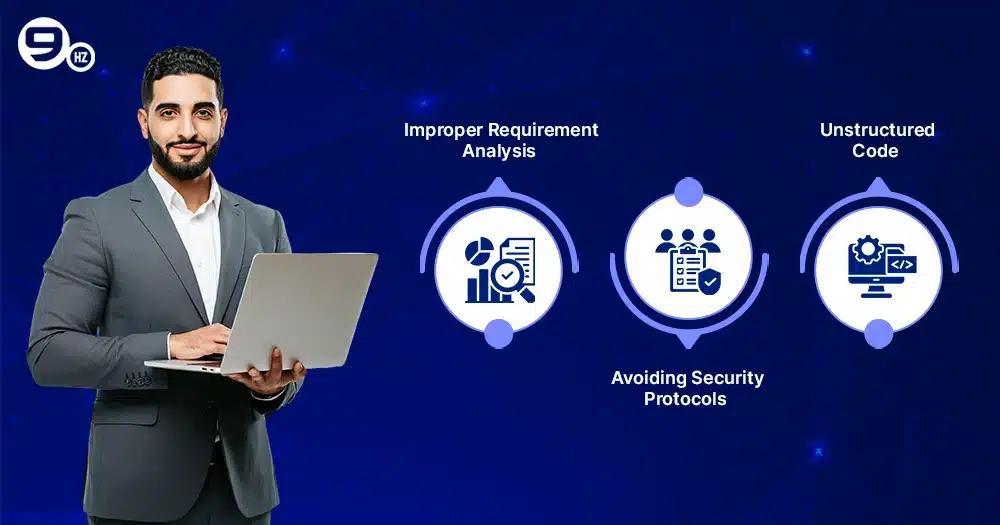
Software development is a complex process that requires careful planning, maintenance and execution, still, this is subject to mistakes. However, addressing these mistakes before or during the development lifecycle will help to prevent costly fixes and improve security for the software. Here are the common mistakes in developing software and solutions to avoid them:
Improper Requirement Analysis
One common mistake is to begin the project without any standard requirements and rules. This can result in misalignment with business goals, costly reviews and updates, and wasted time and resources. So, even if you deploy the best software but fail to comply with requirements, this will be a failure.
Solutions: Follow throughout the project success, connect with stakeholders, and use structured requirements and documents to validate for development with business goals.
Avoiding Security Protocols
Security should be at the core of software development, yet the team fails to integrate security throughout the process. Ignoring these security patches can increase the risk for SQL injections, weak authentication, insecure API endpoints, and Cross-site scripting (XSS).
Solutions: Regularly conducting assessment checks like DAST (Dynamic Application Security Testing) or SAST (Static Application Security Testing) and educating developers with security guidelines and audits can significantly reduce the risk.
Unstructured Code
Coding can either make or break your product in software development, so unstructured code can be a major mistake. It comprises poor formatting, not following coding standards, excessive code complexity, and a lack of documentation of code, API, and architecture.
Solutions: Use the right coding styles and formatting, best code practices, and system design. Written code with clear comments helps explain complex logic and APIs. Developers can also refactor code regularly for team collaboration.
Cost and Time Estimation for Software Development
In the process of getting into ‘how to make software’, companies often look for the right estimation for software development. Based on short or long-term needs, functional requirements, technology used, and project risk, the software development cost and timeline can vary significantly. Understanding these factors is essential for arriving at an accurate estimation.
Here is the table for representing the cost and time estimation for software development:
| Software Type | Complexity Level | Estimated Time | Estimated Cost (USD) | Typical Features |
|---|---|---|---|---|
| Simple Web App | Basic | 1 – 2 months | $5,000 – $15,000 | Static pages, contact forms, basic CMS, mobile-friendly design |
| E-commerce Platform | Medium | 3 – 6 months | $20,000 – $80,000 | Product catalog, cart, payment gateway, user accounts, admin dashboard |
| Mobile App (MVP) | Basic – Medium | 2 – 4 months | $15,000 – $40,000 | Login, dashboard, push notifications, limited features |
| Custom CRM Software | Medium – High | 4 – 8 months | $30,000 – $100,000+ | Contact management, sales tracking, analytics, integrations |
| Enterprise SaaS Product | High | 6 – 12 months | $100,000 – $500,000+ | Multi-tenancy, role-based access, complex workflows, API integrations |
| Marketplace (e.g., Airbnb) | High | 6 – 10 months | $80,000 – $300,000+ | Listings, messaging, bookings, payment, reviews, dispute resolution |
| Social Media App | High | 6 – 9 months | $60,000 – $250,000+ | Feed, likes/comments, media upload, chat, notifications |
| AI-Powered Tool | Medium – High | 4 – 10 months | $50,000 – $300,000+ | Machine learning models, data processing, and real-time predictions |
| Healthcare Software (HIPAA Compliant) | High | 6 – 12 months | $150,000 – $500,000+ | Patient records, secure messaging, integrations with health devices, and compliance |
| Edtech Platform (e.g., LMS) | Medium – High | 5 – 9 months | $50,000 – $200,000 | Course management, quizzes, live sessions, progress tracking |
Case Studies & Real-Life Examples
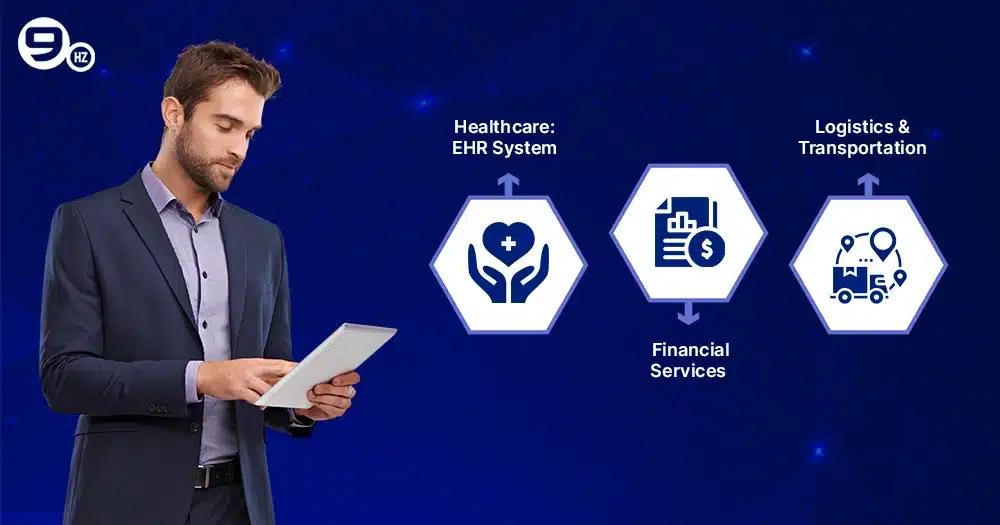
Here are real-world examples of software development and how companies follow the best approach to testing features, functions, size, and scope of development.
Healthcare: EHR System
In the healthcare industry, you will find multiple software types related to the Electronic Health Records System that create a digital process of patient records, efficient data management, and effective patient care, developing a telemedicine platform that increases accessibility for healthcare services through video consultations and secure messaging. Custom medical billing software helps to automate the claim process, reduce administration overhead and ensure timely payments.
Financial Services
The financial industry uses software solutions for online banking, transaction processes, UPIs, mobile banking, and other financial transactions. These solutions help users conveniently access their accounts online and secure financial transactions. Most investment firms and wealth management companies use portfolio management tools to assess risk related to financial markets and data-driven investment strategies.
Logistics and Transportation
This sector has dynamic requirements that follow different software requirements, including maintenance scheduling, vehicle tracking, and route optimisation. You will also find delivery tracking apps to provide customers with real-time updates, delivery ETAs, and convenient delivery options.
Here, we are enlisting case studies related to software development and how big companies are deploying the best usability model to solve real problems.
Tesla: Over-the-Air Software Updates (Industry: Automotive)
Problem: Tesla was looking for a mechanism for its existing system that could scale performance, integrate quality features, and fix bugs without requiring dealership visits.
Solution: The Tesla software development team has integrated an in-built OTA update for the system through secure protocols and modular architecture. This update helps the company to achieve battery optimisation, UI enhancements, and self-driving capabilities.
Spotify: Music and Streaming
Problem: Spotify was facing the challenge of integrating feature updates across desktop, Android, and iOS devices to maintain its reliability and quality.
Solution: Brands follow agile methodologies to help cross-functional teams support features while implementing automated testing and CI or CD pipelines. As a result, Spotify ships production code beyond 100 times without disrupting user experiences.
Netflix: Microservice and Cloud Migration
Problem: In 2008, Netflix witnessed the biggest downtime due to the limitation of its data centre. As the global demand rises, it requires a demand for scalable and resilient infrastructure.
Solution: Netflix decided to migrate its backend to AWS and re-architect the system through microservices. This helps companies stream billions of hours of content across the globe with minimal downtime.
Why choose Ninehertz to develop your Software?
Choosing NineHertz to develop your software means partnering with a team that brings deep industry expertise, innovative thinking, and a commitment to quality. We specialize in delivering enterprise software development services tailored to meet complex business needs—whether it’s automating workflows, improving operational efficiency, or building scalable digital products. With a client-first approach, proven development methodologies, and a track record of successful implementations across industries, NineHertz ensures your software not only meets technical requirements but also drives real business value.
Conclusion
Developing software is a structured yet creative process that involves understanding user needs, selecting the right technology stack, and following a well-defined development lifecycle. From planning and designing to coding, testing, and deployment, each phase plays a critical role in building a successful product. Whether you’re developing software in-house or partnering with a software development company, staying focused on functionality, scalability, and user experience is key. With the right strategy and team, you can turn your software idea into a powerful, user-friendly solution that meets business goals and market demands.
Frequently Asked Questions
How long does it take to develop software?
It will depend on software development projects, and this might range between 2 or 3 weeks for the basic project, while taking beyond 6 months for deploying advanced-version software.
What language should I learn first?
You should learn few common programming languages, such as Python and JavaScript, for web development and Kotlin or Swift for mobile development.
Should I outsource or build in-house?
For long-term project requirements, you can consider building an in-house software development team; otherwise, you prefer outsourcing for short-term projects.
Can I develop software without coding?
Yes, you can choose from no-code and low-code platforms for software development with quality features, drag-and-drop interfaces, and automation workflows.
