

Close Menu
journearn.comjournearn.com
  • Home
  • Apps
  • Business
  • Make Money Online
  • Money Saving
  • Finance
  • Food
  • Investment
  • Travel
Facebook X (Twitter) Instagram
journearn.comjournearn.com
Facebook Instagram Pinterest Vimeo
  • Home
  • Apps

    How AI Is Redefining Supply Chain Resilience in 2026

    August 17, 2026

    How to Sell Mobile Apps: 3 Ways to Make Money in 2026

    August 11, 2026

    IP Ownership Architecture for India ODC Engagements

    July 24, 2026

    Engineering Capability Guide for ISVs

    July 22, 2026

    How AI Solves Supply Chain Risk Monitoring? 8 Use Cases in 2026

    July 20, 2026
  • Business

    Admissions Teams Are Breaking —and Colleges Are Feeling It

    August 19, 2026

    How It Works and Tips to Improve It

    August 18, 2026

    I Found 6 Best Customer Service Automation Tools That Deflect Tickets

    August 17, 2026

    6 AI Customer Support Agents Software I’d Consider in 2026

    August 16, 2026

    7 Essential Tips for Preparing Your Performance Review

    August 15, 2026
  • Make Money Online

    This sofa side hustle could pay £250+ just for sharing your experiences

    August 19, 2026

    Boost Your Personal Income by Reducing the Cost of Car Ownership in 5 Steps

    August 18, 2026

    Why Most Workers Identify As Workaholics, Despite Knowing the Health Risks of Extra Hours

    August 17, 2026

    The £500-a-month side hustle hiding in the time you’d normally spend scrolling

    August 16, 2026

    Tips for Using Numbers to Improve Your Strategy

    August 15, 2026
  • Money Saving

    What to do if you can’t get Buy Now Pay Later any more

    August 18, 2026

    3 Social Security Changes Senators Are Debating — And Which Could Happen First

    August 17, 2026

    Does Wealthsimple want to add sports, politics to its new prediction markets product?

    August 16, 2026

    What Type of Cash Back Card is Best for Everyday Spending?

    August 15, 2026

    How to write a CV that gets you hired faster

    August 14, 2026
  • Finance

    What Indian Founders Learn About Money Management Too Late

    August 17, 2026

    Why Venture Capital Funds Must Get Bigger To Compete

    August 16, 2026

    Webull Is Giving Away 12 Free Fractional Shares

    August 14, 2026

    In this Canadian city, rent gobbles up 95% of a full-time, minimum-wage earner's working hours

    August 13, 2026

    Affordable Ways to Create a Lasting Memorial After Losing a Loved One

    August 11, 2026
  • Food

    Biscoff White Chocolate Oatmeal Cookies

    August 19, 2026

    Beef Rice Noodles – RecipeTin Eats

    August 18, 2026

    These Surreal Dinner Parties in Nature Aren’t AI

    August 16, 2026

    Almond Flour Blueberry Muffins (Gluten-Free)

    August 15, 2026

    Zucchini Lasagna (Noodle-Less & High Protein)

    August 14, 2026
  • Investment

    7 Habits To Succeed at Trading

    August 18, 2026

    Why Bitcoin’s Summer Range Breakout Depends on Three Signals

    August 17, 2026

    This is the type of police NYC is hiring?

    August 16, 2026

    How to Rent Out Your House (Step-by-Step Guide)

    August 15, 2026

    The Risks of Cognitive Delegation in AI

    August 14, 2026
  • Travel

    Digital Nomad Visas Explained for South Africans

    August 19, 2026

    Booking the London Eye Afternoon Tea: What It’s Actually Like – Hand Luggage Only

    August 16, 2026

    Waking Up to the Faraglioni: Capri’s View That Never Gets Old

    August 16, 2026

    Coolcation Destinations – 8 places to Vacation and Stay Cool

    August 14, 2026

    How to Handle Medical Needs When You’re Traveling Abroad With Kids

    August 12, 2026
journearn.comjournearn.com
Home»Finance»How much should you contribute to your 401(k)?
Finance

How much should you contribute to your 401(k)?

info@journearn.comBy info@journearn.comOctober 19, 2025No Comments6 Mins Read
Facebook Twitter Pinterest LinkedIn Tumblr WhatsApp Telegram Email
How much should you contribute to your 401(k)?
Share
Facebook Twitter LinkedIn Pinterest Email


Ten percent? Twenty percent? More?

I’ve written a lot about the benefits of both 401(k)s and IRAs. We’ve also looked at the emerging Roth 401(k) option and when it makes sense for young investors.

But everybody’s next question is: “Okay, okay, but how much should I put into my 401(k)?”

One of the most popular posts in this blog’s ten-year archives is “How Much Should Be In Your 401(k) At 30?”

I was 25 when I wrote it, trying to decide how much to contribute to my own 401(k).

But what I learned from over 200 (sometimes nasty) comments is that setting a savings benchmark by age alone is silly; no two savers are the same. You can’t compare the engineer who graduated at 22 into a $65,000-a-year job with no student loan debt to a doctor who starts practicing at 29 and has $200,000 in loans. Or the social worker earning $35,000 a year and needing all of it just to eat.

You can use this basic 401(k) calculator to estimate how much you will save on your 401(k) based on your personal status:


401(K) savings summary


in retirement at your current savings rate


to maintain a similar income in retirement


The total amount of fees you will pay over time until your retriement. If you see 0, please re-calculate


Tip: You can optimize your 401(k) to reduce fees with blooom Learn more


Assumes 6% annual rate of return on your 401(k) investment.
401(k) fee of 0.05%.
Retirement age of 67 and life expectancy of 95.


Today I want to provide slightly more tactical advice. As a percentage of your income, how much should you contribute to your 401(k)?

  • If you’re in debt?
  • If you can also do a Roth IRA?
  • If your employer does not match funds?

The two fundamental rules of retirement savings

Here are two rules that will apply to almost everyone:

  1. If your employer matches 401(k) funds, contribute enough to get the full match. Do this first. Even if you’re in debt. Even if you don’t put in a penny more. It’s free money, and you should take it.
  2. Next, if you can contribute to a Roth IRA, work on contributing the full annual limit a year to that account before you contribute any extra to your 401(k) (aside from what’s necessary to get the employer match). This will give you a nice cushion of tax-free cash in retirement.

Figure out the ratio you’re the most comfortable with—but keep upping your savings

There are lots of ratios out there recommending how to divide up your income. Some are as simple as spend 50%, save 50%. Although an admirable goal, most people will have a hard time with this. Especially in your twenties. I like 75/20/5.

  • Spend 75%
  • Save 20%
  • Give 5%

But figure out the ratio you’re comfortable with. You may want to defer charitable giving until you’re debt-free. If you need most of your income to eat, it might be spend 90, save 10 or even 95/5. That’s okay. But you should reevaluate this as your financial situation changes and aim to get to at least 80/20.

In this example (75/20/5), if you earn $40,000, you would spend $30,000 or $2,500 a month, save $8,000 a year, or $667 a month, and—if you want—set aside $2,000 a year for your chosen causes. Note that we’re working off of before-tax income, so that $2,500 a month for spending might be more like $2,000 after taxes).

Working backwards from this, let’s say your employer will match up to half of a 6% contribution to your 401(k). So 6% of your pre-tax income is $3,000. Your employer throws in $1,500. You put that in, and you have $3,500 left in your savings budget.

If you don’t have a fully funded emergency fund, this comes next. Open a simple online savings account—they’re boring, but safe—and load it with cash.

If you have plenty for a rainy day, then you return to your retirement options. If you qualify for a Roth IRA, that’s probably where the $3,500 should go. If you don’t qualify or have more than that max left to spend, return to your 401(k) and up your contributions.

The four levels of retirement savings

The lesson is: Figure out what percentage of your income you can save in total, and allocate it appropriately:

Level 1: Max out your employer match in your 401(k). (Free money!)

Level 2: Max out your emergency savings (about six months’ living expenses).

Level 3: Max out your Roth IRA (up to the annual cap).

Level 4: Max out your 401(k) (up to a total limit for employee contributions).

This flowchart will also help.
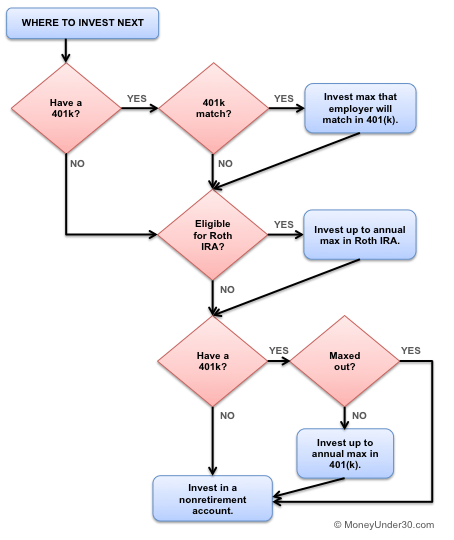
How much should you contribute to your 401(k)?How much should you contribute to your 401(k)?

If you’re in debt, focus on high-interest balances while you save

If your employer matches 401(k) contributions, put in enough to get that match, even if you’re in debt.

Next, if you’re in credit card debt, stop. Put your extra money towards paying that off before making additional retirement contributions. Focus first on getting out of credit card debt and then come back.

Got student loans? Follow the above schedule anyway. Unless your private loans have double-digit interest rates, I don’t recommend repaying student loans early.

It never hurts to save more

Twenty percent is a great goal, but some retirement experts actually suggest saving more like 25% or even 30. Why?

You know that saying, “Past returns are no guarantee of future performance”? That’s why. It’s true that the annual average return of the S&P 500 between 1928 and 2014 was 10%, for example. But that doesn’t mean anything for future returns.

We have no way of knowing what future returns will be—they could be 8%, they could be 4%. But the only way to hedge against an uncertain future is to save more money. The more you have, the less you need jaw-dropping returns to meet your goals.

Get help with your 401(k)

Already have a 401(k)? While you’re researching contributions, take a minute to analyze your current holdings too—there could be big savings to be found.

Check out Empower for a free app that creates easy-to-understand visuals of the investments you own in your 401(k), IRA, and other investment accounts. There’s also Wealthfront for a great all-in-one financial app that allows account holders to take control over their finances, automate saving and investing, and manage their accounts all in one place.

Summary

Everyone’s financial situation is different, and thus everyone’s retirement contributions will also be different. The key is to find a ratio you’re comfortable with, but that also encourages you to save a little extra than you might otherwise. We suggest aiming for a ratio of 80/20 to start with, and upping as you can.


Source link

Share. Facebook Twitter Pinterest LinkedIn Tumblr Email
info
info@journearn.com
  • Website

Related Posts

What Indian Founders Learn About Money Management Too Late

August 17, 2026

Why Venture Capital Funds Must Get Bigger To Compete

August 16, 2026

Webull Is Giving Away 12 Free Fractional Shares

August 14, 2026

In this Canadian city, rent gobbles up 95% of a full-time, minimum-wage earner's working hours

August 13, 2026

Affordable Ways to Create a Lasting Memorial After Losing a Loved One

August 11, 2026

The Rise Of The Stay At Home Man (Boyfriend Or Husband)

August 10, 2026
Add A Comment
Leave A Reply Cancel Reply

  • Facebook
  • Twitter
  • Instagram
  • Pinterest
Don't Miss

Digital Nomad Visas Explained for South Africans

Biscoff White Chocolate Oatmeal Cookies

This sofa side hustle could pay £250+ just for sharing your experiences

Admissions Teams Are Breaking —and Colleges Are Feeling It

About Us

Welcome to Journearn.com – your trusted guide on the journey to earning smarter, saving better, and building a more financially secure future. At Journearn, we believe that financial knowledge should be accessible to everyone.

Quicklinks
  • Business
  • Food
  • Make Money Online
  • Money Saving
  • Travel
Useful Links
  • About Us
  • Contact Us
  • Disclaimer
  • Privacy Policy
  • Terms and Conditions
Popular Posts

Digital Nomad Visas Explained for South Africans

August 19, 2026

Biscoff White Chocolate Oatmeal Cookies

August 19, 2026
© 2026 Designed by journearn.All Right Reserved

Type above and press Enter to search. Press Esc to cancel.