



Large organisations rely on enterprise software on multiple scales to run their business for developing an intelligence system, inventory management, ERPs, marketing, or payment gateways. It is easy to run their daily operations, critical business processes, and unified solutions with enterprise software implementation.
For any business, whether it’s CRM or project management enterprise software, the decision to choose the right software can be complex. However, what’s even more difficult is to understand its successful implementation that extracts the long-term value for business. Given all the different choices by the custom software development company, it is critical to find the ideal one that fits with specific business needs.
In the blog, we will cover crucial steps for enterprise software implementation to evaluate whether it’s the best fit for your existing business process.
Introduction to Enterprise Software Implementation
Unlike traditional applications, enterprise software fulfills all sorts of business requirements and optimizes workflows for better collaboration. Following these implementations, companies can eliminate the data silos issues within departments, improve process efficiencies, reduce IT expenses, and gain faster access to real-time data. So, whether you aim for marketing automation and managing projects, connecting with the right enterprise software will optimise for process.
We can take the example of a large retail company, which is planning to implement an enterprise-level ERP software with integrated financial reporting, supply chain tracking, and inventory management into a single system. So, after enterprise software implementation, it adds an advantage for cost as well as resource benefits for unified operations, tracking for deliverables, automated reporting, and effective communication channels.
What is Enterprise Software Implementation?
Enterprise software implementation is the process of combining the technologies, processes, networks, and infrastructure for integrating software into the existing system. It implies the deployment of software to streamline the core business operations and automate regular functions to interconnect departments.
These implementations do not rely only on technical processes for installing software, but focus on customisation, APIs, data migration, user training, and change management to align software based on the business goals. Apart from the technical steps, it includes the following add-on stages for long-run operations:
- Integration: Business check for integration with existing systems, tools, and diverse databases.
- Customised Features: It helps to fit into business workflows and modify features to enhance usability and function.
- Data Migration: This ensures easy data transfer from the existing to the new system without any data loss or cyberattack issues.
- User Training Modules: They assist employees in a faster adoption and consider innovation for growth.
Why Successful Implementation Matters for Businesses?
Before finalising the enterprise software, businesses opt for a series of selection processes, including choosing a vendor, estimating for budget, installing applications, data migration, testing for its features, and user training modules. Following the right enterprise software implementation allows companies to align processes and overcome the common challenges of cost overruns, compatibility, data loss, and adopt the best practices.
- It helps to assess for real-time data for informed decision-making
- Significantly reduce IT costs to optimise for redundant tools
- Remove data silos and improve information sharing
- It improves productivity and operational efficiency
- It can scale processes with alignment to business growth
So, here’s explaining each stage of software implementation in detail to ensure that it follows the right planning and execution.
Stage 1: Requirement Analysis & Planning

Implementing enterprise software requires a critical assessment to execute with alignment to business goals. In order to begin with, businesses need to define the scope and develop a roadmap for successfully implementing the software. Several times, implementation fails not due to technical defaults rather improper planning that lacks clarity for how the business will adopt software to fulfill the requirements.
Understanding Business Needs
Before the software deployment, the organisation should evaluate the requirements and find gaps to integrate enterprise software. Different business processes have varied needs depending on size and scale, which might include increasing productivity, better collaboration, secure data sync, automation, or customisation.
Like the manufacturing sector focuses more on production planning, the retail sector into supply chain management and the finance sector for security and compliance measures.
Defining Goals and Objectives
Establishing your implementation goals will help you map each step and specify like 70% increase in productivity within 6 months. It creates a benchmark to analyse for plans and distribute tasks following the roadmap without any risks upfront and misalignment among the team. These specific objectives help the development company to design a compatible software based on workflow and secure protocols.
Creating a Detailed Implementation Plan
Having a detailed implementation plan signifies developing a blueprint for pre-implementation, during the process, and post-implementation steps to evaluate for critical assessment. It helps to make the required adjustments and ease future deployments, allocate resources for minimal risks, and follow realistic goals. With the help of phased implementation, it can significantly reduce risks and help employees train faster on the software.
Example: A logistics company is facing issues with shipment delays that dissatisfy their customers after the requirement analysis. It creates demand for an automated ERP software for real-time tracking and addressing operational drawbacks.
Stage 2: System Design & Customization
Requirement planning acts as the foundation for enterprise software implementation. So, the next step is to design for system architecture and customise the software to align with business needs. Fitting into the organisation’s needs doesn’t restrict to structure, it accounts for specific workflows, data integration, customised models, and compliance measures.
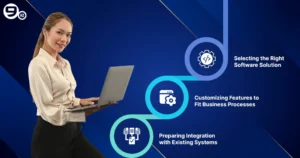
Selecting the Right Software Solution
Once the organisation is ready with its business needs and basic blueprint for implementation, it is time to explore finding the right fit software among vendors. You can measure the software compatibility considering the factors, including security and compliance standards, industry-specific uses, scalability, vendor’s enterprise software development process quality, and customer support.
Customised Features to Fit Business Processes
Large-scale businesses might find it difficult to operate with one-size-fits-all software, due to varied processes, user base, and workflows. With the help of customisation, it ensures that enterprise software fits with existing processes, and while scaling, it doesn’t disrupt workflows. These custom changes include configuration for user roles or authorised access, UI/UX changes, workflow adjustments, and custom extensions.
Preparing Integration with Existing Systems
Enterprise software acts as an umbrella that consists of different applications, including ERP, CRM, Business Intelligence, SCM, and HRMS, to integrate for long-term business operations. It is essential to implement enterprise software that swiftly integrates with other systems through APIs for real-time data sharing, consistency across platforms, and the avoidance of data overlapping.
Example: Any healthcare organisation needs customised software to offer personalised treatment and telemedicine facilities to users. Additionally, it should comply with industrial security standards and satisfy regulatory requirements.
Stage 3: Development & Configuration
By this stage, enterprise software configuration is already completed, and development has started as per business specifications. Here, the custom software development company is ready to set up for feature integration and prepare the system for data migration. This develops a technical foundation for enterprise software that supports operational workflows, secure systems, and compliance updates.
Software Configuration and Setup
Based on the organisation’s policies and frameworks, the software configuration works for setting up user roles, navigating through workflows, and adjusting parameters for systems to align with business functions. Configuration can work for user roles, access control, workflows, regional settings for currency or taxation, or even backup controls.
Custom Development (If Needed)
Unlike generic off-the-shelf software, custom development involves building modules and extensions that comply with security and compliance, supply chain, or deployment models. Many times, businesses require dashboards and in-built reporting tools, and a user interface for improved management. Developing custom dashboards and reports, API connecting with third-party systems, and predictive models, all these contribute to custom development.
Ensuring Security and Compliance
Enterprise software unifies business operations that include confidential data, and it requires cybersecurity measures to protect confidential data. This prevents major reputational and legal risks through role-based access control, data encryption, and compliance checks for international quality standards. These measures include data encryption, role-based control, audit trails, disaster recovery planning, and security patching.
Example: A manufacturing company aims to develop predictive maintenance within software that requires configuration to set up IoT sensors. It automates the functions and schedules for maintenance proactively.
Stage 4: Testing & Quality Assurance

After the development stage and configuration process are over, the enterprise software should undergo functional and non-functional testing and Quality Assurance standards to verify usability, security, functionality, and performance. Software testing doesn’t align to technical aspects only; this also assesses the overall process, whether it integrates with existing workflows or not.
Functional and Performance Testing
Functional testing refers to checking whether the software’s features work based on the user requirements through test cases, and comparing the final results. This operates on a “Black-Box” approach, which shows that testers are not aware of the internal code rather focus on functional requirements.
User Acceptance Testing (UAT)
This software testing focuses on verifying functionalities based on real-life case scenarios that measure functionalities on different devices. Using the feedback from testing, demonstrate whether the software is compatible with business needs and adds to productivity to deliver services or products.
Resolving Bugs and Issues
After verifying for testing and QA standards only, it identifies any bugs and errors that need to be addressed and resolved to ensure improved functionality. If required, you can run a second round of testing to fix these issues and confirm for quality checks. The best approach to resolve these issues is iterative fixes, regression testing, and audit for the IT team support.
Example: Any global eCommerce retailer getting a lakh of orders at once during a seasonal offer will ask for load testing before risking its entire database. Thorough testing helps to prevent downtime during the real sales timeframes.
Stage 5: Deployment & Rollout
Here begins the execution phase for the enterprise software implementation. Before deploying software into the real environment, it is crucial to assess for any disruptions and lack of control for operational needs. It follows deployment through different models, including private cloud, public cloud, hybrid, and community cloud.
Deployment Strategies (Phased vs Big Bang)
Depending on business size, capacity to handle risk, and software complexities, organizations use their deployment strategies. Phased deployment benefits to reduce risk while taking longer for proper implementation. On the other side, the Big Bang deployment model, where the entire software goes live at once, is faster while riskier for the system.
Data Migration and System Setup
For smooth implementation, a careful data migration plan is required to transfer the legacy system to the new platform. Through setting up the right system, it follows the steps of data cleansing to eliminate inaccuracies, validation checks for integrity, and setting backups to prevent data loss.
User Training and Support
Enterprise software connects with different departments within the organisation that need constant employee training, online modules, a user guide, and hands-on workshops to make them learn faster adoption. With ongoing support, it ensures that there is no system failure or fault in business functions.
Example: If the banking sector aims to implement a CRM system in their existing system, considering multiple branches, they will follow a phased deployment for better adoption, seamless integration, and minimal downtime with legacy systems.
Stage 6: Post-Implementation Support & Optimisation
Enterprise software implementation is not restricted to deployment; it requires regular maintenance and improvement to prevent any system failure and ensure support. Following these maintenance tasks backed by regular changes, updates, and modifications for consistent function. Without effective control and support, the deployed software might be exposed to the risk of vulnerabilities and performance issues.
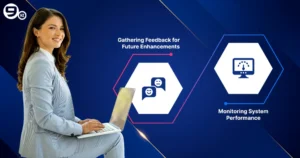
Monitoring System Performance
Organisations use tools and software to track key metrics for measuring performance, like response time, error rates, server timings, database, and containers. It measures how software works in the existing business scenarios and how it affects reliability, performance, and user experience.
Gathering Feedback for Future Enhancements
How do businesses ensure that enterprise software is user-friendly and aligned with business needs? For this, you will need to gather feedback from employees to highlight areas where there is scope for improvement in existing systems. Organisations can set up dashboards, reporting tools, customer feedback forms, surveys, and video-based interviews to generate practical aspects.
Example: A retail store shifting to AI-based inventory tracking software to reduce stockouts. It regulates the system and forecasts demand to gather feedback from store managers to update through dashboards and automate reporting.
Conclusion
Software implementation might be a little complex in dynamic business scenarios. However, with the help of the right tools and strategies, businesses can set up software that aligns with project requirements and core objectives. Companies navigate through vendors to negotiate for quotes and explore their enterprise software development services to ensure a right-fit. A successful implementation followed through a comprehensive plan, defined project lifecycle, system compatibility, configuration, testing, and deployment. As an organisation plans each stage carefully, it critically assesses for successful project implementation.
Key Takeaways for Successful Enterprise Software Implementation
Some key takeaways from the entire details on software implementation that help businesses to streamline their process include:
- Keep your software implementation plan ready with defined business goals, timelines, and resource allocations.
- Negotiate with vendors to select the right fit software, considering scalability, flexibility for integration, and industry relevance for usage.
- For improved optimisation, customisation was followed to align with business workflows and compliance requirements.
- Regular functional and non-functional testing allows tracking of errors and bugs that need to be resolved to avoid expensive maintenance.
- Organisations should monitor the performance gap and set up maintenance frameworks for long-term success.
Ensuring Long-Term ROI
After the successful enterprise software implementation, the long-term ROI can be measured by its performance, ability to scale, and innovation capabilities. It saves the organisation from costlier setbacks and delivers sustainable growth. Measuring ROI refers to tracking financial benefits rather than counting technical advantages. Over a period of 5 to 10 years, this can be used to generate lifecycle costs; a positive ROI indicates a profitable investment, while a negative ROI implies a loss and fault in implementation.
