



Before we jump into inaccurate demand forecasting in supply chain, let’s face a hard-hitting fact!
Did you know?
Businesses faced $1.1 trillion in global supply chain waste, while 99% executives face adverse outcomes due to inaccurate demand forecasting. (Source: McKinsey).
Sounds surprising, doesn’t it?
Even in 2026, many businesses are facing constant challenges as they try to keep pace with current market trends and establish a robust market foothold.
This is where the importance of demand forecasting for supply chain management comes in!
Gone are the days when demand forecasting methods relied solely on historical data and current market analysis, which led to inaccurate predictions and ultimately, huge losses.
However, things have changed now! These methods efficiently leverage Artificial Intelligence (AI) and Machine Learning (ML) to drive more accurate data-driven predictions.
Ready to dive into the world of demand forecasting? If so, let’s get started!
What Is Demand Forecasting in Supply Chain?
To put it in simple terms, demand forecasting for supply chain management is the “advanced planning and predicting of inventory demand for a product” to remain competitive in business. It efficiently leverages the statistics models, historical data, social media activity, market trends, online reviews, and more. When you implement demand forecasting effectively, it helps reduce costs, increase profitability, save money, and protect against market uncertainties.
Did you know?
AI-based forecasting significantly reduces supply chain network costs by up to 50%. Furthermore, ML-based integration helps address challenges associated with new products. Implementing demand forecasting helps minimise transportation and warehousing costs and supply chain administrative expenses.
Irrespective of your business size, demand forecasting plays a crucial role in creating a robust, effective supply chain management strategy.
However, if you don’t implement demand forecasting for supply chain management, businesses lack crucial information for manufacturing planning. Furthermore, it predicts the quantity of finished inventory required to meet market demand. Therefore, companies can optimize their inventory management strategy to avoid over- or under-stocking.
What are the Common Causes of Inaccurate Demand Forecasting in the Supply Chain?

There are abundant reasons behind inaccurate demand forecasting. Here are some of the common causes of inaccurate demand forecasting.
Inconsistent Demand Patterns
One of the significant causes of inaccurate demand forecasting in the supply chain is the instability of demand. Since most demand is unpredictable, forecasting the patterns can be potentially challenging. When customer demand changes, historical data are insufficient to predict the future, especially in dynamic markets.
External Factors
The other frequent cause is external factors, such as political instability, economic changes, and supply chain disruptions, which can significantly impact the forecast. This is why the use of external data that could minimize the risk of error, such as market trends, anticipated demand, and high-quality economic data, is essential.
Fragmented Data
Since many businesses rely on disconnected legacy systems, the information may be inaccurate or outdated. Therefore, it could ultimately cost the company in the long run. Implementing an integrated system that combines ERP, CRM, and external data enables accurate forecasting.
Using Static Models
Models that do not adjust quickly or abruptly to changing markets do not perform well, especially in competition, and lead to incorrect demand forecasts. Therefore, using AI-based models helps prevent the risk and facilitate accurate demand forecasting.
What are the Operational and Financial Costs of Poor Forecasting?
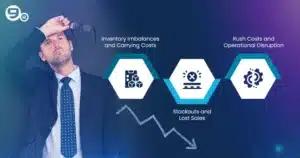
Inaccurate demand forecasting in the supply chain harms both the operations and the bottom line of businesses. Here are the estimated operational and financial costs of poor forecasting.
1. Inventory Imbalances and Carrying Costs
When forecasts overreach demand, unsold inventory is placed idle in warehouses. Yet again, it strains working capital that could otherwise be reinvested in growth strategies, marketing and branding, or other research and development. The costs of carrying inventory are not trivial: actual carrying costs (related to storage, handling, insurance, and depreciation) typically add 20-30% to the price of the inventory each year.
In simple terms, for every $1 million in inventory on hand, a company could incur roughly $200,000–$300,000 in annual holding costs simply because forecasts were off.
2. Stockouts and Lost Sales
If customers can’t find what they are looking for, they don’t wait; they buy from someone else. According to data published by the Harvard Business Review, 4% of lost sales is what stockouts represent for the average merchant, which, for a larger company, can mean millions of dollars in lost revenue. More problematically, stockouts lead to lower customer satisfaction and repeat purchases.
This is especially dangerous for retailers, as forecast errors contribute to an annual global loss of approximately $1.8 trillion due to inventory mismanagement, of which $1.2 trillion can be directly linked to stockouts and lost sales.
3. Rush Costs and Operational Disruption
An incorrect forecast will drive teams into costly reactive behavior. Companies will rush/overnight ship products or charge premium rush rates to meet a need they didn’t know they had until it was too late. Such last-minute reactions can increase unit logistics and per-unit production costs by 50% to 200% over planned operations.
These types of disruptions are not just costly; they also stretch staff, time, and resources away from mission-related work, degrading morale as teams are constantly putting out fires instead of being innovative.
Industry Examples of Forecasting Failures
Prediction failures have an immediate impact. If companies don’t correctly interpret demand, they will lose revenue, waste inventory, and frustrate customers. Even established brands have learned this the hard way.
Retail Industry
Nike is a clear case of how forecasting mistakes can snowball. Due to inaccurate demand forecasting in the supply chain, the company produced the wrong variety of products, some of the most popular items sold out quickly, while others piled up in warehouses. Nike then reported a $100 million loss due to this overproduction and missed sales. It did cause the company to put products on sale and to rethink how it used forecasting technology.
Consumer Electronics
The main reason consumer electronics companies can maintain tight product cycles is the scale of their business. Inventory has zero value when the forecast is wrong and demand is unanticipated. Industry statistics indicate that companies are losing hundreds of billions of dollars a year because the electronics stock is held too long and doesn’t move as fast as it should. But stockouts also drive customers into competitors’ arms, particularly during product launches.
In this area, poor forecasting often makes innovation a financial sinkhole.
Fashion and Apparel
Precise demand signals are crucial in the apparel industry. The effects of missing trend forecasts can be seen within a few weeks. UK fashion retailer Bonmarché was unable to match its inventory to customer demand and lost £5.5 million before administration. Clothing that didn’t sell required heavy discounts, which destroyed the profit margin and cash flow. The average market does not provide such oversight of accurate market trends and make-good.
How AI Improves Forecast Accuracy?
AI provides clarity to businesses that old methods can’t match. Furthermore, it learns from vast amounts of data, adapts instantly to change, and unlocks patterns people often miss.
1. Learns from More and Better Data
AI is not simply about past sales numbers. It takes into account real-time data from various sources such as weather, special offers, social trends, and actual sales. This perspective allows it to “see” demand signals that a naïve model could not. For example, unlike a traditional forecasting system, which may account for only three to five factors, AI can process dozens, and even hundreds, at once, significantly increasing predictive ability.
2. AI Boosts Accuracy and Reduces Errors
The use of AI models greatly minimizes inaccurate demand forecasting in the supply chain. One study states that AI in demand forecasting can increase forecast accuracy by 20-50% compared to traditional (statistical) methods. This type of model would allow companies to be better able to predict actual customer behavior and therefore avoid the expensive mistakes of stockouts and overstock.
3. AI Adjusts Forecasts in Real Time
The markets move fast. And AI changes along with them. Forecasts are revised as new data comes in, so companies do not have to wait for weekly or monthly reviews to act. For example, in the case of a sudden increase or decrease in demand, AI reacts to shifts instantly. This kind of real-time responsiveness gives companies a head start on the costly reaction lags caused by typical forecasting.
4. AI Cuts Bias and Human Error
Human predictions often reflect human bias or assumptions. AI remains entirely data-driven. It has no favorites and seeks to detect hidden patterns in all the signals, as opposed to just ‘having a feel’ for it. It also helps eliminate bias in decision-making and enables teams to base decisions on data rather than intuition.
5. Improves Business Outcomes
The actual impact of AI on prediction accuracy is evident to businesses. More accurate predictions mean fewer stockouts, and customers find what they need when they need it. Furthermore, AI has tools to help reduce unnecessary stock, freeing more cash and lowering holding costs. In a few instances, the predictability of AI implemented by such firms has reached 80 to 95%, a percentage that is difficult to obtain with traditional approaches.
Key AI Techniques Used in Demand Forecasting
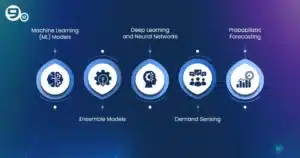
AI uses advanced techniques that help businesses better understand demand and act sooner. Here are the most essential AI methods that improve forecast accuracy and help reduce inaccurate demand forecasting in the supply chain.
1. Machine Learning (ML) Models
Machine learning models can understand patterns that humans often miss, as they ingest and process enormous amounts of data. Rather than relying on historical averages and demand to repeat itself, ML models explore thousands of such variables, e.g., price changes, promotional activity, seasonality or other market indicators to identify relationships that are not immediately visible.
Companies using ML often experience 30-50% lower forecast errors than traditional forecasting models, and up to 90% for short-term forecasts as the models continue to train on new data. And these are the actual learning and improvements that make ML so powerful.
2. Deep Learning and Neural Networks
Deep learning performs exceptionally well when the demand requires incorporating many relatively subtle factors. Recurrent neural networks, in particular architectures such as LSTM (Long Short-Term Memory), are very good at time-series data, as the network retains information about patterns at very different time scales and smoothly adapts to new information. Such models can detect long-term trends and sudden changes that humans can only struggle to recognize peering at spreadsheets.
3. Demand Sensing
It is a type of forecasting that is inherently behind what is actually happening by the nature of relying on historical data. Demand sensing inverts this by acting as a sponge for daily sales, POS data, weather, and even online search trends, providing real-time information and detecting demand shifts in supply chain management as they occur.
Instead, it is about sensing demand to react to manage your inventory levels quickly, mitigating the risks of expensive stockouts and overstocks. It is a particularly useful method for retailers and grocery chains because consumer behavior can change quickly.
4. Probabilistic Forecasting
Probabilistic forecasting does not provide planners with a single “expected demand” number; instead, it offers a range of possible outcomes and their likelihoods. This allows teams to ask more thoughtful questions, such as: What is the best-case demand? But what if there’s a spike in demand? What level of risk should we insure? They don’t guess at what the future holds; they create probability curves and forecast distributions, then set their safety stock or develop their contingency plan at a level they can withstand, not one they pretend is certain.
5. Ensemble Models
But there is no one-size-fits-all model. The Ensembled Forecast is a combination of several AI techniques, including machine learning, deep learning, and traditional time-series methods, that combine predictions to produce a forecast better than any single system can. Consider it as having many consultants rather than one. But merging predictions using so-called ensemble models reduces errors in individual predictions and provides better overall predictions that work well across all products, regions, and seasons.
Benefits of AI-Powered Demand Forecasting for Supply Chains

AI is helping to revolutionize supply chains and reduce inaccurate demand forecasting in the supply chain. Rather than being responsive to issues, businesses can become proactive in anticipating demand, minimizing waste, and serving customers more effectively. Here is where AI has a real impact.
1. Cut Inventory Costs
AI assists businesses in stocking the right products in the right quantities. It also has the advantage of learning from previous sales, seasons, promotions, and expected demand driven by other factors, e.g., weather or local events, allowing it to make better predictions than a human would be able to. As McKinsey points out, companies that adopt AI in supply chain planning reduce inventory by 20-30% while keeping or even increasing service levels. Reduced inventory means less money tied up in stock, savings on storage and insurance, and reduced spoilage from products that didn’t sell.
2. Avoid Stockouts
Customers hate it when the good things are out of stock; it drives them to another retailer. Here, the problem can and will be addressed by artificial intelligence, which, through real-time data such as sales at various points of sale, online activity, and broader social trends, can detect changes in demand much sooner. This benefits retailers, grocery chains, and consumer goods companies the most, as this demand can scale rapidly.
3. Respond Faster
Supply chains are often dynamic. Production delays, sudden spikes in demand, or supply problems can cause disorganization. These AI-generated predictions are continuously updated as new data arrives, so teams can respond in real time. Firms can reschedule shipments, plan production accordingly, or move stock before any scarcity or excess has materialized. According to Gartner, supply chains using AI-enabled forecasting are up to 3 times more reactive to disruptions than those relying on traditional forecasting methods.
Use Cases Across Different Industries
Demand forecasting for supply chain management using AI is resulting in positive outcomes across all sectors. It can also improve service, reduce costs, and make companies more responsive to shifts in demand.
1. Retail
AI ensures the shelves are always filled with what is new based on what’s selling, promotional push, and online buzz. Walmart deployed AI technology to help limit stock-outs and overstock, thereby increasing the availability of goods and boosting sales by 10-15%.
2. Consumer Electronics
Electronics companies use AI to anticipate when products will be released and to predict seasonal demand. Apple and Samsung don’t sit on surplus inventory, see increased profits and ensure that the hottest, most popular phones are in stock when desired.
3. Manufacturing
Machine learning anticipates orders and adapts production schedules, helping companies like Siemens achieve 20-30% efficiency gains. It shortens lead time, reduces inventory costs, and enables on-time product delivery.
4. Food & Beverage
An AI platform that predicts the daily demand of perishable goods. Kroger leverages it to modify sales orders to align with the sales and weather, subsequently minimizing waste and ensuring that additional fresh items are available for consumers.
5. Fashion & Apparel
Retailers use AI for fashion prediction and inventory planning. Zara sells more at full price, resupplies its stores twice a week and has a higher profit margin because its stores are always full of new and right items.
How Supply Chain Software Integrates AI Forecasting
AI has also been embedded in modern supply chain software, such as demand forecasting engines, and it is becoming more common in advanced software, making it easier to forecast future demand with much greater precision. Unlike traditional “historical” models, AI systems continually, autonomously update themselves as they receive new data, such as current sales patterns, inventory levels, market data, and other criteria. It allows companies to take the lead on demand changes before they happen and to replan immediately. For example, it has been estimated that AI-based demand forecasting can reduce inaccurate demand forecasting in the supply chain by 20-50% compared to traditional approaches and decrease product availability losses due to out-of-stock inventory by up to 65% for companies that have calibrated these systems to real-world cues.
The NineHertz is a trusted supply chain software development company that has developed software for the supply chain that incorporates these sophisticated AI forecasting capabilities into your pre-existing systems, so that you obtain actionable insights as opposed to guesswork. It ties together predictive analytics, machine learning models, and real-time dashboards to enable teams to plan inventory better, more efficiently plan production, and coordinate supplier schedules. With accurate demand forecasting solutions, companies can eliminate inventory shrinkage, improve delivery reliability, and ultimately enhance customer satisfaction.
Future Trends in Demand Forecasting and AI
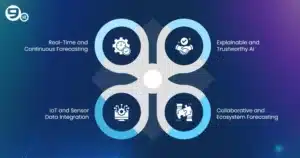
Companies that leverage AI trends will be able to make wiser choices and develop agile supply chains prepared for the future. Here are the main future trends of demand forecasting for supply chain management.
1. Real-Time and Continuous Forecasting
The next step is moving toward real-time “forecasting”. Instead of focusing only on history-based predictions, AI’s predictions get updated continuously as the availability of data increases. Instead of daily or weekly reports, this enables companies to adjust inventory and production schedules instantly. Computers also have the advantage of being able to model complex patterns, analyse trends, and perform calculations that humans simply can’t. Analysts predict that AI solutions will outperform existing models by 50% in error and 65% in service-level fill rates. The ability to act quickly to changing consumer behaviors is indeed empowering.
2. IoT and Sensor Data Integration
The Internet of Things (IoT) will support more intelligent prediction. Predictive capabilities will be more intelligent and based on the Internet of Things (IoT). Businesses will hook their demand-forecasting engines to sensors, smart shelves, track delivery, and even weather data. The advantage of this data is that AI can infer patterns more quickly and with greater accuracy and predictive power. It also provides the capability for ultra-granular data, for example, enabling changes to a particular store’s inventory in real time based on foot traffic or sales trends.
3. Explainable and Trustworthy AI
As AI becomes more integrated into planning, companies will want more explainable AI predictions. Explainable AI (XAI) thinking can help a planner understand why the forecast looks the way it does, not just what it forecasts. This kind of transparency increases trust within teams and allows organizations to successfully defend their decisions when they are tied to larger financial or operational decisions.
4. Collaborative and Ecosystem Forecasting
AI will dissolve the silos within supply chains. Rather than the forecast being an activity performed by one of the partners in a value chain, collaborative forecasting systems will harmonize demand perspectives among the manufacturer, distributor, and retailer. Together, they can result in reduced mismatch and latency, better coordination among suppliers, and ultimately lower supply chain costs. Each partner can thus contribute to building consolidated prediction models that represent the signals of the entire ecosystem.
Conclusion: From Guesswork to Data-Driven Forecasting
The impact of inaccurate demand forecasting in the supply chain is widespread, including piles of inventory, lost sales, and disgruntled customers. Static markets and rapidly fluctuating demand are no longer compatible with traditional forecasting techniques. That would be altered by AI-powered demand forecasting. It leverages machine learning and real-time data to deliver improved forecasts and smarter supply chain planning. Companies that implement AI-based supply chain forecasting can reduce risk, improve inventory management, and make better, quicker decisions.
If you want better demand planning, lower inventory costs, and better supply chain execution, then it’s time to invest in AI-powered supply chain software. So, The NineHertz partners as a supply chain software development services provider for businesses worldwide, assisting them in creating and implementing demand forecasting for supply chain management that aligns with their operations and capabilities.
Contact us today and change the way you forecast, and establish your long-term competitive advantage.
Faqs
What is demand forecasting in the supply chain?
Demand forecasting for supply chain management projects determines what customers will purchase in the future. Firms use it to plan inventory, production and deliveries to avoid stockouts and excess inventory.
How does AI improve demand forecasting?
AI can find hidden patterns in vast amounts of information and make dynamic, up-to-date predictions. This allows companies to react more quickly to changes in market demand and achieve more accurate forecasts.
What causes inaccurate demand forecasts?
Forecasts are usually wrong because of limited data, outdated models, human bias, and sudden market changes.
Which industries benefit from AI forecasting?
Some industries, such as retail, manufacturing, consumer electronics, fashion, food and beverage, and healthcare, may benefit from AI for forecasting.
