



This article may contain affiliate links where I make a small commission for purchases you make from links that you click from this article. By purchasing through these links, you support me at no additional cost to you. Thanks for your support.
If you are worried about Antarctica cruise motion sickness, you are not overreacting, and you are not alone. Before my first trip to Antarctica, my biggest fear was not the cold or the cost, it was crossing the Drake Passage and dealing with rough seas.
I am naturally prone to seasickness, so I went deep on research, tested multiple remedies, and learned the hard way what actually works and what does not. After three separate Antarctica expeditions, including both the Drake Passage (twice) and the Southern Ocean to the Ross Sea, I have firsthand experience with expedition cruise motion sickness, failed fixes, and reliable strategies.
This guide combines real-world experience with practical, tested tips so you can feel prepared, pack the right options, and improve your odds of feeling functional instead of miserable during your crossing.
How to Deal with Seasickness When Traveling to Antarctica
Like I said, I’m prone to seasickness, so prior to my first trip to Antarctica, I pored through info and sought people’s advice from social media.
The Drake Passage certainly intimidated me and my stomach. I’d heard a lot of different stories of the passage that it takes two days to pass through, and not many were very positive! They all ended with a barf bag and feeling uncomfortable for a few days.
There’s lots of great advice out there – from patches to electric currents to homeopathic remedies to good old-fashioned drugs.
Here’s what my experience was like and some tips from both trips.
TLDR: How to Avoid Antarctica Cruise Motion Sickness
- Remember, the Drake Passage and Southern Ocean can bring very rough seas, but severity varies by crossing.
- Expect a few adjustment days — most travelers do get their sea legs.
- Preparation and flexibility matter more than any single “miracle cure.”
- Bring multiple seasickness remedies — one method is often not enough.
- Prescription patches and motion-sickness tablets are usually the strongest options.
- Natural remedies and wristbands can help, but work better as backups.
- Start medication before the rough crossing begins, not after you feel sick.
- Expedition ships have onboard doctors if your symptoms get severe.
Quick Picks: Antarctica Cruise Motion Sickness Remedies
These quick picks for Antarctica cruise motion sickness remedies are based on real Drake Passage crossings and what actually helped in rough seas.
| If You Want… | Best Option | Why |
|---|---|---|
| Strongest prevention for rough crossings | Scopolamine Patch | Long-lasting and widely used for Drake Passage conditions, but has side effects. |
| Less drowsy pill option | Stugeron (Cinnarizine) or Bonine (Meclizine) | Lower sedation, simple once-daily dosing |
| Over-the-counter strong backup | Dramamine | Easy to find and reliable, but may cause sleepiness |
| Drug-free option | Reliefband Wristbands Giner |
No side effects, good as a support method, but probably not enough on it’s own. |
| Best results for many polar travelers | Patch + tablet combo or tablet + reliefband combo | Layered approach works better in extreme seas |
| Emergency rescue if nothing works | Onboard doctor meds | Fast relief when other remedies fail |
Drake Passage vs Southern Ocean: Rough Water Differences
The rough water experience was different between the Drake Passage and the Southern Ocean crossing, mainly because of duration and recovery time.
The Drake was intense but shorter, taking about two days, and even though I felt pretty miserable, it passed before long. The Ross Sea, on the other hand, meant navigating rough water for 7 to 10 days, the longer exposure made preparation and medication strategy more important.
In both cases I still got seasick, but the second trip taught me that adjusting meds and giving my body time to get its sea legs made a noticeable difference.

My Drake Passage Seasickness Experience
I experienced some pretty bad seasickness on my first trip, the one across the Drake Passage. Here is an account of my experience at the time from my journal:
The Breakfast Table Scene
Glasses and plates rattle like the percussion section. The boat crashes back down onto the water with a boom of a bass drum. The constant hum and rumble of the engines provide the melody. Occasionally, you’ll hear a wave crash against the boat with a swishing noise in a completely different key.
As I sat in my chained-down chair at the breakfast table, I watched my coffee in my cup teeter-totter back and forth towards the rim of the cup. I tried to guess when it would finally go over the side and spill over into my saucer. As I fixated on the service staff rolling and pitching with large platters in their hands, I overheard a man say that today we had a very confused sea. I thought about the term confused sea and slightly chuckled to myself, giving my uneasy stomach a moment of relief as my mind had something else to think about for a moment. I mused to myself that it’s not really the sea’s fault – it’s just a little mixed up, as if someone didn’t provide the correct directions.
Horizontal Survival Mode
I leave after eating a couple of bites of my fruit and retreat to the horizontal position that the Drake Passage requires me to be in. I don’t like the horizontal position – it gives me too much time to think. I think about my stomach, think about my life, I think about every little noise, and I think about just how much the ship is pitching and rolling.
This is what I was worried about when we were preparing for the trip. The Drake Passage is the body of water between the southern tip of South America and the South Shetland Islands of Antarctica. It gets its reputation as the roughest sea in the world for good reason. The Antarctic Circumpolar Current gets squeezed through this narrow gap between the South American and Antarctic continents, and it is the squeezing of this current in an area of naturally high winds that is a major cause of Drake’s moodiness.
I close my eyes, but the symphony continues – the popping and creaking noises never stop. Why won’t they stop? It sounds as if you are deep underwater, and the popping and crackling noises are the water and pressure on your head – squeezing it like a vice.
Just as I predicted, my dad is unaffected by the sea, but I’m down for the count even after taking meds. He even goes outside to the top deck to watch the chaos. He gets to see Cape Horn and gets a picture of the Atlantic and Pacific Oceans ‘intersection. He comes back to the room with sea spray covering his glasses and brings a burst of fresh air into the stale room. He talks excitedly about what he’s seen as if he’s a young boy who just got off his first roller coaster ride. I can’t help but smile.

First Time Standing Up Again
His energy brings life back to me. I decided I should get vertical again and try to stare at the horizon. As I wobble down the hall, it hits me – it’s as if our ship is a Labyrinth Tilt game – my old childhood game with a little silver ball that you had to work through a maze by tilting the board and avoiding the holes. You hug the hallway wall as the ship pitches to the left and then position yourself near the next-door jam to your right, anticipating the pitch right, which will roll you through the opening and into the next hall. Ahhh – the haziness of the meds is wonderful at times.
Dad and I sit in chairs near the reception area and look out the big windows. I watch as the horizon seems to slide up and down the window about 14 to 20 inches with every swell. Yes – I actually measure this. The water is steel gray with little white caps. I stare at the seagulls surrounding the ship like the paparazzi following our every move. They are thrilled we are stirring up the sea for their hunting and providing new air currents for their gliding. They are such a contrast to the turbulent, angry sea. They provide effortless fluidity, barely looking as if they are doing an ounce of work. Just watching them glide makes me feel better.
As I started feeling better, my social side came back to me, along with the color on my face. A friend joked, “The only way to avoid seasickness is to sit under a tree.” I chuckled. Apparently, I had my sense of humor back, too.
There is no grand finish to Drake’s symphony of sounds, sights, and feelings – it just sputters out, and my body and mind wake up out of the miserable coma it has been in for the past day.
To get to Antarctica, you have to cross the Drake. Yes – it can be uncomfortable, but it’s a small price to pay to be transported to the bottom of the world and back.
Note – our trips through the passage were quite tame compared to how it can be. If you want to get an idea of the extreme side, just check out this video of the G Expedition crossing the passage in March 2011.

Seasickness on Southern Ocean Crossing to the Ross Sea
The Southern Ocean is some of the roughest water in the world, and you will be navigating through it for 7 to 10 days before you reach Antarctica (3 to 4 times longer than the Drake Passage to the peninsula). It was so rough that within the first 4 hours of leaving our port in New Zealand, someone had to be helicoptered off the ship due to injuries when they fell due to rough seas.
The expedition to the Ross Sea (eastern side of Antarctica) was a dream trip for me and for most people who take it. Even though I’m prone to seasickness, it didn’t make me hesitate a second in saying yes to travel to Antarctica again.
However, I was still nervous about how rough these seas were and my ability to deal with them. In the past, going through the Drake Passage, I’d ended up in bed all day, not able to even get up.
But as a rule, I refuse to let things like seasickness, not knowing the language, or fear in any way stop me – so I dealt with it.
You can watch my Southern Ocean seasickness experience below!

What Actually Helped (And What Didn’t)
After three Antarctica expeditions and a lot of trial and error, I learned that managing my seasickness was less about finding one magic fix and more about having options and adjusting quickly.

Scopolamine Patch
What helped most was switching medications instead of stubbornly sticking with the first thing I tried. The Scopolamine patch helped a little, but it did not carry me through the roughest days. Plus – I absolutely hated the side effects of the Scopolamine patch – dry mouth and weird dreams. For me, the dry mouth sensation was unbearable.
Stugeron – Cinnarizine
I switched off the patch to Cinnarizine (also known as Stugeron and found in the UK). Stugeron is an antihistamine and calcium channel blocker primarily used to treat motion sickness, nausea, vomiting, and vertigo. It worked better for me and made the biggest difference once I changed over..notably, no more dry mouth! Bringing multiple types of remedies gave me flexibility when one approach was not enough.
This is the same type of drug as Dramamine which is sold in the US for motion sickness and nausea. But for some reason – Dramamine didn’t work as well for me at all. Maybe it lacked the vertigo blocking element – I have no idea. But I much preferred Stugeron. So I suggest to bring both just in case. You can only get Stugeron in the UK though – so whenever I travel there I pick some up to have in my first aid travel kit!
Reliefband Sport
On my most recent Antarctica voyage, I skipped the patch, used Stugeron, and added the use of a Reliefband Sport. The Reliefband Sport is an FDA-cleared, waterproof wearable that treats nausea via transdermal neuromodulation. It emits gentle, rhythmic electrical pulses to stimulate the median nerve on the underside of the wrist, sending signals to the brain that normalize nerve messaging, block nausea signals, and stop vomiting.
The sport band is waterproof (which is important for a cruise) and you can set it at different levels of intensity. Turn on the device and adjust the intensity until you feel a slight tingling in your palm and middle fingers. There were plenty of times when I had it turned up all the way and it reminded me of a TENS unit – my fingers would move uncontrollably with the pulse!
But overall – I did really like it. It was perfect for day to day stuff on the ship and zodiac cruising. In fact – once I got my sea legs, most days I didn’t take any medication and just used the Reliefband and was fine. And then on the rougher seas, I would use both Stugeron and the Reliefband and would be ok.
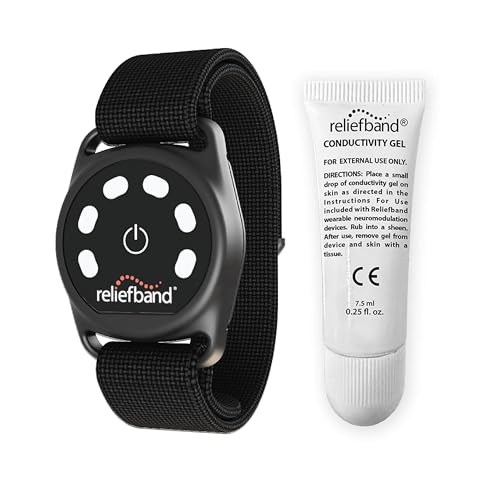
Reliefband Sport Anti-Nausea Wristband
The updated Reliefband Sport is a revolutionary therapeutic device indicated for use in the treatment of nausea and vomiting due to motion sickness. I used it on my Antarctica crossing and it helped a lot. It was great for day to day use on the expedition ship.
I earn a commission if you click this link and make a purchase, at no additional cost to you.
03/10/2026 10:02 pm GMT
Additional Tactics While on the Ship
Layering methods also helped. Using medication plus simple tactics — like getting horizontal when needed, then later sitting upright and watching the horizon — made recovery periods shorter and more manageable. It also really helped when I could get outside and get fresh air – even if it was short stints. And finally – time matters. Getting my sea legs took about 4 days, and once my body adjusted, I felt noticeably better for the rest of the voyage.
What did not work was relying on a single remedy and expecting it to solve everything. Even with medication, I still had a few miserable days in rough water. Waiting too long to switch strategies also made things harder than they needed to be.
If I did it again, I would still bring multiple remedies, start early, and change course faster if something was not working. On rough expedition seas, flexibility beats optimism every time.

Remember These Four Tips and You’ll Be Alright
Here are my tips based on my seasickness experiences
1. Even if you aren’t prone to seasickness, bring something
In the roughest waters, probably half of our ship was not feeling well. I found myself lying in bed, pretty miserable for the first 3 to 4 days when we were in rough waters. And yes, I was taking various medications, and nothing worked completely for me.
2. Don’t worry; you’ll get your sea legs eventually
The good news is that the term ‘get your sea legs’ isn’t a myth. I did get my sea legs eventually, and then I was fine the rest of the time.
3. Bring more than one option for sea sickness
Different solutions and combinations work for different people, so bring options. Keep scrolling for a full list of available options.
I started off using the Scopolamine Patch (prescription necessary from the US), then switched to Stugeron/Cinnarizine (only found in the UK over the counter), and that seemed to work better for me. Then I layered a Reliefband on top of that. All bases were covered! People also had motion sickness wristbands, ginger tablets, and Dramamine.
4. There’s always the onboard doctor
If you are really in a bad situation and nothing seems to work, then the onboard doctor can typically help with stronger medication.
Best Seasickness Options for Antarctica Cruises
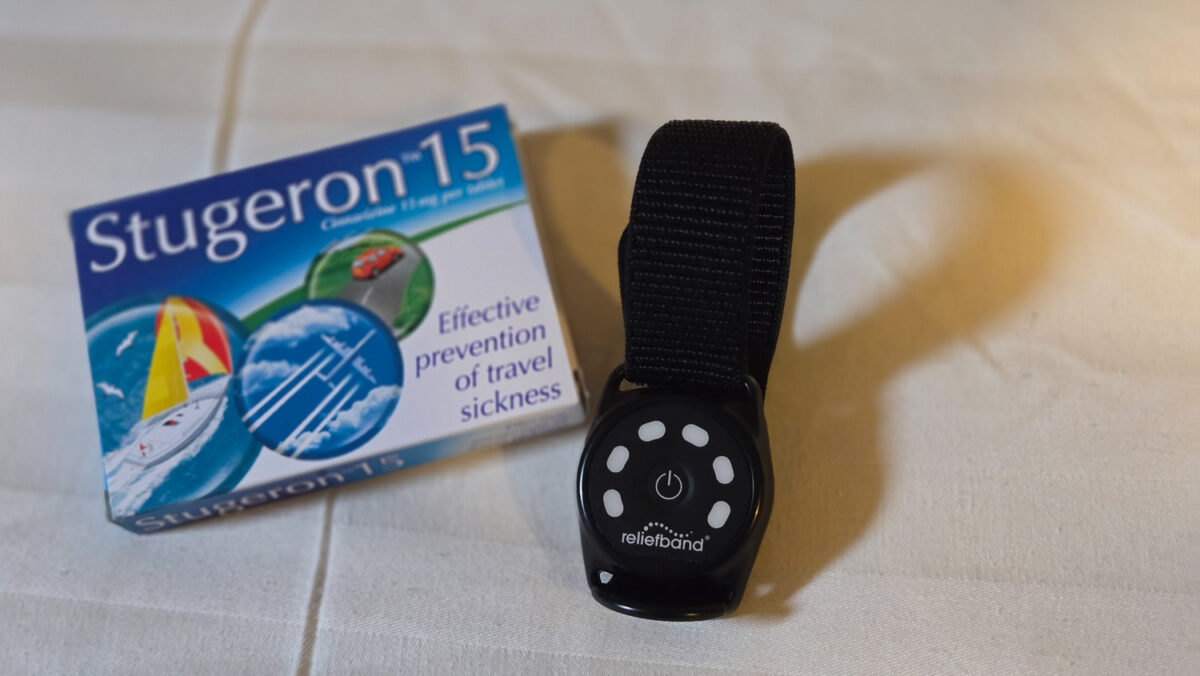
To avoid a repeat of what happened when I crossed the Drake Passage, I packed every type of seasickness medicine and natural remedy possible on my second and third trip! I suggest you do the same. Here is what’s available for you:
| Remedy | Type | Pros | Cons | Prescription Needed | Drowsiness Risk |
|---|---|---|---|---|---|
| Scopolamine Patch | Transdermal patch | Long-lasting, strong prevention, widely used on expedition cruises | Possible dry mouth-UGH! , blurred vision, not ideal for some medical conditions | Yes (US) | Low-Moderate |
| Cinnarizine (Stugeron) | Tablet | Worked better for some travelers (me!) in rough polar seas, easy dosing | Not available over the counter in all countries – specifically the US | No (UK OTC) | Moderate |
| Reliefband Sport | Band you wear around your wrist | Is a great addition to medication. Can be used in lew of medication in calmer waters. | You have to charge it – so you will have to take it off occasionally. | No, can buy on Amazon | None |
| Dramamine (dimenhydrinate) | Tablet | Easy to find, affordable, works for many people | Can cause sleepiness and brain fog | No | High |
| Bonine (meclizine) | Tablet | Less drowsy formula, once-daily dosing | Not strong enough for extreme seas for some users | No | Low-Moderate |
| Motion Sickness Wristbands | Acupressure band | Drug-free, reusable, no side effects | Mixed effectiveness, often not enough alone in rough seas | No | None |
| Ginger Tablets or Chews | Herbal | Gentle option, helps mild nausea, safe to combine with other methods | Usually too mild for the Drake Passage alone | No | None |
| Onboard Doctor Medication | Injection or strong tablets | Fast relief in severe cases, supervised dosing | Only available once you are already sick | No (ship medical) | Moderate-High |
Final Tips for Rough Sea Crossings
Motion sickness during an Antarctica cruise is common, but it is manageable with preparation and the right strategy. Bring multiple remedies, start them early, and adjust as needed. Even if you have a rough couple of days, most travelers recover once they get their sea legs and can fully enjoy landings and excursions.
Plan ahead, use layered solutions, and treat the crossing as part of the adventure, not a reason to skip the trip.

FAQ About Antarctica Seasickness
No — the Drake Passage is not always rough. Conditions range from relatively calm (“the Drake Lake”) to very turbulent (“the Drake Shake”), and you will not know which one you will get until you are crossing.
Seasickness on ships is best managed with a combination of prevention and flexibility — proven seasickness remedies like Scopolamine patches or motion-sickness tablets, plus simple tactics like resting flat and focusing on the horizon, tend to work better than relying on a single method. Bringing more than one option gives you backup if your first choice is not enough.
Seasickness wristbands can help some people, especially for mild symptoms, but they are often not strong enough on their own in very rough seas. They work best as a low-risk backup or when combined with other seasickness remedies.
Related Reading
