



Fleet operations are the center point for modern logistics, and underlying complexities, including traffic issues, high fuel costs, and inefficient maintenance, are driving more demand for AI. Traditionally, fleet management involves static routing, reactive maintenance, and manual tracking. Hence, groundbreaking technology, Artificial Intelligence, or AI, brings a major shift with computer vision, automation, and measurable results. As per the latest insights, the fleet management market for the vehicle diagnostics and maintenance segment is valued at $2.9 billion. Due to the rise of predictive maintenance tech, the estimated value might reach $6.3 billion by 2030.
In recent years, the logistics and transportation industries have been getting more traction with escalating demand for fleet management, driving transformation with unparalleled capabilities. An AI in fleet management can add a competitive advantage to be equipped for operational efficiencies, result in informed decision-making, and implement safety protocols.
Modern technology has transformed fleet management for enhanced decision-making through the integration of telematics, GPS tracking, cloud-based analytics, and predictive maintenance systems. Partnering with a fleet management software development company enables businesses to capture diversified data on vehicle location, driver behavior, and performance with real-time access. Remodeling operational strategies with updated technology helps reduce costs, improve productivity, mitigate risks, and implement core principles of fleet management.
What is AI in Fleet Management?
The implementation of AI in fleet management is considered a turning point. Initially, it was a manual or reactive process resulting in static data and delayed operations, but this transformed into digital systems with automation, data analytics, and AI.
AI in fleet management can be understood as the application of AI technologies to update fleet operations and manage multiple functions at once. It consists of machine learning algorithms, advanced data processing, and predictive analytics to streamline routine tasks and data-driven decision-making.
AI fleet management will scale operational efficiencies, reduce expenses and ensure driver safety with less strain on the environment. From vehicle upkeep to driver oversight, specialised tools and software, such as Samsara, Geotab, Verizon Connect, Fleet Complete, and Motive, can optimise all integral facets of fleet management.
Benefits of AI in Fleet Management
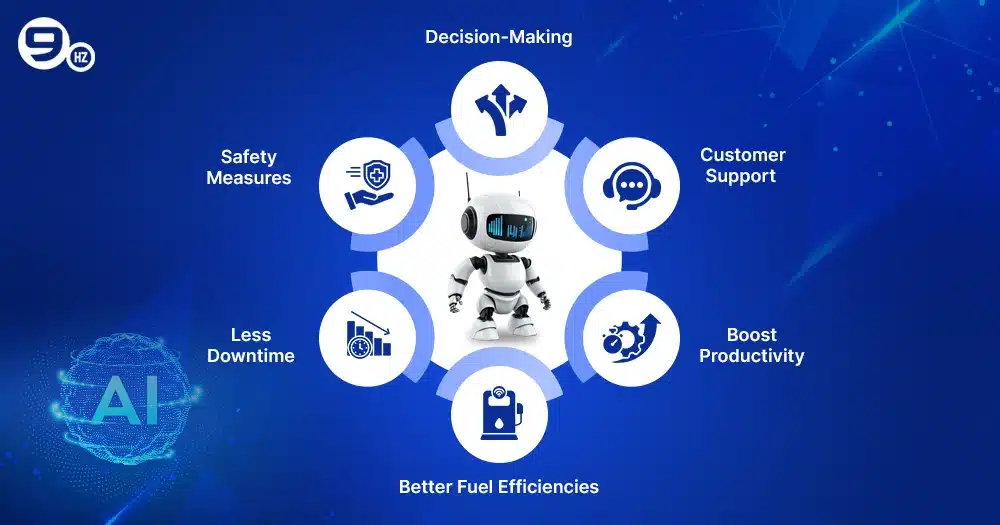
One of the best benefits that AI creates for fleet management is to transfer large amounts of complex data and store it for real-time decision-making with the support of GPS coordinates and sensor readings, studying historical performance metrics. However, it has varied benefits to help organisations achieve operational efficiencies. Let’s discuss here:
Decision-Making
Using AI in fleet management can help with data mining, delivering real-time updated data to managers. AI can upgrade the system to make better decisions, improve efficiencies, and monitor drivers’ behaviour to handle vehicle operations. The automated reporting feature can generate accurate and timely reports indicating core parameters for vehicle utilisation, maintenance, fuel consumption, and vehicle distance.
Safety Measures
Real-time driver monitoring can provide behavior analytics to minimize risk and send alerts to ensure safe driving patterns. As a result, there will be less overhead expense burden, including repair costs, insurance costs, litigation costs, and others. AI tools can detect risky situations like overspeeding and harsh braking and take action with driver training, resulting in fewer accidents and lower insurance costs.
Less Downtime
Every time any vehicle is down due to unplanned maintenance and repairs, it can result in lost revenue, so managing downtime can result in more profitability. AI helps to address the issue by integrating vehicle sensors, tracking speed and capacities, and using predictive analytics to forecast any issues. The integration of route optimization can guide traffic patterns and help select the best route with less travel time, efficient fuel consumption, and operational costs.
Better Fuel Efficiencies
Fuel costs are a major part of fleet operations’ expenditures, and as they hit a high record, companies are looking for ways to prevent cost implications. AI Software and tools for route optimisation can address issues, help drivers navigate traffic routes, analyse weather and road conditions, and reduce fuel wastage. They also benefit load management.
Boost Productivity
Real-time tracking can help to monitor vehicle adjustments in response to changing conditions. It can optimize for route saving, as well as more time and fuel wastage incurred due to manual searching. Using the right insights allows us to pick the nearest vehicle, reduce unnecessary transit, and result in high operational efficiencies with more productivity.
Customer Support
With an AI-backed solution, fleet operators can serve customer needs 24 hours a day by checking accurate estimated time of arrival (ETAs), alert notifications for delays, and delivering tracking for high customer satisfaction and loyalty. With developed AI and ML modules, it can provide long-term benefits for improved fleet performance, sustainability, and profitability, delivering operational efficiencies.
Role of AI in Fleet Management
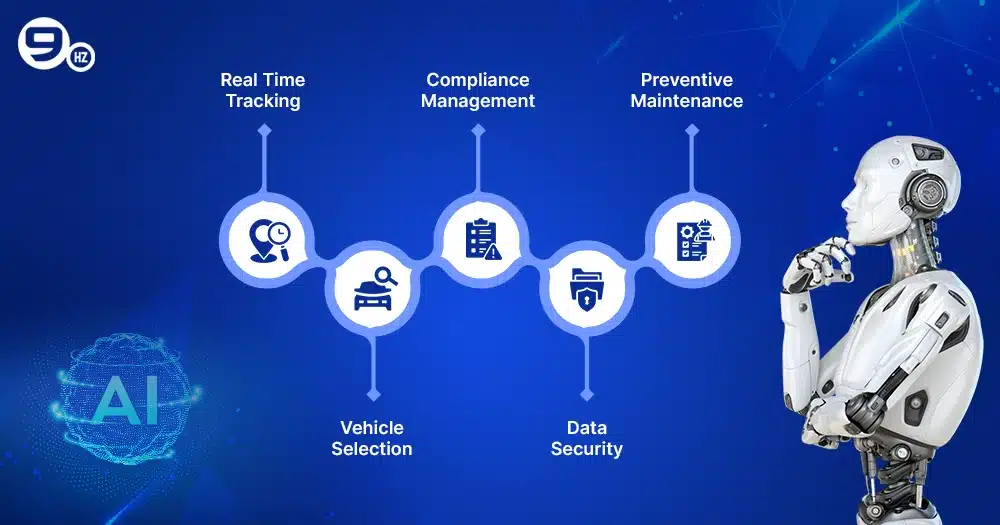
Discussing the significant role of AI in fleet management defines how redefining technologies like predictive analytics, machine learning algorithms, and highly advanced data processing capabilities have impacted fleet operations. Here are the considerations for AI in fleet management:
Real Time Tracking
It is one of the standout features that AI can provide to fleet management, with increasing capacity to deliver real-time insights. For safety enhancements, fleet managers can keep track of speed, locations, and vehicle conditions. Adding visualisation for routes and identifying unsafe behaviours for reckless driving can help cultivate a safety standard.
Vehicle Selection
Using AI, businesses can monitor historical data, trends, and business projections to place vehicle acquisition requests. It evaluates options based on operational requirements, adds budget estimation, researches vehicle models, and gets quotes, procurement, and completion of acquisition tasks.
Compliance Management
AI can assist with compliance measures by capturing vehicle data, applicable compliance requirements, licensing status, monitoring vehicle emissions, verifying inspection results, and suggesting corrective actions to avoid violating any legal or financial risk measures.
Data Security
Data in fleet management is more complex to manage, and integrating AI can protect sensitive data such as driver data, vehicle specifications, and trip records. It can further implement security measures using data encryption and multi-factor authentication to mitigate risk and insecurities.
Preventive Maintenance
If you prefer more safety and security advancements, regular inspection of tyres, brakes, and fuel level can help schedule alerts for management and follow maintenance. It can anticipate maintenance requirements before the problem escalates and recognise trends to provide necessary action.
AI Use Cases in Fleet Management
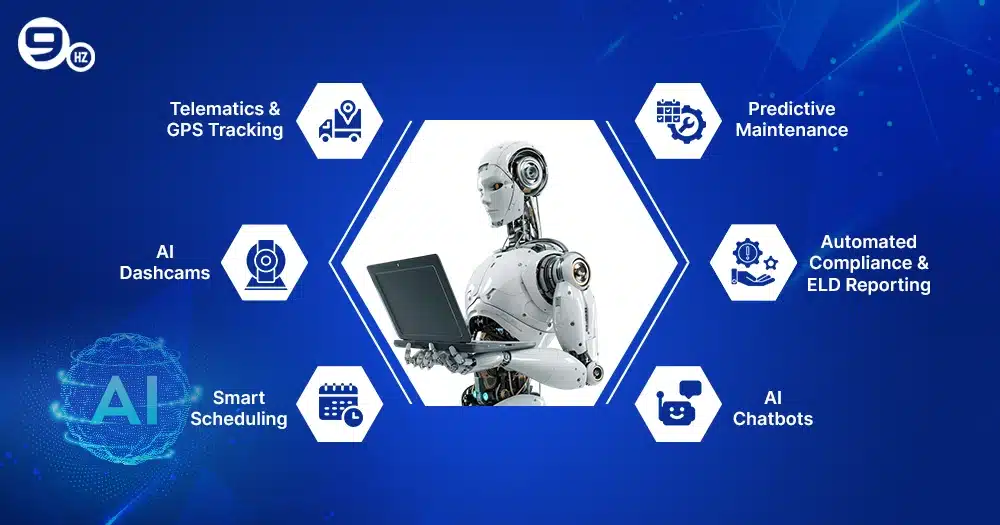
Artificial intelligence in fleet management helps to identify patterns, perform predictive analytics, and perform pattern recognition to automate routine tasks. Here are some of the different applications of AI used in Fleet Management:
Telematics & GPS Tracking
Businesses can implement telematics to collect vehicle-related data and turn insights into decisions. Over time, it evolved with GPS, cellular modems, backup batteries, sensor connections, and a digitalised telematics system. Telematics is the need of the hour due to urban infrastructure, which pushes industries to take an innovative approach and use data and technologies to maximise efficiencies.
Companies like Amazon Logistics use GPS tracking for vehicle delivery, routes, and monitoring driver performance.
AI Dashcams
Another interesting implication of AI in fleet management is the AI dash cam. It is a camera installed on your vehicle that uses AI to collect data and insights. AI dash cams constantly monitor for driver distraction and flag any dangerous pattern of smoking, speeding, harsh braking, or smoking.
Knight-Swift Transportation is employing AI dashcams of Lytx to improve driver training and reduce accidents.
Smart Scheduling
Fleet management comprises juggling tasks of tracking vehicles, maintenance, fuel management, generating reports, and safe driving experience. Smart scheduling can transform processes to achieve operational efficiencies, cost savings, more safety and risk management, and sustainability.
Uber and Lyft are using AI-powered smart scheduling to match rider bookings with drivers.
Predictive Maintenance
Data-centric insights can regulate fleet operations and reduce breakdowns with proactive management. AI-based trackers can monitor equipment failure, prioritize maintenance with no failure risk, optimize inventory management, extend asset lifespan, and ensure fleet safety. It can boost efficiency through reactive and preventive maintenance for vehicles.
Tesla has been using AI-based predictive maintenance for their electric vehicle fleet.
Automated Compliance & ELD Reporting
Companies are inclining towards using AI-based compliance systems and electronic logging devices (ELDs) to reduce manual updates to regulations and paperwork through an automated process. The ELD system can easily integrate with other fleet management software, reporting tools, and payroll. It can simply audit check-ins, inspections, and fuel tax reporting.
Schneider National is using ELD solutions to manage its fleet compliance and prevent legal violations.
AI Chatbots
Implementing chatbots can help manage fleet management with updates on data, route optimisation, regulatory compliance assistance, and operational efficiencies, and guide users for document upload. It helps to provide personalised support to fleet managers and drivers and communicate based on specific needs and roles.
Volvo Trucks is using smart feet chatbots as AI-driven digital assistance for vehicle monitoring and fleet diagnostics.
AI in Fleet Management: Challenges and Solutions
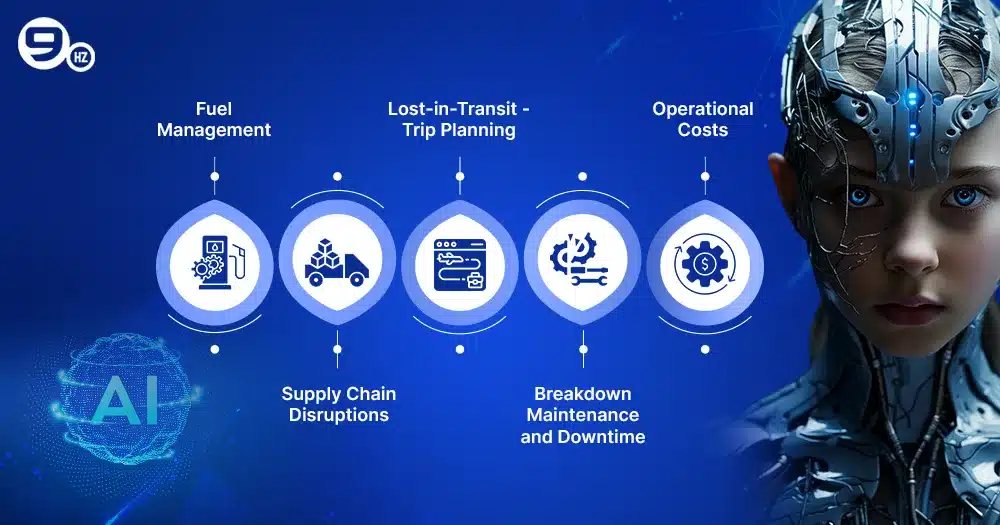
Managing fleet management using AI-based software and tools like telematics and GPS tracking on a large scale within an organization results in cost savings, safety, and efficiencies. However, there are underlying challenges while juggling tracking vehicles, ensuring driver safety, and planning routes to stay competitive. Here are the challenges related to AI in fleet management:
Fuel Management
Rising fuel costs can be a significant concern based on dynamic market and global economic fluctuation, geopolitical events, and taxes. There is no way to control fluctuating pricing. Inefficient fuel maintenance can negatively impact driving habits and broken route planning and add up to the cost.
Solution: One recommended solution is the use of hybrid and electric vehicles, fuel card systems, and AI-powered solutions with telematics, which can directly result in fuel efficiencies and reduce maintenance costs by up to 20%.
Supply Chain Disruptions
Post-COVID, the fleet management sector suffered major setbacks with supply chain disruptions, and it is anticipated that these disruptions will persist. This impacts operations in multiple ways, including high fuel prices, increased material costs, and a shortage. Companies are struggling to implement an integral solution that overcomes these challenges with optimal results.
Solutions: Solutions like automated workflows and tracking for data insights can help businesses assess market trends and price volatility. Collaborating with a supply chain software development company enables the integration of AI-based visibility tools that support shipment tracking, inventory management, and supplier coordination.
Lost-in-Transit – Trip Planning
Many companies deal with lost-in-transit issues that cause more delays, financial losses, customer complaints, and material damages. It can frustrate clients and result in reputational damage. Micromanaging drivers will further increase costs and drive overtime expenses.
Solutions: Using an ideal route optimisation tool will help deliver more efficient trips. Fleet managers can use predetermined stops, geofences for virtual boundaries and set halt times for advanced vehicle tracking.
Breakdown Maintenance and Downtime
Manual tracking has major drawbacks for maintenance deadlines and extended downtime that can impact fleet efficiencies and safety. Regular maintenance can be challenging with mismanaged schedules, vehicle downtime, and misalignment with fleet efficiencies and safety protocols.
Solutions: Installing an AI system with proactive maintenance and scheduling inspections, predictive maintenance for data analytics, and automating workflows to predict any breakdowns and accidents before.
Operational Costs
A major portion of fleet management’s operational costs comprises expenses related to maintenance, fuel capacity, insurance, and administrative costs. If a company fails to balance these costs, it can significantly impact profitability and budget. Due to green initiatives, businesses should also be required to manage CO2 emissions.
Solutions: By implementing AI-driven fuel-saving techniques and minimizing mileage, leading to lower operational costs, predictive maintenance can save from costly breakdowns and extend for fleet assets. Also, adopting smart inventory and automating administrative tasks such as invoice processing and reporting can improve operational efficiencies.
What is the Future of AI in Fleet Management?
The future trends for AI implementation in fleet management focus on the goal of sustainability, data-driven decision-making and real-time assessment. Some of the industry’s recognised names, such as Geotab, Motive, Samsara, Verizon Connect, and Fleetio, are focusing on researching new, innovative ways to implement AI.
Some existing practices, such as driver behaviour monitoring, route optimization, predictive maintenance, fuel optimization, telematics, automated scheduling, real-time analytics, and vehicle health, are setting standards for innovations.
Here are the top trends we can witness in the future of AI in fleet management:
Fleet Electrification
It is one of the innovative and strategic trends for fleet management for major shifts towards electrification. As the industry shifts to reduce carbon emissions and increase sustainability, businesses are investing in electric vehicles for their fleets. It can ensure long-term cost savings with less maintenance and fuel expenses.
AI and ML Integration
AI and ML implementation are bringing innovative changes with intelligent assistants, pattern analysers, and fleet operations management. It involves smart routing algorithms, sensor tracking and AI models, driver behavior monitoring, automated supply chain management, and real-time location tracking.
Wearable Technologies
Vehicle drivers can use wearable technology to ensure their safety. This technology can include fatigue management tools, in-vehicle alert systems, eye-tracking sensors, heart rate monitoring, and EEG sensors to reduce accidents and breakdowns. Fleet operators will provide training to drivers to use wearables and save their physical and mental health with less stress and fatigue.
Gamification
Developers are adding interesting gamification elements to fleet management tools and software to enhance the user experience. Some key measures are point-based systems, leaderboards, game-like training models, telematics, and target accomplishment dashboards.
How Can Ninehertz Help Build AI Solutions in Fleet Management?
Partnering with NineHertz, the Leading software development company, will offer you the right technology, expertise, and operations management. Our expert and skilled team can help you develop vehicle management software, Route optimization, fleet tracking tools, fleet analytical tools, consulting services, and app development.
NineHertz supports more than 100 fleet operators in developing the right software and tools, integrating features of document management, return management, vehicle maintenance, business intelligence, route optimisation, real-time GPS tracking, and driver management. ISO 9001 Certified with NASSCOM & STPI accreditation, NineHertz has set a new milestone for software development with 800+ projects across 15 years of experience.
So, if you are looking for trusted developers who can develop fleet management software with AI technologies and advanced features, count on NineHertz!
Conclusion
By the end of the blog, we can say that AI in fleet management is beyond just a technology update – it has revolutionized the logistics and transportation sector. If your business is not adapting to AI, it will be hard to stay competitive in the long run. From route optimisation to fuel efficiency, AI-powered systems can adjust to changing conditions, ensure optimal deliveries, and minimize delays. Partnering with a logistics software development company can further accelerate the integration of AI, helping fleet managers be more productive and better equipped to adapt to new technologies.
With expansion, it addresses crucial challenges like vehicle disposal by analysing factors, including vehicle age, maintenance cost, and data management. AI-driven monitoring will predict vehicle cost and help fleet managers make timely and economic decisions. So, in the upcoming years, the fleet management industry will grow with predictive analytics, real-time data processing, and machine learning.
Frequently Asked Questions
What is AI in fleet management?
It refers to the use of AI-powered systems in fleet management to analyze data from GPS, telematics, fuel sensors, and maintenance logs to improve efficiency, cost assessment, and safety measures.
How does AI improve fleet management operations?
It improves by integrating the solutions of predictive maintenance, route optimization, fuel efficiencies, driver behaviour, automated dispatching, load optimization, compliance regulations, and AI-powered fleet analytics and reporting.
What are some real-world applications of AI in fleet management?
We can have examples of DHL and FedEx implementing AI-powered route optimization to adjust delivery routes and monitor real-time traffic, weather, and road conditions. Amazon delivers AI-powered cameras to monitor drivers’ behaviour.
How does AI help with demand forecasting?
It can be analysed through data-driven predictions, real-time demand sensing, optimised fleet allocation, event-based forecasting, reduced cost and waste and improved customer satisfaction.
How does AI improve fleet management efficiency?
It can be achieved by automating routine tasks, constantly monitoring driver behaviour, predicting maintenance needs, and optimising routes.
What industries get more benefits with AI in fleet management?
Some major industries that deal with logistics and transportation include eCommerce, Mining, Construction, manufacturing, and trucking.
Can AI help to optimize inventory management?
Yes, AI can optimize inventory by selecting the right tools, parts, and supplies through predictive analysis and tracking records to overcome overstocking, reduce costs, improve maintenance efficiency, and prevent vehicle downtime.
How does AI enhance logistics and transportation?
With adoptive measures of real-time traffic management, warehouse automation, predictive analytics, and route optimisation to ensure more efficiencies, reduce costs, and improve customer experiences.
