



Key Takeaways
- Custom AI is expensive, depending on complexity and end goal. Custom AI solutions are typically priced from $10,000 to $200,000, depending on the data, model, and system configuration.
- Data is the largest driver of AI development costs. Businesses spend far more time on data processing, archiving, and analysis than on building the AI model.
- The cost of AI development is both visible and hidden. Scaling of infrastructure, model retraining, maintenance, and compliance obligations can have serious implications in the long run.
- Custom AI is more valuable in the long run than generic tools. Custom AI can be more flexible and customized to specific business needs, while SaaS AI solutions can be more expensive at first.
- Strategic planning reduces risk and improves returns on investment. Companies with clear goals, realistic budgets, and competent developers use AI faster and achieve better outcomes.
Artificial intelligence is fast becoming more than a hype and a real business impact. Today, firms use AI to automate processes, personalize user experiences, and make informed, more accurate decisions.
But before companies begin development, the question always arises: How much does it cost to build a custom AI solution?
It’s a difficult question to answer because AI projects require much more than coding.
According to McKinsey, 77% of organizations are already using or exploring AI. Furthermore, IDC estimates AI could contribute $19.9 trillion to the global economy by 2030.
Cost drivers are crucial to understand as they highly fluctuate the investment required for a business creating their own AI solutions. Quality data, model complexity, infrastructure, and integration choices all impact the final decision, and early recognition enables organizations to be more informed about their investment and to avoid costly surprises.
Let’s get started!
What Determines the Cost of Custom AI Solutions?
Each project has its own goals, data requirements, and technical challenges. Unlike traditional software, AI development is the product of experimentation, continuous learning, and constant optimization. Ultimately, firms decide on what to invest in their AI systems on several fronts.
Here are the five most important factors that impact the cost of custom AI solutions:
1. Problem Complexity
Cost is most influenced by the complexity of the custom AI solutions. Such an application as a simple chatbot or automation tool requires less effort to develop, while more complex applications, such as predictive analytics or real-time decision engines, need extensive research, testing, and refinement.
2. Data Quality and Preparation
Qualitative data is a major feature of the AI models. Teams devote a great deal of time organizing, cleaning, labeling, and analyzing data. Poor or incomplete data takes longer to develop and costs more.
3. Model Development Approach
Pricing also depends on either adjusting existing models or building a newmodel from scratch. Pre-trained models are relatively costly. On the other hand, fully customized models need more expertise and computational resources.
4. Infrastructure and Computing Resources
Cloud services, GPUs, and data storage are needed to train and run AI models. Larger datasets and processing needs in real time result in higher infrastructure costs.
5. Talent and Expertise
Developers, data scientists, and machine learning engineers are crucial to AI projects. The investment in experienced engineers is highly significant for project budgets as experts in AI are sought after.
10 Key Factors Influencing Cost of Building Custom AI Solutions
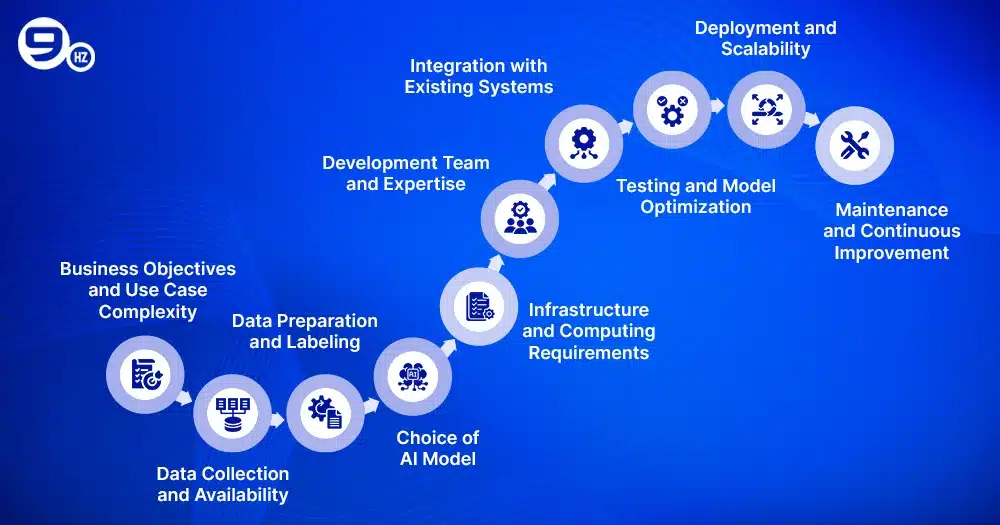
A solution to AI requires thinking, technical knowledge, and repetition. Instead of traditional software, AI development requires experimentation, data refinement, and continuous optimization. That is, costs are enormously variable due to several technical and business factors. Here are 10 significant factors that affect the cost of building custom AI solutions.
1. Business Objectives and Use Case Complexity
Development can be a costly affair, depending on the magnitude and complexity of your business problem. Even a simple chatbot that merely relies on AI to answer the frequently asked questions is far less expensive than a complex recommendation engine or predictive maintenance. Successful operation conditions in complex systems include algorithm design, increased time of experimentation, and increased time of validation. Effective objectives help the teams to save time, which would otherwise be squandered in the development and control expenses.
2. Data Collection and Availability
AI systems learn from data, and therefore, this access to relevant datasets is crucial for cost estimation. Development can be swift if your organization already has structured and usable data. But when data is collected at multiple levels, customer interactions, sensors, or third-party providers, the project timeline and budget are dramatically reduced. Often, data acquisition is not an investment that businesses look at very early on.
3. Data Preparation and Labeling
In general, raw data does not always materialize as quickly as an input to machine learning models. Teams have to clean duplicates, fix inconsistencies, fix errors, and structure information correctly. Many programs require developers to identify images, text, or audio manually to train models correctly. This preparation phase can take a large portion of project time because better data directly improves AI performance.
4. Choice of AI Model
Cost has a huge impact on the development method. Businesses can tweak existing pre-trained models or build entirely new models to meet their own needs. Fine-tuning reduces the amount of time wasted, and infrastructure is erected, while model building is a complex process that requires extensive computational power, as well as research and experimentation.
5. Infrastructure and Computing Requirements
A powerful computing environment is essential to the development of AI. The most common training models require GPUs, cloud platforms, large storage systems, and scalable processing power. Models run large datasets or provide higher-cost real-time predictions. On top of that, the cost of infrastructure increases after installation as the systems address live user interaction.
6. Development Team and Expertise
Custom AI projects also require professionals such as data scientists, machine learning engineers, software developers, and domain experts. Experts have better models and can lower development risk, but they are more costly. Cost and time frames also depend on the size and level of the team.
7. Integration with Existing Systems
AI-based systems cannot function on their own, but must join existing business systems. Models must work with applications, databases, APIs ,and internal workflows of developers. The development time to develop and the cost and time for complex legacy systems or security needs can be enormous.
8. Testing and Model Optimization
Experimentation is the key to improving AI models. Teams test multiple versions of models, adjust parameters, and assess performance by applying real-world scenarios. It is an iterative process that is accurate and reliable, but takes more computing power and development hours. Continuous optimization is necessary before and after deployment.
9. Deployment and Scalability
Suddenly, the idea becomes an AI solution, with new challenges. The teams should have the system adaptable to handle real-world traffic. The first step is to add monitoring tools, automated pipelines, and scalable infrastructure, but it does not cause performance problems.
10. Maintenance and Continuous Improvement
AI systems don’t quite get there. Models need to be retrained and redesigned as user behavior changes and new data emerge. Businesses have a responsibility to maintain performance, address biases, become more efficient, and build new infrastructure over time. These efforts now account for large percentages of the lifecycle cost of custom AI solutions.
Average Cost of Building Custom AI Solutions in 2026
In 2026, custom AI solutions can cost much more because no two AI projects are the same. Data complexity, customization, infrastructure needs, and team expertise all influence the final investment. It’s fairly easy to build small AI systems from existing models, but it takes time, experimentation, and computing power to build enterprise-level systems.
For instance, industry estimates for most AI projects today run $10,000 to $200,000 and several million for large enterprise platforms or fully customized AI ecosystems, depending on their size and complexity.
| AI Solution Type | Estimated Cost Range (USD) | Development Timeline |
|---|---|---|
| Basic AI Automation | $10,000 – $25,000 | 4–8 weeks |
| Custom AI MVP (Minimum Viable Product) | $25,000 – $60,000 | 2–4 months |
| Business Intelligence AI System | $50,000 – $100,000 | 3–6 months |
| Advanced AI Application | $80,000 – $150,000 | 4–8 months |
| Enterprise AI Platform | $120,000 – $180,000+ | 6–12+ months |
| Large-Scale Custom AI Systems | $150,000 – $200,000+ | 9–18+ months |
Hidden Costs in Custom AI Development
Businesses typically plan for visible costs like development time, infrastructure, and hiring experts in their custom AI project. Yet many AI projects are more expensive than initial budgets as hidden costs are the result of development or beyond. These costs are often not seen in the initial estimates, but are important to the total cost of ownership.
Understanding these hidden costs helps organizations better plan for future financial uncertainties and avoid such costly surprises later.
1. Data Cleaning and Preparation
The majority of firms do not realize the level of effort required to prepare data. Raw data is often inaccurate, contains duplicates, missing values, or inconsistent formatting. For the models to learn well, teams spend time cleaning, assembling, and validating data. This is the only phase that can consume a great deal of time during a project.
2. Data Labeling and Annotation
Labeled data are important for many AI models to train correctly. Labeling images, text, audio, or videos is often done manually or with external services like annotation. Larger datasets often lead to a rapid increase in labeling costs, particularly in complex cases such as computer vision or natural language processing.
3. Model Retraining and Performance Drift
AI models aren’t perfect. Model drift can result from changes in user behavior, market conditions, or raw data, as well as over time, problems with models. Model retraining requires teams to periodically retrain models, including development and computational costs.
4. Infrastructure Scaling Costs
Estimates on the initial infrastructure are often limited to development. Once the AI solution is ready and used, businesses need to scale up cloud resources, storage, and processing power. It is likely that the operating cost will increase tremendously during busy periods or when requests are processed in real time.
5. Integration Challenges
Connecting AI systems to third-party software, databases, or services is often more difficult than you might think. Compatibility issues, security changes, and API development require substantial additional engineering work that wasn’t included in early budgets.
6. Testing and Quality Assurance
AI testing is based on probabilistic rather than fixed outcomes, unlike traditional software testing. In many cases, teams test accuracy, bias, edge cases, and real-world performance.
7. Compliance and Data Security Requirements
Privacy and security governance should be adhered to in organizations that deal with sensitive information. Encryption, access controls, audits, and compliance checks should be developed further, but they should be performed to implement safe AI.
8. Ongoing Monitoring and Maintenance
If a system is to function smoothly, it needs constant monitoring after it’s deployed. Model accuracy, system health, and user actions are kept on hand for teams to continually improve and improve results. Businesses often overlooks repeated operational costs of these ongoing activities.
How can The NineHertz Help You?
The NineHertz, a leading AI development company, has a well-defined development process to help enterprises transform their ideas into revolutionary AI-oriented products. Their process starts by digging deep with customers on their business goals, needs, challenges, and data, and then building a bespoke AI strategy. They provide end-to-end support along the entire process of AI consulting, data preparation, model building, and system integration, customized to your business objectives at each stage. The company’s use of current A.I. modeling and scalable technologies provides solutions to create efficiencies, put processes on autopilot and enable smarter digital experiences.
In addition to this development, The NineHertz provides ongoing support to ensure your AI solution continues to work properly as your business grows. They also assist you in testing, deploying, iterating on, and maintaining your models to keep them relevant and accurate over time. Whether a bespoke chatbot or a predictive analytics, computer vision, or intelligent automation application, the company helps it build scalable AI products that will create long-term business value and foster innovation.
Conclusion
The requirement for custom AI technology will be beyond leveraging new technology in 2026; it requires thorough thought, experience, and an adequate understanding of cost drivers. From data preparation and model development, infrastructure and long-term maintenance, each decision affects the overall investment and success of an AI project. Those companies that plan, articulate practical use cases, and improve scalability at an early level could drive real-time, measured value from AI over short-term experiments.
This process can be much easier if you choose an experienced AI development company. The NineHertz helps businesses design, develop, and scale customized AI solutions to specific business goals while remaining cost-effective and technically advanced. With the right technology partner, organizations can control risk, reduce costs of development, and help develop AI ideas to deliver reliable, long-term solutions that drive growth and innovation.
FAQs
How much does it cost to build a custom AI solution?
The cost of a custom AI solution is typically $10,000 to $200,000. They are either simple automation tools or AI-powered chatbots, with higher investment in enterprise-grade platforms that feature advanced analytics, integrations, and large datasets. The final cost is heavily influenced by data preparation, infrastructure, and customization level.
What is the biggest cost driver in AI projects?
Data preparation often becomes the largest cost driver in AI development.Many teams spend time gathering, cleaning, organizing, and labeling data prior to training models. Artificial intelligence systems will not produce very good results unless they are well-constructed, and firms must invest enormously in this stage to guarantee long-term success.
Is custom AI more expensive than SaaS AI tools?
Yes, the upfront cost of custom AI solutions is typically more than that of SaaS AI tools, because they are built for you by the developer. But customised AI solutions can often add more value over time. It provides greater scalability, greater integration with existing systems, greater control of data, and specific performance that some generic SaaS platforms may not provide.
How long does custom AI development take?
Custom AI development takes between 2 and 12 months, depending on the scale of the project and data quality. Basic AI MVP could be out in a few months, while enterprise-level solutions need longer time frames for model training, testing, integration, and optimization. Setting clear goals and prepared datasets can speed up development.
Can small businesses afford custom AI?
Yes, small businesses can afford custom AI by starting with specific, impactful use cases rather than large-scale implementations. Many start with an AI MVP or automation solution to verify results and then expand further. With the growth in the cloud and the availability of pre-trained models, small companies are now able to employ custom AI more quickly and easily than ever before.
