



Scroll through a few marketing blogs, and you’d think the marketing tools have already taken the wheel. You see endless posts about AI-powered customer journeys, intelligent agents performing marketing tasks, and self-optimizing campaigns. On the surface, it sounds like marketing automation is already fully “smart” and running on its own.
But once you’re inside a real marketing org, that “self-driving” story starts to fall apart fast.
Yes, AI decisioning, or, put simply, autonomous decision-making in marketing, is real. It can help decide what to do next for each customer: which message to send, which channel to use, when to reach out, and who to target with an offer.
But it isn’t magic. It only works when the system is designed well, uses reliable data, and fits the way marketers actually plan and run campaigns. For every big AI success story, there’s another team dealing with messy data, unsure whether to trust automation, or overwhelmed by how hard it is to plug AI into their day-to-day work.
That’s why, for this report, I went directly to the platforms building the next generation of decision intelligence. Over the past several weeks, I gathered candid input from five companies leading this evolution: MoEngage, Customer.io, Blueshift, Bloomreach, and Iterable. Collectively, they power decision-making for thousands of brands across SaaS, retail, fintech, and more.
I asked them what’s really happening behind the scenes, how far companies have come with AI-guided decisions, what’s working, where decisioning fails, and what innovation is coming next.
This report isn’t about the hype or futuristic predictions. It’s about the practical, grounded reality of AI decision intelligence today, how it works, where it’s headed, and what the platforms themselves are seeing across their customer base.
TL;DR: AI decision intelligence at a glance
Here are the key trends shaping 2026:
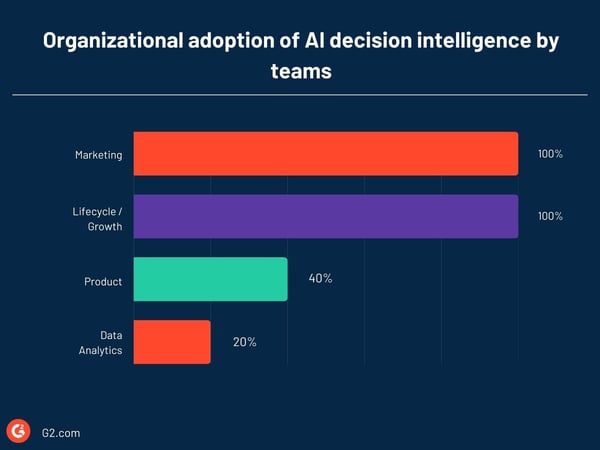
- Adoption is accelerating: Between 26% and 75% of customers across vendors already use AI decisioning features, signaling a decisive shift from testing to operational use.
- The future is autonomous: Every vendor highlighted autonomy, real-time decisioning, automated next-best actions, AI-driven experimentation as the next major breakthrough.
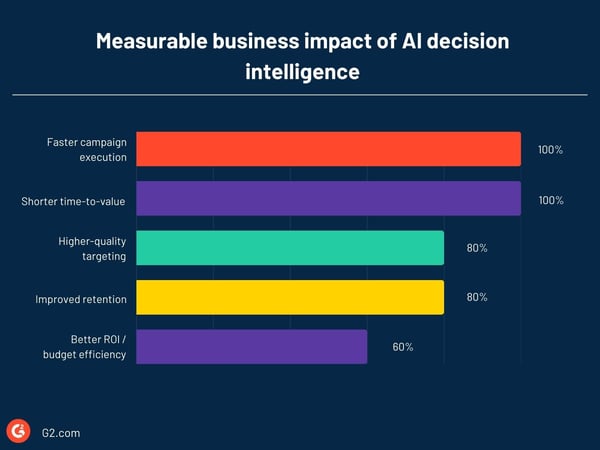
- Impact is measurable: Platforms consistently reported faster execution, higher conversion rates, improved retention, stronger targeting, and better ROI.
- Data remains the biggest roadblock: Even the most advanced AI systems fail when data lacks structure, completeness, or integration.
- AI explainability is gaining importance: Teams want systems that “think with them,” not just act for them, a theme repeated across multiple vendors.
- AI decision engines are becoming sharper and more context-aware: Capabilities like real-time optimization, journey orchestration, predictive modeling, and in-product intelligence are maturing rapidly.
AI decision intelligence is no longer an abstract concept, it’s becoming the core operating system for modern marketing teams.
.jpg?width=600&height=450&name=AI%20Decision%20Intelligence%20Adoption%20Distribution%20(1).jpg)
These signals are based on what leading platforms are seeing across their own customer bases today. To show how I arrived at these takeaways, here’s a quick look at the methodology behind this report.
Methodology
Between late November and early December 2025, I sent a structured survey to five industry-leading platforms shaping AI decision intelligence in marketing:
I asked each vendor to share:
- Their current AI decisioning capabilities
- Adoption across their customer base
- Areas of innovation and future investment
- The real-world outcomes decision intelligence improves
- Barriers preventing teams from scaling AI
- What decision intelligence means in their own words
I analyzed the responses to surface clear patterns, themes, and early signals that point to where decision intelligence is heading.
Together, these responses offer a cross-section of how AI decision intelligence is being built and used today.
Before we dive into the details, it’s worth briefly introducing the five platforms behind these insights.
Who are the five innovators defining AI decision intelligence in 2026?
This report includes insights from:
- MoEngage (G2 Rating: 4.5/5): Known for goal-based autonomous agents and intelligent decision orchestration.
- Customer.io (G2 Rating: 4.4/5): Focused on lifecycle automation, experimentation, and in-product decision support.
- Blueshift (G2 Rating: 4.4/5): A leader in predictive intelligence, real-time decisioning, and customer data activation.
- Bloomreach (G2 Rating: 4.6/5): Specializes in real-time data structuring and autonomous campaign execution.
- Iterable (G2 Rating: 4.4/5): Powers adaptive, cross-channel customer journeys with strong predictive modeling.
These platforms represent the core of the decision intelligence ecosystem, and their perspectives shape the analysis that follows.
What does decision intelligence in marketing look like today?
This section focuses on how AI decision intelligence is being applied in live marketing environments today.
AI decision intelligence has moved beyond predictive scoring and simple rules-based workflows. What I saw across the vendor responses is a robust system of interconnected decisions, decisions about who to target, which channel to use, when to send, what to say, and how to adapt based on real-time performance.
Across all five platforms, the most widely adopted AI-driven decisions include audience selection, channel routing, send-time optimization, journey progression, creative optimization, and automated A/B testing. In many cases, these decisions happen at a scale that would be impossible for human teams to manage manually.
It’s not just automation; it’s orchestration. Marketers are increasingly relying on AI to reduce guesswork and guide their next move.
Vendors like MoEngage, Blueshift, and Iterable describe customers using AI to automate increasingly complex decision flows, from adaptive cross-channel journeys to real-time optimization. Customer.io also points to growing interest in AI-driven performance interpretation, where decision intelligence helps surface insights and recommendations that might otherwise be overlooked.
The direction is clear: teams are shifting from manually coordinating campaigns to supervising systems that make and justify intelligent decisions in real time.
“We’re seeing AI decisioning deliver transformative outcomes. Global brands expect adaptive journeys that reason in order to consistently drive higher conversions, increase retention, and accelerate time to value.”
Gray Hardell
Senior Director, Product Marketing, Iterable
How mature are brands in AI decision intelligence in marketing?
One of the most revealing findings is how differently brands approach AI maturity depending on the platform they use and the data foundations they’ve built.
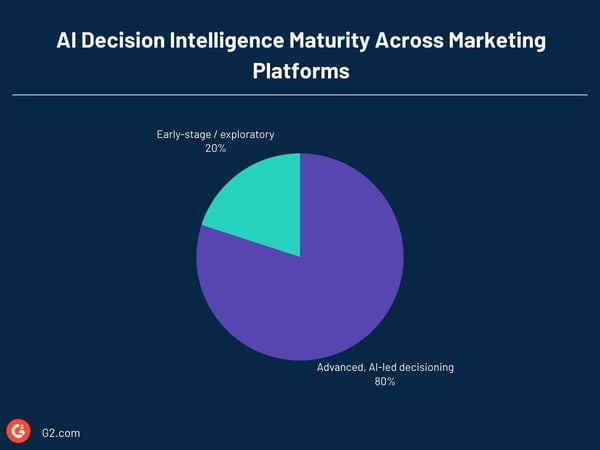
MoEngage, Blueshift, Bloomreach, and Iterable describe operating at an advanced stage, supported by years of investment in predictive modeling, autonomous decision engines, and real-time optimization frameworks. Their customers are applying AI across multiple decision layers, from audience selection and channel choice to experimentation and journey orchestration; embedding decision intelligence directly into execution workflows.
Customer.io reflects a phased adoption model that mirrors how many organizations evolve. Their users are beginning with predictive signals and lightweight automation, then expanding into more connected decision workflows as data readiness and internal confidence grow. Rather than a single maturity curve, this highlights how decision intelligence adoption progresses incrementally, shaped by organizational context and priorities.
Vendor responses point to a clear shift in expectations: advanced, AI-led decisioning is no longer limited to experimentation, but increasingly embedded into core marketing workflows. That lines up with what we’re seeing in G2 Data as well. Nearly 60% of enterprises now have AI agents in production, and we predict that aggressive adopters of AI-powered automation will reduce marketing operational costs by 30%.
“Marketers don’t need more dashboards; they need smarter decisions. AI is becoming the engine that predicts opportunity, automates execution, and accelerates growth.”
Janet Jaiswal
Global VP of Marketing, Blueshift
How many customers are using AI decisioning in marketing today?
When vendors were asked what percentage of their customers actively use AI decisioning features, the responses revealed an encouraging trend: adoption is solid and rising quickly.
- MoEngage and Customer.io estimated adoption between 26% and 50%, reflecting the early to mid-stage journey many of their customers are on.
- Blueshift, Bloomreach, and Iterable reported significantly higher adoption, between 51% and 75%, highlighting stronger readiness and deeper reliance on decision intelligence.
Taken together, these ranges suggest we’re somewhere between early adopters and early majority on the adoption curve. AI decisioning is now a meaningful part of how many teams operate, but there’s still plenty of headroom, often within the very same platforms for growth. In past years, AI was often applied narrowly, to score leads, predict churn, or recommend content. Today, companies are weaving AI into the decision-making fabric of their operations.
What results AI decisioning actually delivers in marketing
Across vendor responses, measurable impact surfaced most clearly in execution speed, performance lift, and efficiency gains.
Across the five participating vendors, the following performance outcomes were consistently validated as the areas where AI decisioning drives the most noticeable improvements:
- Campaigns go live faster
- Conversions increase
- Retention improves
- Budgets stretch further
- Targeting becomes more accurate
- Time-to-value decreases
MoEngage, Bloomreach, Blueshift, and Iterable all pointed to meaningful gains in execution speed. By letting AI handle decisions that once consumed hours of manual setup, marketers reclaim time for strategy and experimentation.
Conversion improvements were also common. When audience selection, send-time optimization, and channel choice shift from guesswork to machine-driven precision, performance naturally follows. Blueshift emphasized this specifically in the context of real-time decision loops that eliminate delays between insight and action.
Retention gains emerged from predictive identification of at-risk users and automated re-engagement flows, areas where MoEngage, Iterable, and Bloomreach have seen strong impact.
Once decisions become automated and self-optimizing, performance improvements begin reinforcing each other across campaigns, channels, and journeys. That compounding effect ultimately shows up as revenue growth, but only when teams move beyond productivity gains and start automating with goal-based AI agents, a point MoEngage emphasized strongly.
“Marketers don’t need AI that acts for them — they need AI that thinks with them. Decision intelligence closes the gap between ‘here’s your data’ and ‘here’s what it means,’ giving teams the insight to move faster without losing control of the strategy.”
Naomi West
Senior Product Marketing Manager, Customer.io
Why decision intelligence in marketing sometimes fails
This section examines where decision intelligence breaks down in real-world marketing operations
For all the upside AI decisioning delivers, every vendor also agreed on a hard truth, even the most sophisticated AI systems falter when foundational elements aren’t in place. The vendors were unanimous on this point: data quality is the single greatest barrier to effective decision intelligence.
AI-driven systems require clean, unified, and timely data. Without it, decisions either stall or misfire. Blueshift emphasized this challenge directly, pointing to the need for richer datasets and deeper integrations.
Iterable mentioned that skill gaps within customer teams often restrict adoption. Even when the tech is in place, teams may not know how to design decision strategies, interpret outputs, or integrate AI into their processes. Bloomreach highlighted that even advanced systems struggle when organizations lack internal alignment or clarity around goals for what decision intelligence should achieve. In other words, you need both the capability and the clarity to make AI decisioning work.
Customer.io raised another critical point: explainability. Teams hesitate to adopt AI-driven decisions when they can’t understand why the system recommended a particular action. That gap erodes trust and slows down adoption.
Vendor responses consistently pointed to operational readiness as the limiting factor, not model capability. Without robust processes, clear strategies, and educated teams, even the most powerful decision engine cannot deliver transformative value.
Where will teams invest marketing AI decision-making in 2026?
If data, skills, and trust are where decision intelligence in marketing breaks, they’re also where teams are now focusing their energy. From vendor responses, it’s clear that companies are preparing for deeper, more integrated AI decisioning by strengthening three core areas.
Real-time data infrastructure
Across responses, platforms emphasized the need for faster, more reliable data pipelines. Teams are investing in systems that surface customer signals instantly, so AI-driven decisions are grounded in the freshest possible context. As decisioning moves closer to real time, outdated or delayed data quickly becomes a bottleneck.
Predictive and autonomous decision engines
Vendors consistently pointed to advances in predictive modeling and autonomous execution as a major investment priority. Blueshift and Bloomreach highlighted the importance of systems that learn continuously and adjust decision logic in real time. MoEngage and Iterable echoed this direction, emphasizing goal-based agents and adaptive workflows that reduce the need for constant manual reconfiguration as campaigns scale.
Customer enablement and trust-building
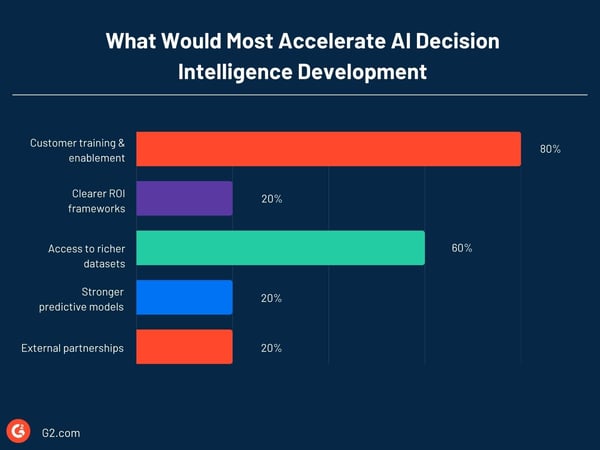
Several platforms underscored that technology alone isn’t enough. For decision intelligence to succeed, teams need training, clearer ROI frameworks, and systems that feel collaborative rather than opaque. Investment is increasingly flowing into enablement, helping marketers understand, trust, and confidently guide AI-driven decisions instead of working around them.
What I found especially telling is that vendors consistently described investment priorities that span data, people, and process. The evolution of decision intelligence is as much about people, skill development, and trust as it is about models and algorithms.
Where is decision intelligence in marketing heading next?
Across every vendor response, one message was clear: 2026 marks the shift from AI-assisted decision-making to autonomous execution.
MoEngage’s goal-based agents, Bloomreach’s real-time memory framework, Blueshift’s self-refining intelligence, Iterable’s adaptive journeys, and Customer.io’s expanding decision layers all point toward the same future; AI systems that don’t just inform decisions, but actively carry them out.
As autonomy increases, four changes will define the next phase of decision intelligence.
From recommendations to autonomous action
Decision intelligence is moving beyond surfacing insights or “next best actions.” Autonomous systems will continuously evaluate options, select the optimal path, and execute decisions across targeting, timing, channel selection, and creative delivery. Bloomreach envisions this extending to fully autonomous campaign execution, where AI generates content, chooses distribution paths, and optimizes outcomes without manual orchestration.
From static testing to continuous experimentation
Experimentation will no longer be a discrete workflow. Instead of planning individual A/B tests, teams will rely on AI systems that generate hypotheses, allocate traffic dynamically, measure outcomes, and roll forward winning variations automatically. Iterable and MoEngage both point toward experimentation becoming an always-on capability embedded directly into decision engines.
From scheduled optimization to real-time recalibration
As decision systems ingest live behavioral signals, optimization will happen moment by moment rather than in fixed cycles. Blueshift describes this as the continuous transformation of unified customer data into high-impact decisions, where every interaction refines the next one in real time.
From external automation to in-product intelligence
Decision intelligence is also moving closer to the product experience itself. Customer.io highlights the growing role of in-product guidance, where AI supports users directly within the application, adapting onboarding, feature discovery, and engagement based on live usage patterns.
Taken together, these shifts signal a fundamental change in how marketing teams operate. As decision intelligence becomes autonomous, marketers move away from configuring workflows and toward directing strategy, setting goals, defining guardrails, and overseeing intelligent systems that learn, act, and optimize continuously.
“The future of AI decisioning is autonomous, where marketers and lifecycle experts act less like important cogs in the campaign machine and more like air traffic controllers who oversee AI agents executing and optimizing campaigns.”
Jonathan Senin
Senior Product Marketing Manager, Bloomreach
What this means for leaders in 2026 and beyond
One theme stands out above all: AI decision intelligence is becoming the foundation of how modern marketing teams operate.
Leaders who want to stay ahead should begin laying the groundwork now.
This starts with improving data readiness, unifying sources, cleaning structures, and ensuring signals flow where they need to go. It also means building internal AI literacy so teams understand not just how to use decision intelligence, but how to trust it.
Most importantly, leaders must rethink how marketing gets done. Instead of manually orchestrating campaigns, teams will increasingly design systems that think, adapt, and optimize autonomously.
“Over the past decade, marketers have increasingly adopted AI, with Generative AI driving significant productivity gains in the recent past. However, this increased productivity does not guarantee higher revenue. To achieve real growth, brands must implement AI Decisioning.
By utilizing goal-based AI Agents, companies can finally automate the massive number of micro-decisions needed to personalize every customer interaction”
Raviteja Dodda
CEO & Co-founder, MoEngage
Final reflections and what comes next
After analyzing insights from MoEngage, Customer.io, Blueshift, Bloomreach, and Iterable, a clear direction emerges: AI decision intelligence is entering its defining phase.
The shift underway is more than faster automation; it represents a fundamental redesign of how marketing decisions are made. Teams are beginning to supervise systems that can reason, learn, test, and autonomously optimize outcomes across channels and customer touchpoints.
In the months ahead, decision intelligence will extend deeper into planning, orchestration, and real-time optimization. Marketers will spend less time manually assembling campaigns and more time directing intelligent agents that adjust journeys, creative, targeting, and timing on their own.
And as data becomes continuously activated rather than passively collected, organizations will unlock decision loops that get smarter with every cycle.
To understand how AI is reshaping marketing workflows and decision-making, explore G2’s AI Marketing Mind report, a research-backed resource on the tools and intelligence powering the next generation of autonomous marketing.
