



Merging Artificial Intelligence (AI) with IoT is one of the groundbreaking approaches in the technology domain. On one side, IoT combines different systems for data compilation, while Artificial Intelligence (AI) implements the capacity to perform tasks that require human intelligence, such as predicting, identifying objects, or generating natural language. Combining these two tech supports helps to decode a new way of automation for IoT infrastructure that scales basic functionalities to use simple data for real-time decision making. We can take examples of smart home automation, autonomous vehicles, and predictive maintenance to demonstrate the real use case of Artificial intelligence in IoT.
With the growing trends of AI in IoT, businesses are expanding their secure and intelligent system. From edge computing, digital twins, IoT security enhancements, to Green IoT, artificial intelligence has major use cases in IoT for supporting real-time decision making.
For businesses exploring IoT app development services, The NineHertz stands out as a leading IoT app development company delivering custom IoT applications, seamless platform integration, embedded software & firmware development, and advanced IoT data analytics to help businesses drive innovation and efficiency.
Let’s dive into the details of the benefits, use cases for Artificial Intelligence in IoT with the blog ahead.
What is Artificial Intelligence in IoT?
Artificial Intelligence is deemed as the simulation of human intelligence using specialised algorithms through speech recognition, machine learning, NLP, and machine vision. Integrating artificial intelligence capabilities into the Internet of Things (IoT) devices helps in creating intelligent and autonomous systems. AI enables IoT devices to process a large volume of data, provide access control, analysis, and optimisation. It allows IoT networks to deliver improved functionalities to develop smart devices and sensors.
We can take the example of the manufacturing sector, where smart factories are using IoT and AI to develop a predictive maintenance system. Installing AI sensors linked to IoT devices to predict any breakdown and failure that significantly results in cost savings and increased efficiency.
Why is AI the Game-Changer for IoT?
It is the biggest game-changer as AI works like the smart brain, while IoT functions as the nervous system for the digital world. One of the key drivers of interconnected IoT devices is transferring real-time data, and automation converts this process more smartly, faster, and personalised through advanced human intelligence.
The convergence of AI into IoT has transformed the adoption of Industry 5.0 to establish synergy between manual intervention and intelligent systems across different applications. It eases the transition to merge the digital and physical domains that favour predictive maintenance, defect prediction, automated product development, and sustainability analytics.
One of the classic examples is autonomous vehicles that utilise AI to process data through sensors and allow drivers to navigate without manual control. These vehicles are embedded with an array of IoT devices comprising lidar, radar, cameras, and sensors to collect data. The AI algorithm will analyse to identify objects, predict movements, and enhance safety measures. Top companies like Waymo, Tesla, and Uber are investing in adopting AI in IoT to conduct extensive testing and launch self-driving vehicles with safe transportation systems.
How Artificial Intelligence Powers IoT Applications?
AI maximises IoT application capabilities to build intelligent systems. AI integration can extract real-time insights, detect patterns, and make predictions to support industrial and healthcare IoT. Next, Natural Language Processing connects with IoT devices to control via voice commands through a virtual assistant like Amazon Alexa or Google Assistant. AI can improve security by tracking for any potential vulnerabilities by analysing existing patterns.
AI brings more flexibility to handle complex IoT networks with millions of devices, support smart data analysis, predictive maintenance, anomaly detection, and a customised experience.
Some key examples:
- For smart homes, AI can track fluctuating energy levels, sensors to control light and temperature, and manage security systems.
- For Healthcare, it can analyse health issues and provide personalised health recommendations.
- In transportation, AI integrates with IoT to manage predictive parking, logistics, and optimise traffic flow.
To explore more on IOT, you may also like reading our detailed blogs on
20 Top IoT Development Companies (2025)
IoT Impacting the Future of Web Development
Real-World Use Cases of AI in IoT
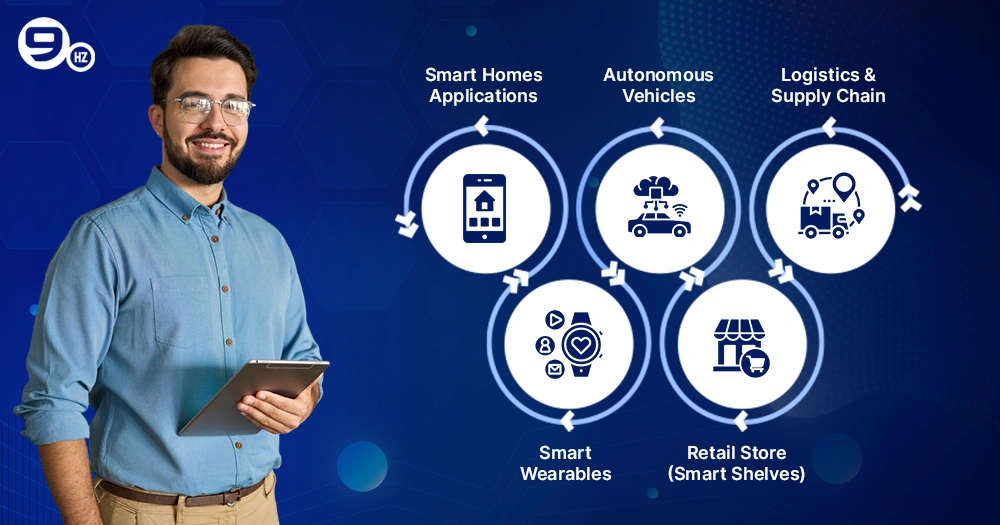
From the consumer space to multiple industry domains, the use cases of AI in IoT are increasing day by day to train for different tasks, including data collection, training models, or generating inferences and predictive insights. Here are the following use cases of AI in IoT:
Smart Homes Applications
For the smart home settings, IoT devices include lightning systems, cameras, and thermostats that collect real-time data based on user behaviour. It perfectly works for energy management through adjusting temperature, like Google Nest does for the heating and cooling effect. Combining AI in IoT for smart homes results in cost savings and environmental footprint in daily lives.
Smart Wearables
With the increasing trend of fitness trackers and smartwatches, AI in IoT helps to integrate an advanced system for tracking key health data like oxygen levels, sleep cycles, and heart rate. It also helps to maintain other metrics to track for activity, like workout intensity, calories burned, and regular steps taken. AIoT supports personalised health checkups to increase proactive treatment.
Autonomous Vehicles
Modern vehicles require AI for IoT devices to collect data through GPS, camera, and radar. Automation processes real-time data for a balanced driving experience, detecting collisions, predicting obstacles, and navigating lane changes. For example, Tesla Autopilot comes with self-driving smart features and increases safety protocols.
Retail Store (Smart Shelves)
AI with IoT track for shelf inventory, count product interactions, and check for customer movement to comprehend their buying pattern. Smart shelves can send an alert to staff when inventory is low, and AI can predict to improve sales and less checkout time. By combining AI sensors into IoT devices, it delivers personalised recommendations for improved customer engagement.
Logistics and Supply Chain
Many delivery companies like FedEx and DHL use AI in IoT to track supply chain operations by constantly monitoring location, temperature, and humidity for product quality control. Artificial intelligence further adds features of automated warehousing and demand forecasting to deliver fast and reliable logistics solutions.
Benefits of AI in IoT
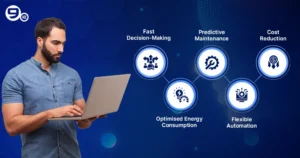
The integration of AI into IoT devices helps businesses enhance their capabilities and easily transfer, store, and process data. It improves multiple dynamics of IoT devices for data analysis, personalisation, failure detection, real-time decision making, and resource allocation. Let’s list all the benefits of implementing AI into an IoT system:
Fast Decision-Making
Any industry dealing with a vast amount of data that is constantly updating requires prompt decision-making. Manual processes may take hours, while AI with IoT will analyse data within seconds and save time for operators. As a result, the company can make informed decisions while minimising the risks.
Optimised Energy Consumption
Many sectors demand energy-saving operations to save huge expenses. Through automation, it can monitor for energy consumption rate and automatically adjust to reduce wastage. AI-based video trackers and motion sensors are improving the energy efficiency of overall production.
Predictive Maintenance
By integrating AI in IoT, this will provide access to predictive maintenance that can significantly reduce unplanned equipment failure and downtime. For manufacturing plants, unexpected breakdowns resulting in huge losses and business, are opting for AIoT tools to save additional costs through early detection.
Flexible Automation
Previously, companies faced difficulty training robots to adapt to changes that affect productivity. However, with AI in IoT, these adaptations are making automation more practical and easier to handle in a changing environment. Bots with AI capabilities can make faster and better decisions.
Cost Reduction
AI integration for IoT devices has eliminated major operational tasks for optimised resources, reduced wastage, automated tasks, and low operational expenses. This results in saving additional costs to increase profitability and can make the business more competitive in the market.
Also Read
How to Build an IoT App?
Challenges in AI + IoT Integration
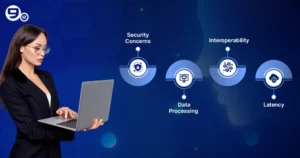
There are numerous benefits of AI and IoT integration that revolutionise industries for better data analysis, process optimisation, predictive maintenance, and improved decision-making. However, multiple challenges might come in the pathway during implementation. Let’s discuss here:
Security Concerns
IoT devices are bound with the risk of cyberattacks due to weakened security protocols; however, integrating AI will implement end-to-end security and extra protection. AI algorithms protect sensitive personal information and support accurate predictions.
Data Processing
Another challenge is handling unstructured data generated through IoT devices. Specifically, while dealing with deployment from multiple sources, this might increase complexities. AI models are trained to process data and filter to extract insights.
Interoperability
In many cases, the lack of standardisation across IoT devices and platforms make it more difficult to integrate AI in IoT. As the system follows diverse communication data formats and operating systems, it can lead to compatibility issues. Following IoT protocols and AI frameworks will favour smooth integration.
Latency
AI with IoT has deployed applications like healthcare monitoring tools, industrial automation, and self-driving vehicles. During the operations, transferring IoT data to cloud AI processing often shows latency. This creates a challenge to optimise AI models for low latency without compromising accuracy and processing power.
Higher Implementation Costs
Most organisations with high-scale production require advanced AI + IoT integration through sensors, cloud platforms, and edge computing devices. For small and medium-sized businesses, they find it a high upfront investment, although this delivers long-term benefits. So, a cost-effective solution or shared infrastructure makes it more accessible.
Future Trends of Artificial Intelligence in IoT
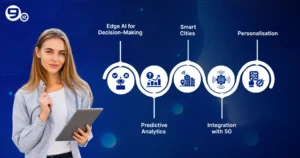
Merging two revolutionary technologies like AI and IoT unlocks new growth avenues for industries through advancements like edge computing and 5G networks. It strategically eliminates existing challenges of data quality issues, latency, and obstacles for real-time decision making. Growing year, the trend for AI and IoT is expanding to assist businesses with new models. These are the following trends:
Edge AI for Decision-Making
One of the remarkable trends is edge computing, where AI models run through IoT devices directly without relying on cloud storage. It provides the benefit of lower bandwidth consumption, real-time processing, and reduced latency. Majorly for IoT applications like industrial robots and remote healthcare, edge AI creates instant decisions without any delays.
Predictive Analytics
IoT devices are generating data streams, and when combined with AI, they support monitoring and predicting future outcomes. Predictive analytics arises as the trend to forecast maintenance schedules, equipment failure, and reduced downtime. Beyond prediction, this analytics track suggests taking the best decision and adjusting workflows.
Smart Cities
The future smart cities will rely on AI and IoT integration with effective waste management, traffic flow, automated energy consumption, and public safety measures. IoT-based sensors collect huge data, and AI algorithms function to improve urban planning. It also accomplishes the goal of sustainability to reduce pollution and provide better quality of life.
Integration with 5G
The future is 5G, which will act as the gateway for industries to process data faster, enable smart decision-making, and alter the way machines interact for functionalities. 5G capabilities will create real-time automation and connectivity with faster speed, laying the foundation of drone delivery, AR/VR shopping, and real-time industrial automation.
Personalisation
Future trends of AI in IoT will be more human-focused to generate personalisation and adaptive experiences. Smart homes and wearables are training models to collect user data and track their health for safety and precautions. This brings a major shift for personalisation that makes IoT a connected, intelligent system and user-friendly.
Also Read
IoT App Development: How Much Does it Cost to Develop?
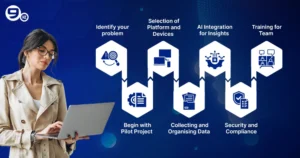
Businesses are ready to adopt AIoT to enjoy the combined benefit of connectivity and intelligence. But, how to get started? Without a fundamental plan for implementing AIoT, it would be hard to deliver desirable intelligent automation, faster decision-making, and predictions.
Here are the guided steps that suggest how the business should get started with AIoT:
#Step 1: Identify your problem
Before starting with technology directly, it is essential to assess the challenges your business is facing, like reduced downtime, supply chain disruption, or energy overconsumption.
#Step 2: Begin with Pilot Project
Implementing AIoT across the entire process will be expensive and risky, so pick a small pilot project to check for results, feasibility, and performance improvements.
#Step 3: Selection of Platform and Devices
Selecting the best AIoT device that supports your existing system for analytics, cloud integration, and edge computing. To choose from cameras, sensors, trackers, and AIoT platforms.
#Step 4: Collecting and Organising Data
After integrating the right IoT device or tools, check for the data processing to ensure capturing reliable data and establish a system for cleaning, storing, and managing it properly for AI-based analysis.
#Step 5: AI Integration for Insights
The next step is to integrate an AI model for enhancing predictive capabilities that analyse data, detect breakdowns, predict future possibilities, and automate decision-making.
#Step 6: Security and Compliance
AIoT networks can be more vulnerable if security measures are not implemented, like access controls, encryption, and data security logs. Also, following industry compliance standards like HIPAA or GDPR protects your device and data.
#Step 7: Training for Team
To ensure seamless implementation of AIoT, it is essential to train the team resources and employees on AI insights and how to execute them in daily operations. Only an empowered and trained team will be able to unlock the full value of AIoT integration across the organisation.
Frequently Asked Questions
1. What is AI in IoT with an example?
AI in IoT implies the integration of AI into IoT devices to create intelligent systems for data processing, faster decision-making, and automated processes. We can take examples of factories that implement AI in IoT for predicting breakdowns and repairs.
2. How does AI improve IoT performance?
AI focuses on shifting the simple manual process to intelligence-based decision-making in real time for improved performance.
3. What are the top use cases of AI in IoT?
Some of the top use cases for AIoT are smart healthcare, connected vehicles, predictive maintenance, smart retail stores, and precision farming.
4. What industries benefit the most from AIoT?
Some of these industries are energy and utilities, healthcare, manufacturing, retail, and logistics.
5. What is the future scope of AI in IoT?
The future scope lies in creating smart cities, healthcare innovation, edge intelligence, autonomous systems, and sustainability.
