



The main difference between conversational AI and chatbots is how they understand and respond to users. Chatbots follow predefined rules and scripts, which limit them to predictable questions and fixed paths. Conversational AI interprets intent and context, allowing conversations to adapt, continue naturally, and improve over time.
That difference directly impacts customer experience. The right choice can reduce resolution time, scale support, and improve satisfaction, while the wrong one can create friction, dead ends, and frustration. This guide explains how conversational AI and chatbots work, the differences between them, where each performs best, and how to choose the right option for your business in 2026.
Learn how chatbots boost CSAT & revenue
Watch this free on-demand webinar to learn how to scale service and drive growth with AI-powered chat.
What Is Conversational AI?
Conversational AI is an umbrella term for technologies that help computers converse like humans. Natural language processing (NLP) and machine learning (ML) assist conversational AI in helping computers understand and respond to customer queries while learning from every interaction.
Conversational AI has progressed rapidly, but it’s still evolving. Although it likely won’t achieve human-like consciousness (though human cognitive functions may be replicated within machine systems), its ability to understand intent, learn from interactions, and respond naturally continues to improve at an extraordinary pace.
Businesses use conversational AI for:
- Increasing work productivity: Many contact centers use conversational AI software to make their human agents more productive. The technology answers FAQs, routes inquiries, and assists with personalized recommendations or simple transactional requests while agents focus on the more important issues, delivering faster resolution.
- Improving accessibility: Conversational AI applications integrate with complementary technologies such as text-to-speech (TTS) and speech-to-text (STT) to dictate or translate the output into the required language easily, reducing entry barriers for users who work with assistive technology.
- Workflow automation: Customer-facing teams can benefit from conversational AI’s integration with CRM, ticketing, or workflow systems for onboarding or between sales and service handoffs. Some businesses also leverage conversational AI as voice assistants in their interactive voice response systems, where they route calls based on customer responses and agents’ availability and skill set.
Conversational AI simplifies the way people interact with devices and interfaces. On the business front, it helps companies reduce the time and effort of using contact centers to address repetitive queries.

Example: ChatGPT, Google Dialogflow, IBM Watson Assistant, Domino’s Pizza ordering bot “Dom,” and Nextiva’s AI-powered contact center are among the most widely used platforms.
Pros:
- Personalized: Learns from user inputs and past interactions to provide context-specific answers and recommendations.
- Context-aware: Can recognize tone, intent, and previous exchanges, allowing for more natural conversations.
- Scalable: Handles thousands of conversations simultaneously without sacrificing quality, making it ideal for enterprises or customer service teams.
Cons:
- Complex implementation: Requires data training, integration with backend systems, and continuous tuning to maintain accuracy.
- Higher setup and maintenance cost: More expensive than rule-based chatbots due to infrastructure, customization, and ongoing optimization needs.
Strengths and weaknesses of conversational AI
A major strength of conversational AI is its ability to adapt responses based on context, making interactions feel more human. However, a key weakness is that its effectiveness depends heavily on data quality and proper training.
Conversational AI isn’t ideal for every scenario. For straightforward, rule-based tasks or fixed conversational flows, a traditional chatbot remains a simpler and inexpensive option.
Real-world examples
Conversational AI is already transforming how companies interact with customers, from voice assistants to intelligent support agents. Here are practical examples of conversational AI at work:
| Company / Platform | Use Case | Description & Why It’s Conversational AI |
|---|---|---|
| Nextiva Intelligent Virtual Agent (IVA) | Customer support & call routing | Uses AI to understand intent, transcribe calls, and handle customer requests conversationally, escalating to agents when needed. |
| Bank of America’s “Erica”* | Banking assistance | Understands voice and text commands to provide financial insights, reminders, and transaction help. Learns from interactions to improve accuracy and relevance. |
| Google Assistant | Voice-based task automation | Understands open-ended natural language, holds context over multiple turns, and integrates with other apps to perform complex, real-time actions. |
| Domino’s “Dom” Voice Assistant | Order management | Processes natural speech for food orders, modifies requests, and tracks deliveries using contextual understanding rather than fixed scripts. |
* Bank of America’s Erica functions as a chatbot, but also goes beyond basic chatbot functionality by offering voice-based dialogue and personalized financial guidance, making it a full-fledged conversational AI agent.
What Is a Chatbot?
Simply put, chatbots and conversational AI are related, but not synonymous. Not all chatbots use conversational AI. Rule-based chatbots exist without any AI at all, whereas conversational AI is the broader technology framework that powers AI-enabled chatbots, virtual assistants, and voice interfaces.
A brief history
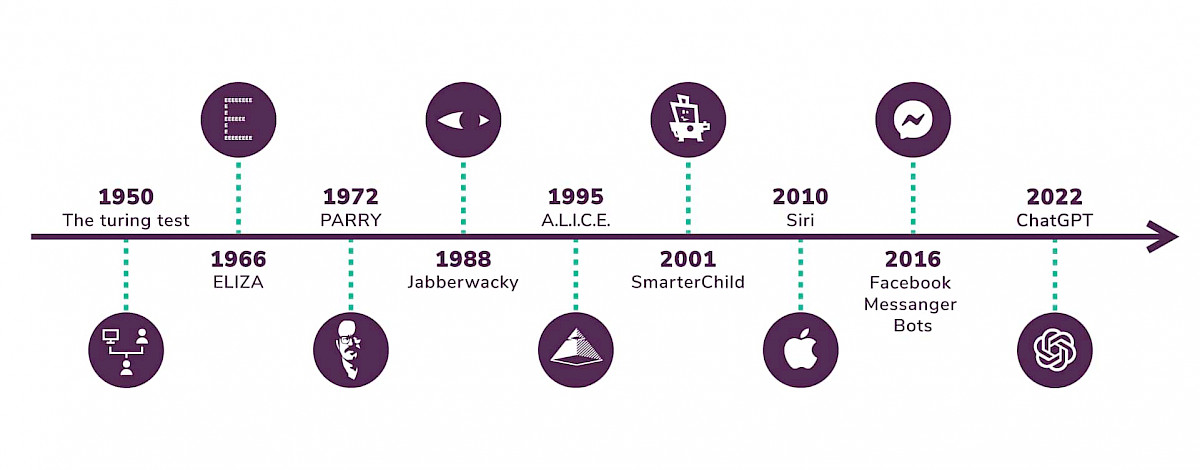
While they feel like a modern phenomenon, chatbots have a surprisingly deep history. It started in 1966 with ELIZA, a program that mimicked a therapist using simple pre-scripted responses. We moved from these early experiments to mainstream assistants like Siri (2010) and business tools on Facebook Messenger (2016), eventually leading to the generative power of ChatGPT in 2022.
This evolution brings us to the two distinct types of chatbots businesses use today:
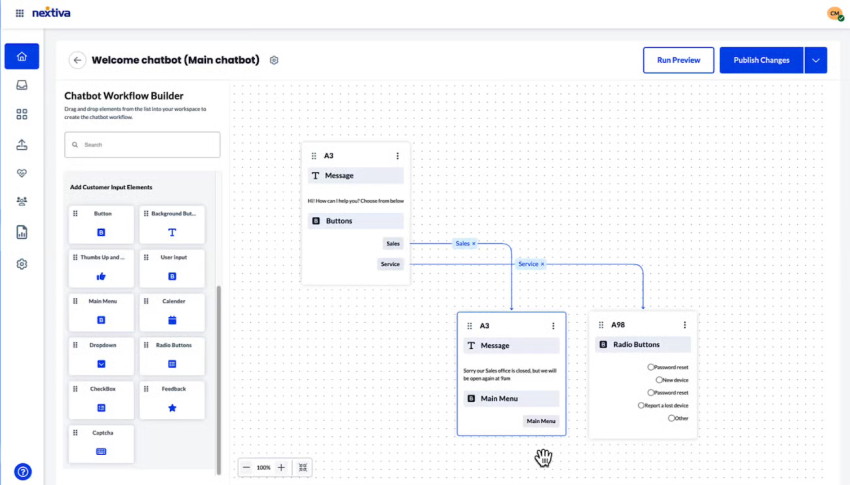
Rule-based chatbots (decision tree bots). These follow a series of pre-defined rules to interact with users. They solve common problems by mapping out human conversation flows like a flowchart — predicting what the user might ask and how the bot should respond. They work strictly within the scenarios you program them for, making them reliable but limited.
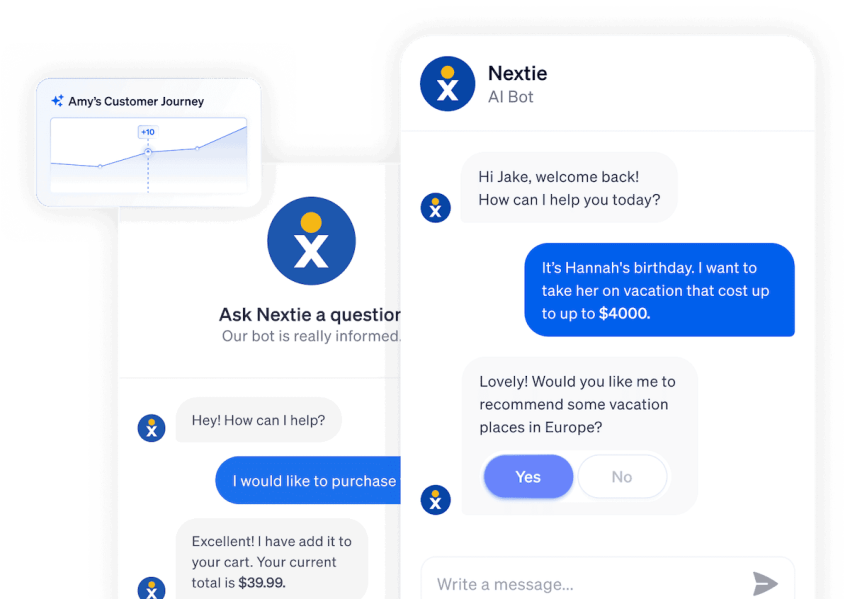
AI-powered chatbots. These use NLP to understand a query’s context and intent and then respond accordingly. They also use ML to improve with every interaction over time. They can interpret open-ended queries, generate natural responses, and become more accurate and helpful with every interaction.
Businesses use chatbots to:
- Support customers: Contact or call center teams have more time to address complex issues when text-based conversational AI chatbots address customers’ simple, repetitive queries. It reduces wait times while improving the overall customer experience.
- Generate leads: Businesses use chatbots for lead generation. A chatbot becomes a text-based virtual AI agent that helps prospects on your website get answers to their queries. The chatbot can help a prospect set up a demo or navigate to specific content that can best address their queries.
- Perform simple tasks: From checking order status in e-commerce to scheduling appointments in the healthcare sector to delivering billing reminders in the finance industry, chatbots streamline everyday transactions. When they begin handling context-aware reminders or tasks, they evolve into intelligent virtual assistants (IVAs).
Example: Chatbots range from simple rule-based systems—like basic website widgets, FAQ bots, or Duolingo’s Practice Bot (although they now have a Conversational AI version)—to AI-powered assistants that use NLP and machine learning to improve responses over time, such as Intercom’s Resolution Bot or Drift’s AI chatbot.
Nextiva’s Chatbot Builder gives businesses a flexible way to design conversational experiences — from simple rule-based workflows to AI-enhanced interactions. While many chatbots built with the tool rely on predefined rules and flows, the platform also supports NLP and machine learning capabilities through its AI Chat and Intelligent Virtual Agent features. This layered approach allows companies to start simple and scale toward more complex conversational AI over time.
Pros:
- Versatile: Can handle both simple, predefined workflows and more dynamic conversations if enhanced with NLP and ML.
- Cost-effective: Rule-based versions are affordable to deploy and maintain, while AI-enabled options offer scalability and deeper engagement without dramatically increasing costs.
- Fast setup and flexible: Easy to launch for common use cases (like FAQs or lead capture) and can evolve into smarter assistants as the business grows.
Cons:
- Limited understanding (in basic forms): Rule-based bots can only respond to specific triggers and fail when questions fall outside their scripts.
- Inconsistent experience across types: AI-enhanced chatbots perform much better, but quality depends heavily on training data and integration, which can mean an uneven user experience.
- Still less contextual than full conversational AI: Even advanced chatbots typically lack persistent memory or true multi-turn context handling across channels.
Strengths and weaknesses of chatbots
A key strength of chatbots is their speed and efficiency in handling repetitive questions and simple transactions. And AI chatbots go further, using natural language processing to interpret intent and offer more conversational, helpful interactions.
However, chatbots remain limited in scope and adaptability. Rule-based models can’t manage unexpected queries, and even AI-enhanced ones depend on structured data and regular tuning. For complex tasks or emotionally nuanced conversations, conversational AI offers a more capable solution.
Real-world examples
Chatbots are widely used across industries to streamline interactions and support users efficiently. Here are some use cases of chatbots in action:
| Company / Platform | Use Case | Description & Why It’s a Chatbot |
|---|---|---|
| Nextiva Chatbot Builder* | Website FAQs & lead capture | Enables businesses to create rule-based or flowchart-style chat experiences that automate simple inquiries and routing. |
| H&M Kik Chatbot | Shopping recommendations | Guides users through style quizzes and product suggestions using predefined rules and button-based choices — no true NLP. |
| Duolingo Practice Bot** | Language learning | Simulates conversation practice using scripted responses and predictable dialogue patterns. |
| YETI’s retail chatbot | Customer support and product guidance | Answers basic customer questions and provides product navigation through a rule-based chat interface. |
* Nextiva’s Chatbot Builder is a hybrid platform; it supports both rule-based chatbots and AI-powered chatbots (via NLP and ML integration).
** Duolingo now functions as both a chatbot and a conversational AI.
Key Differences Between Conversational AI and Chatbots
Take a look at the different aspects of both technologies (broken down into rule-based chatbots, AI-powered chatbots, and conversational AI).
Conversational AI vs chatbots comparison table:
| Feature | Chatbots | Conversational AI |
|---|---|---|
| Core Function | Automates responses using predefined rules or limited NLP | Manages conversations using intent, context, and learning models |
| Understanding | Responds to specific keywords or structured inputs | Understands intent, language patterns, and context |
| Conversation Flow | Follows fixed paths and decision trees | Adapts dynamically across multiple exchanges |
| Context Awareness | Limited or session-based | Maintains context across conversations and channels |
| Learning Ability | Does not learn or improve only with manual updates | Continuously improves using interaction data |
| Query Complexity | Handles simple, repetitive questions | Handles complex, multi-step interactions |
| Personalization | Basic personalization using rules or fields | Personalizes responses based on behavior and history |
| Integrations | Basic integrations with support tools or CRMs | Deep integration with enterprise systems and data sources |
| Cost & Setup | Lower cost, quick to deploy | Higher initial investment with long-term ROI |
| Best Use Cases | FAQs, order status, and appointment booking | Customer support, omnichannel automation, personalized CX |
Basically, rule-based chatbots excel at handling predictable, repetitive interactions.
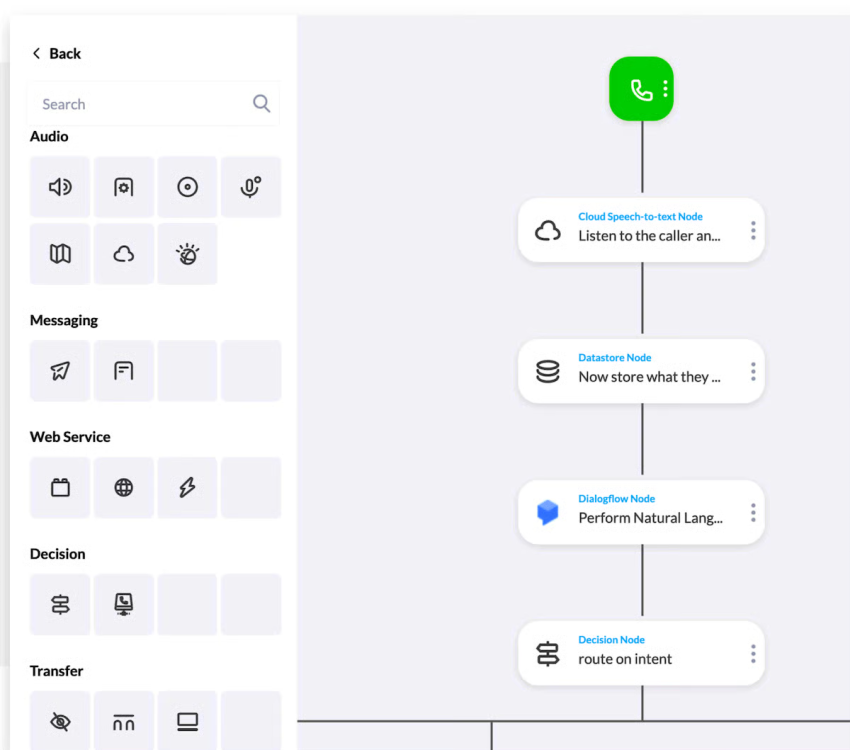
AI-based chatbots bridge the gap by using natural language processing to manage slightly more complex requests.
Conversational AI, however, goes a step further—understanding context, emotion, and intent across multiple exchanges to deliver a more natural, human-like experience.
Which one is better suited for your business?
Conversational AI vs chatbots – choosing between them depends on the complexity of your use case, desired customer experience, and available resources. Consider the following points when deciding which platform to use in your business:
Complexity: If you deal with simple and repetitive inquiries, it’s best to use a simple rule-based chatbot. However, as your inquiries become more complex or personalized, conversational AI offers the flexibility and intelligence to handle them effectively.
Budget: Be realistic about your investment and determine how much you are willing to spend. Conversational AI will require a fairly substantial upfront investment, but can deliver a strong long-term ROI by automating complex workflows.
Scalability: Consider how your needs may evolve. As your business expands—adding new markets, products, or policies—conversational AI scales seamlessly, adapting to new contexts and data sources. But don’t forget to account for the complexities that can arise in the future, like payment policies for different geographies or return policies for different categories of products you might add.
Integration and Data: If your business relies on multiple systems (CRM, helpdesk, analytics), make sure your chatbot or AI solution can integrate easily. AI-driven platforms use these integrations to deliver context-aware responses and valuable insights.
Customer Expectations: Finally, think about your brand experience. Customers today expect fast, individualized, and human-like interactions—an area where conversational AI increasingly outperforms traditional chatbots.
Here’s a simple comparison table when debating between conversational AI vs chatbots:
| Factor | When to Choose a Chatbot | When to Choose Conversational AI |
|---|---|---|
| Complexity | Best for simple, repetitive inquiries that follow clear rules or scripts. | Ideal for complex, personalized, or multi-step interactions requiring deeper understanding. |
| Budget | Lower upfront cost and easy to maintain. Suitable for small teams or limited use cases. | Higher initial investment but offers long-term ROI through automation and efficiency gains. |
| Scalability | Works well for limited use cases and smaller customer bases. | Scales easily as your business grows, adapting to new markets, products, and data. |
| Integration & Data | Basic integrations with CRM or support tools; limited context use. | Deep integration across platforms; uses data and context to tailor responses. |
| Customer Expectations | Provides quick, transactional support for routine issues. | Delivers more natural, human-like conversations that enhance customer satisfaction and loyalty. |
When comparing conversational AI vs chatbots, it’s clear that both technologies have distinct strengths depending on your business needs. Chatbots excel at handling repetitive, rule-based tasks quickly, while conversational AI brings deeper understanding and context awareness to customer interactions.
But really, the most effective businesses use a combination of both—automating routine queries while enhancing complex conversations with AI.
Nextiva unites conversational AI and chatbot functionality in a single platform that scales with your business—helping you deliver faster, smarter, and more human customer interactions at every stage of growth.
Personalize experiences at scale with AI chatbots.
Save time – for you and your customers – and deliver human-like, personalized sales and support in every interaction.
Frequently Asked Questions About Conversational AI vs Chatbots
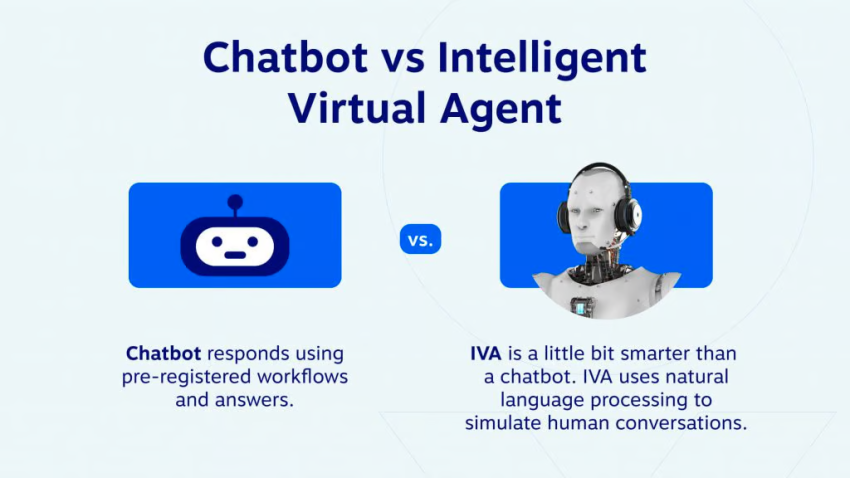
Chatbots are relatively simple and typically used to answer basic questions or provide links to relevant information. They follow pre-programmed rules and cannot understand the context of a conversation.
Intelligent virtual agents (IVA) are more sophisticated, using AI technology and natural language understanding (NLU) to simulate human speech, understand customer intent, answer real-time queries, better grasp user language, and offer more personalized responses. You can also ask follow-up questions and forward chats to human agents if necessary.
Yes. ChatGPT is a form of conversational AI that uses natural language processing (NLP) and machine learning (ML) to understand context, generate human-like responses, and engage in dynamic conversations.
Some can. AI powered chatbots may be categorized as a conversational AI chatbot because they use NLP and learning algorithms, but rule based chatbots do not—they rely on pre-defined scripts and logic.
They often overlap. Chatbot AI refers to chatbots enhanced with artificial intelligence, while AI chat generally means direct interaction with an AI system (like ChatGPT) capable of open-ended conversation beyond preset rules or topics.
Facebook Messenger is a messaging platform, not inherently a chatbot or a conversational AI. But Messenger hosts both chatbots and conversational AI systems; the classification just depends on the underlying technology you plug into it.
