



If you have an e-commerce, retail, manufacturing, or warehouse business, nothing is more essential than “Inventory Management.”
As per reports and surveys, you will be shocked that stockouts are responsible for nearly $1 trillion in missed sales annually, and 43% of small businesses face lost revenue yearly.
Fortunately, open-source inventory management software is available that you can use without fear of cost or quality. Your competitor might already be using it, so now it’s time for you to adopt it into your business practices.
96% of global organizations use open-source software, and inventory management is one of the top-grossing segments. The global inventory management software market ($2.38bn in 2025) is projected to reach $8.48 billion by 2035 at a CAGR of 13.1%(2025- 2035).
Inventory management systems are increasingly used across various industries, including healthcare, logistics, and manufacturing, not just in e-commerce and retail.
So, it’s the right time to invest in inventory management applications to improve your business’s efficiency. What are the top features you need to know before using open-source software? We’ve created a blog to walk you through the information you seek.
Let’s start with the blog!
Introduction to Open Source Inventory Management Software
Let’s start with some basics to have a clear understanding.
What is Open Source Inventory Management?
Inventory management software is a software solution that helps businesses track, manage, and optimize their inventory. When it is an open-source inventory management system, the source code is available at zero cost, and you can view, modify, and distribute the software for your own use.
Still, some readers might be confused about proprietary vs. open-source software. If you are using proprietary software, it means it is developed and owned by a company, and you need to pay for the license. On the other hand, users can use an open-source inventory system without paying a penny.
The key characteristics of open-source inventory management software are Cost-Effectiveness, Customization and Flexibility, Community Support, and No Vendor Lock-In. However, some limitations also exist, such as the requirement for technical expertise, limited official support, and a variable feature set.
Now, the question is why the graph of open-source solutions is increasing. Let’s have a look.
Why Do Businesses Prefer Open Source Solutions?
The open-source inventory solutions offer myriad benefits that a business can have in a true sense. What these are as follows: Factors to Consider Before Implementation
- Cost Saving
- Flexibility
- No Vendor Lock-In
- Transparency
- Self-Audit
Open-source software is free for everyone, from a small business to a large enterprise, reducing the substantial investment in tools and applications.
With open-source software, you have maximum flexibility to mould the code based on its applicable use case to your business.
While using these systems, you’re not dependent on a single vendor. This means you can migrate, innovate, and integrate on your own terms.
Open-source inventory management software is based on the concept of “Many Eyes.” It is associated with a large community of developers and experts who can review bugs and security vulnerabilities. This collective approach makes open-source software transparent.
Your team can audit the code anytime or whenever you need to ensure it is safe and follows industry standards.
Now that we have an understanding of the basics and the reasons behind adopting open-source solutions for inventory management, let’s move to the next section, which is about the central theme of our blog
Key Features of Open Source Inventory Management Software
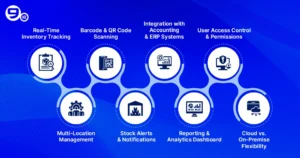
What makes one solution far better than others are its features and inventory management is not an exception. Thus, what are the key features while looking for open-source inventory management software? Here are these as follows:
Real-Time Inventory Tracking
Real-time inventory tracking is one of the key features. The system automatically updates inventory levels the moment you pick, receive,transfer or return the consignment. This feature records, saves, and tracks all information related to inventory operations such as open orders, lots, batches, serial numbers, and more.
Multi-Location Management
Using open-source inventory management software solutions not only a single warehouse you can handle inventories of multiple warehouses located at different locations.
Barcode & QR Code Scanning
Barcode and QR code scanning help streamline operations. It accurately captures data when receiving, picking, and conducting inventory checks, utilizing RFID technology.
Take a Look..
How to Create an Inventory System: Features, Use cases, Steps
Stock Alerts and Notifications
The stock alert feature is one of the important features that keeps track of stock. When stock goes low, it warns before it runs out and auto-creates purchase suggestions or blocks overselling. You can configure the software to send automated alerts via email, sms, or within the software.
Integration with Accounting and ERP Systems
You can seamlessly integrate an open-source inventory management system with your existing accounting and ERP systems. The open APIs make it possible.
Reporting and Analytics Dashboard
Reporting and analytics help make strategic decisions. This feature allows you to understand inventory performance, generate a report on sales data and inventory turnover rate, and more. The customized dashboard helps businesses visualize KPIs(key performance indicators) and gain valuable insights.
User Access Control and Permissions
Inventory data is sensitive, and you can’t give access to anybody in your organization. Thus, while using the software, you can set role-based access with some permissions in or out. For example, warehouse staff see scanner screens, Buyers see vendor data and resupply, and finance sees valuation and postings.
Cloud vs. On-Premise Flexibility
You have complete flexibility with open-source inventory management software, such as how you deploy it on the cloud or on-premises. Businesses can host it on-premise(on their servers), having complete control, or they can use a cloud solution with cost-effectiveness and without a dependency on resources. Thus, you can choose a deployment model that fits your budget, technology, and security requirements.
Benefits of Using Open Source Inventory Tools
Earlier in this blog, we have already read that why do businesses prefer open-source inventory management software? That part almost covers the benefits in a different way. Now, let’s discuss some of its key benefits.
Cost-Effectiveness
No licensing fee associated with open source inventory management tools and this is a universal truth. It is open for all, anyone can access it, and can integrate with their existing system. What you need is technical help to deploy the system and that you can get from any reputed inventory management software development company. The best thing about the open-source software is there is no price hike and paid add-on plans associated.
Customization & Scalability
The reality is every organization’s needs and workflows are diverse. An open-source management software allows businesses to gain complete control over the code so they can modify it according to their needs and objectives. They can add custom modules and integrate the software without vendor restrictions and adapt to shifting market trends.
In-terms of scalability, open source tools are the best as they can expand with a business’s growing requirements. For example, from a single warehouse to multiple warehouses, you gain complete control over inventory operations. There is a flexibility in deployment such as on-premise or cloud. Still, if you need more features, you can freely add it without expensive license upgrades.
Community Support and Frequent Updates
Almost all open source software have strong community support and a large number of active contributors, and developers for example, Odoo inventory, ERPNext and others. They contribute through updates in features, add-ons, and help others through providing answers to technical issues. This means at no-cost you can have a solution to an issue that bothers you while using open-source inventory management software.
Choosing the Right Open Source Inventory Management Software
Although there are several open-source inventory management software available on the market, selecting the right solution can only lead you to the results you want to achieve.
So, how do you choose the right software?
Let’s make it simple. There are some factors to consider while making the right choice.
Factors to Consider Before Implementation
- Business Needs Assessment
- Customization
- Scalability
- User-Friendliness
- Ownership
- Community Support
- Security
The most essential thing that you need to do is assess your business needs like what pain points you want to solve with an open source inventory management application. Apart from it, you also need to check whether the software offers all features that you need such as real-time inventory tracking, barcode scanning, multi-location management, and others.
The next thing you need to ask is what about the customization scope means does the software support the customization you need such as modification in modules, dashboards, features, and data fields without any rigorous technical effort.
The ideal software should support scalability so with the growing needs of inventory management it can expand itself without any roadblock. While selecting the software, ensure that it can seamlessly handle increasing data and users when your business scales.
User-friendliness is another significant factor that you need to consider. The software must be easy to use and must provide an intuitive user interface so your team can easily use it. It will also help a business reduce the cost and time required to train its employees on an open-source inventory management system.
Although open-source software is available for all, still, you need to check what kind of authority you have. It may be possible that there are some limitations that you can’t unlock with the help of a vendor.
Always look for an open source software that has robust community support because some software has a small community and later it can create a problem for you. Well, also check how the community is active, so in case of any issue you can port your question and get a quick resolution.
It’s true that open source software is cost-effective but it does not mean they are safe for use. So whatever software you are going to choose, ensure they provide advanced security features to maintain the integrity and safety of your business data.
If all of the above factors go well with the software, you can make a final decision. The best way is to choose widely popular options.
Also Read
eCommerce Inventory Management Software: Features, Benefits & How to Build One?
Popular Open Source Inventory Tools in 2025
Here are some of the top-five and most popular inventory tools to consider for your business in the existing year.
- Odoo Inventory
- OpenBoxes
- ERPNext
- Dolibarr
- Tryton
Odoo inventory is the right choice for small businesses, looking for a highly customizable inventory management system. You can also count it as the best option for the industries like manufacturing, wholesale, and distribution. Its key features are, smart restocking & automation, warehouse & logistics management, and real-time inventory control.
OpenBoxes is especially designed for the healthcare industry that simplifies the tasks such as inventory stock level monitoring, multiple location management, expiry date tracking, demand forecasting and more.
ERPNext is one of the widely popular open source inventory management software among small and medium sized businesses and is powered by Python and JavaScript. It offers a comprehensive suite of features such as batch management, inventory tracking, barcode support, multi-currency, and more.
If you are looking for a cross-platform web based solution for SMBs. It works tremendously on all major operating systems such as Windows, Linux, and Mac, and provides key features like stock management, multi-warehouse management, barcode scanning, automated stock resupply, and others.
can be your best choice if you need a powerful combo of open source inventory and ERP software. Using this platform you can install specific modules that suit your business needs. Tryton’s key features are, complete stock traceability, warehouse location management, automated rules, inventory valuation, and more.
Common Challenges in Inventory Management and How Open Source Solves Them
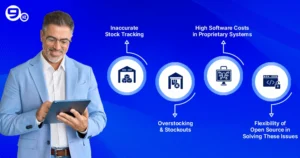
Now, here comes the most interesting part and that is common challenges in inventory management systems and how open source solves them replacing proprietary software.
Inaccurate Stock Tracking
Pen and paper, spread sheets, or any other manual processes to maintain the inventory are prone to errors and this happens. With conventional methods discrepancies happen that leads to unexpected stockout or overstocking.
Overstocking and Stockouts
For an ideal business overstocking and stockouts both lead to loss, cash trap, and missed sales. Simplifying it, at one hand overstocking costs you in terms of storage, resources, and risk of damage. On the other hand, understocking creates dissatisfaction among customers.
High Software Costs in Proprietary Systems
Proprietary systems held by software product development companies are costing them, crushing their sales and revenue goals. There might be chances that the price may not suit you but you need to forcefully buy it for use. Additionally, there may be price hikes and forced upgrades that you do need really.
Multiple Warehouse Management
Conventionally, it is a tough job to manage multiple warehouses located at separate locations. Tracking and managing inventories of these warehouses is complex and high chances of errors.
Inaccurate Data and Analysis
Inaccurate data and analysis is also one of the biggest challenges in inventory management and it can create roadblocks for your business growth. It will also affect your strategic efforts for your business.
So, how open source inventory management software solves these challenges
- Real-time inventory tracking can help you track stocks live and prevent you from overstocking and understocking.
- The open source inventory management systems help in workflow automation. You can customize workflows as per your business needs and move forward.
- The multi-location management capability of open source software helps manage multiple warehouses and complex inventories across locations.
- Integration capability helps in integrating open source software with your existing system such as sales platform, accounting, ERP, and others and helps in keeping data transparent. You will have accurate data analysis and can use it to create a perfect business strategy.
- Transparency and control are one of the significant advantages with open source solutions, so you can audit the code, add new features, and implement updates.
- Compared to proprietary systems, open source inventory management tools are cost-effective solutions for all inventory management needs.
Security Features in Open Source Inventory Systems

For every business around the globe, security of data is everything as a loophole can bring disaster. Therefore, what are the security features you should look for in open source inventory systems.
Role-Based Access Control
Role-based authority is necessary to control who can access the data and what type data can be accessed by a particular role. It ensures authority. The role-based access control helps in defining roles for warehouse staff, procurers, managers, team leads, and finance. The administrator can provide access to the data based on their job specific roles maintaining the authenticity. The best practice is to use SSO with SAML or OAuth.
Data Encryption and Backups
Data encryption ensures ultimate data security, and it protects the data from unauthorized use while storing and transmitting. Suppose that if the server is compromised, the data remains in an unreadable format until you have a decryption mechanism. When data is transmitted between users and the server, secure protocols like SSL/TLS prevent the data from being intercepted.
In terms of backup if your open-source inventory management system has an in-built backup feature then it will be good. Or, you can also easily integrate with open-source backup solutions (like Bacula or Bareos). It will help you automate the backup process with complete control overdata. In case of system failure, you can easily recover the data.
Community Audits for Vulnerability Fixes
Open source software is based on “Many Eyes” principles and the global community of developers can easily review the code. Due to the continuous scrutiny security vulnerabilities are often discovered and reported. The active community of developers, experts, and researchers contributes through updates and patches that makes open-source inventory management systems robust.
How Open Source Inventory Management Supports E-Commerce Businesses
For eCommerce businesses, inventory management is crucial that helps them to oversee inventory operations, sales operations, and stocking. Here open source inventory management simplifies key inventory challenges of an eCommerce business.
Let’s have a look at how it helps!
Integration with Online Marketplaces
No matter if you’re selling your products through your own website or using platforms like Amazon, eBay, Shopify, and more, open-source inventory systems often provide customizable APIs that make integration easy with your online store. Through unified management capability your stock remains visible and updated across all platforms, saving efforts, time, and cost.
Automated Order Processing
Manual order processing consumes time and requires effort, which creates a challenge for order processing. Compared to conventional methods, open-source inventory software automates the order processing. For example, when a product is sold, it automatically deducts the item from stock and prevents overselling.
Using the software you can generate packing slips and shipping labels. Some open source systems also come with a feature that manages backorders and returns. This establishes transparency between businesses and customers and enhances customer satisfaction.
Real-Time Stock Sync Across Channels
Overselling is a potential challenge for any ecommerce business, and this happens especially when you have a manual inventory management process. The biggest advantage of open source inventory tools is the prevention of overselling, which happens through real-time stock synchronization features. The real-time sync feature creates a centralized mechanism to oversee the stock and automatically updates the stock status across diverse channels.
Future Trends in Open Source Inventory Management
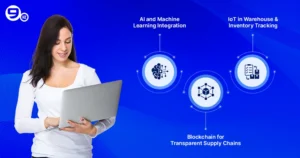
The world is moving faster and technologies are evolving overnight. So what are the future trends in open source inventory management? Here are some trends to watch in 2025, and for upcoming years.
AI and Machine Learning Integration
AI and Machine learning integration is trending from the software development perspective and the AI-powered software market is expanding like a wildfire. AI & ML also has potential use cases for inventory management. Thus, latest open-source inventory management solutions are leveraging the concept for demand forecasting, optimal stock levels, and automated resupply.
For example- AI & ML powered algorithms help in analyzing sales trends and data for predictive demand forecasting. Based on it businesses can make decisions to improve their sales and inventory ops. Other use cases are automated resupply that creates purchase suggestions and orders automatically minimizing manual efforts and over or understocking.
Blockchain for Transparent Supply Chains
Blockchain technology is known for transparency and robust security. So, using it, you can enhance the transparency of supply chain operations. The blockchain-based inventory management system offers advantages like end-to-end traceability, enhanced trust, counterfeit prevention, and fraud prevention. The records remain tamper-proof and make it easy to trace a product’s journey, creating complete transparency.
IoT in Warehouse and Inventory Tracking
IoT powered warehouse and inventory management solutions are the best for the businesses where they deal in perishable products such as food and healthcare. Collecting data through sensors, these systems help in inventory tracking. IoT also helps in predictive maintenance of warehouse equipment.
Conclusion
Inventory management is an integral part of businesses where product range exists at large-scale or you need to maintain multiple warehouses. An Open Source Inventory Management Software gives you unparalleled freedom and control. The most significant advantages you’ll gain include cost-effectiveness, real-time stock tracking, multi-location management, customization, stock alert automation, integrations, analytics, and permissions. Ultimately, these features help a business to enhance customer satisfaction.
The only thing you need to do is choose a platform that fits your team and growth plan. Adopting solutions powered by cutting-edge technologies like AI & ML, Blockchain, and IoT is another best practice. These solutions will help you not only achieve your existing goals but also helps for future growth.
Perhaps your competitors have already adopted open-source inventory management software, and now it’s your turn. So, what’s your plan? As a reputed inventory software development company, The NineHertz, we can provide all the customization you need to meet your specific goals. Let’s connect and discuss your needs.
FAQs
What is open source inventory management software?
It is inventory software with source code you can read, use, and modify. It manages products, locations, orders, and movements. You can deploy on-premise or in the cloud, easily integrate with your current tools, and customize workflows to match how your team works.
Are there many open source applications available for inventory management?
Yes, some of the popular choices are Odoo Inventory, ERPNext, Tryton, Dolibarr, and OpenBoxes. Each tool has strengths, so test them with your data and your flows before you choose.
Can I customize open source inventory software?
Yes, of course, you can add fields, automate steps, build modules, and connect to other systems through APIs and webhooks. Most tools offer extension points, which makes it easier to fit niche products, rules, and channels without waiting for a vendor release.
Is open source inventory management software secure?
It can be very secure if you implement it well. Use role-based access, SSO, TLS, and encryption at rest, set backups and test. The best idea is to take help of experts from an experienced inventory software development company.
