



Imagine a million-dollar deal being finalized without any human intervention!
It sounds hypothetical, but it’s quickly becoming a reality. Agentic AI is more than a chatbot or a simple application; it’s a system that makes intelligent decisions to solve problems and achieve business goals.
Organizations are already reaping the rewards of Agentic AI for enterprise. Uber is using AI agents to improve the efficiency of its workforce, reducing service delivery time, and Toyota has reduced 10,000 person-hours per year using an AI platform it created.
These are just a few examples; there are more. So, there is no need to prove that Agentic AI has taken over other technologies and appeared as an enterprise’s secret weapon. In the future, due to evolution, these AI agents will be more responsive and resilient, helping organizations achieve their goals.
The AI trend is gaining momentum. From the market stats perspective, the global agentic AI market size is projected to reach $187.48bn by 2034. The enterprise agentic AI market is set to be $24.50bn by 2030, at a CAGR of 46.2% from 2025 to 2030.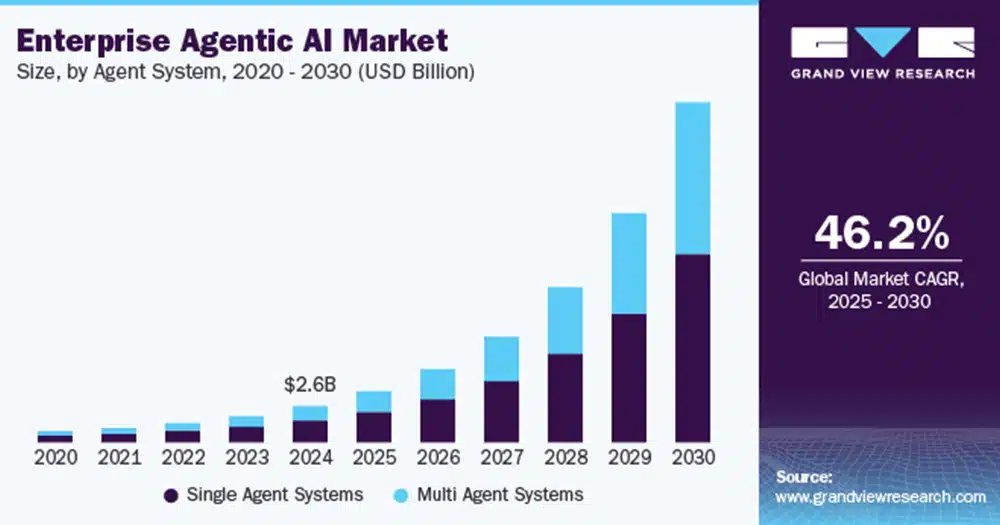
Your competitors might be in a phase where they are just about to launch an agentic AI-based system to achieve agility, reduced cost, and double the profit. Now is the right time to adopt it for your business.
If your question is, “How do I start?” or How to build agentic AI systems from scratch? We’ve created an article for entrepreneurs like you. This article will walk you through crucial information on agentic AI enterprise adoption, applications, use cases, case studies, and more to provide you with all the answers.
Agentic AI Enterprise Adoption- Market Stats
Agentic AI enterprise adoption is one of the significant trends in 2025. It now has increasing applications in diverse industries such as healthcare, finance, manufacturing, shipping & logistics, and other sectors. So, let’s look at some key market stats to know more about the adoption of AI in large-scale businesses.
- 96% of businesses are about to increase the utilization of AI Agents.
- More than 29% of enterprises are actively using Agentic AI in their business, and 44% plan to implement it next year.
- North America is the top region for enterprises to adopt Agentic AI, and its industry has the highest share, 39%, dominating the global industry.
- Machine learning is a foundational technology for agentic AI, allowing systems to learn independently and improve performance. It holds a 29% global revenue share, and the projected CAGR for 2024-2032 is 44.1 %.
- The maximum revenue for the single-agent systems segment is projected to be $23.43bn by 2032. Additionally, multi-agent systems offer great potential for handling complex and collaborative tasks.
- Agentic AI is a boon for the customer service and virtual assistants segment, which is growing at a CAGR of 43.8% (2024-2032).
- NVIDIA Corporation, Oracle, Microsoft, Google, SAP SE, and Accenture are some of the top enterprises using agentic AI.
- Industries such as Retail and eCommerce, Professional Services, Finance Services, Healthcare, and Tech and software have already adopted agentic AI to achieve their goals.
Some readers might have a question: What comprises the Agentic AI ecosystem? The ecosystem comprises infra/framework providers, Agentic AI platform providers, Agentic AI services providers, and application providers.
Now, let’s move to the next section of this blog.
Why Does An Agentic AI System Matter for the Enterprise?
To understand it completely, like how Agentic AI works and matters for an enterprise, let’s revise its definition.
Agentic AI systems act and respond autonomously, utilizing the full potential of artificial intelligence, machine learning (ML), and natural language processing (NLP). They can make decisions, continuously learn, and accomplish complex tasks without human oversight.
In today’s fierce market competition, agility, quality, and adaptability are survival tools. Customers’ expectations are evolving, and personalization is the top priority. Conventional business methods are less effective, and competitors find innovative ways to target the audience to gain an edge. Here, Agentic AI offers a powerful approach to achieving business goals and improving efficiency.
Let’s make it simpler through an example!
The long waiting time to get an answer to a query is a common issue for customers. We also experience this in everyday life. Sometimes, as customers, we get different answers from different customer support executives for a simple question. Here, a traditional chatbot works only for fixed answers, but an AI agent breaks a customer’s query into parts, understands the intention, and can provide a precise answer to a customer. This makes customer support faster and more effective.
This is just a simple example. Let’s look at the bigger picture, such as how an Agentic AI system can benefit your business.
Key Benefits of Agentic AI for Enterprise
Here’s a closer look at the key impacts an Agentic AI system can have on an enterprise.
1. Decision Making
One of the core abilities of an Agentic AI system is processing vast amounts of data accurately in less time, which accelerates an enterprise’s decision-making process. Based on this, a business can make perfect strategic decisions and cater to its audience’s needs, enhancing customer satisfaction. On the other hand, it also helps enterprises respond to market changes quickly, improving adaptability.
2. Increased Productivity
One of the top advantages of using Agentic AI for enterprise is automation, which significantly reduces human efforts for repetitive tasks by streamlining workflows and improving an organization’s productivity. According to a report published by a trusted source, by 2029, Agentic AI systems will autonomously resolve 80% of customer service issues and reduce operational costs by 30%.
3. Scalability
Due to increasing customer demands and market competition, enterprises are under heavy pressure to increase headcount and infrastructure. Here, Agentic AI is a savior, handling tasks autonomously without increasing infrastructure, human resources, and other overhead costs.
4. Adaptability
AI systems that can act and learn on their own. They are good at changing with the times because they learn from what happens around them. This makes them useful when markets are always changing or when something unexpected happens, like a problem with getting supplies. These systems let businesses respond fast and stay flexible.
5. Workforce Empowerment
Agentic AI supports a collaborative environment where humans and AI agents work together to achieve business objectives and desired outcomes. These systems empower human resources by taking over repetitive tasks so the employees can focus on work that requires human skills.
6. Risk Management
You will be surprised to know that Agentic AI can detect risks and issues before they become serious. By analyzing vast amounts of data, these systems can find unusual patterns or possible threats. So, as an enterprise, you can apply measures even before any risk arrives.
7. Customer Engagement
Industries like eCommerce, healthcare, and fintech strive to provide personalized services to their customers. Agents can learn from customers’ past purchases and browsing habits, analyze sales trends, and, based on this, offer personalized product recommendations, boosting sales.
Key Agentic AI Applications in the Enterprise
AI is not science fiction; it is a reality, and Agentic AI is more than an AI-driven software or chatbot; it autonomously works and makes smart decisions. So, what are the Agentic AI use cases? Here they are:
1. Customer Services & Support
Organizations are under heavy pressure to improve their customer service and support better than the previous day. If they fail, their competitors will lead. From this perspective, Agentic AI works tremendously, such as in the form of Virtual Shopping Assistants, Proactive Customer Support, and Intelligent Call Centers. This makes customer service effective and impactful.
Agentic AI systems for customer support can handle queries, reduce issue resolution time, provide personalized product recommendations, resolve issues before they escalate, and provide intent-based answers and tailored responses to the customer.
2. IT Operations & Cyber Security
On the brighter side, technology solves complex challenges, but issues and risks also arise. An enterprise can easily optimize workflow and mitigate risks by using an AI agent for IT operations. In terms of IT, Agentic AI applications in the enterprise involve Automated Incident Management, Threat Detection and Response, DevOps Optimization, etc.
You can utilize Agentic AI to automate incident management. An agent can monitor IT systems for anomalies and diagnose problems that reduce downtime and streamline operations. From the cybersecurity perspective, Agentic AI can monitor network activities, track suspicious behavior, implement countermeasures, and neutralize threats autonomously.
3. Financial Services
Fraud detection, claim management, loan settlement, assessing investment opportunities, and offering personalization are challenges for the fintech industry. But not with the Agentic AI systems for banking and finance. For example, in the insurance sector, it helps with claim processing automation, risk analysis, and policy customization.
Agentic AI for finance helps with automated fraud detection. An agent can identify unusual patterns and suspicious activities, analyze transaction data, and trigger if something is not authentic as per compliance or standards. Its other application is wealth management, which analyzes market trends, identifies investment opportunities, and creates tailored financial plans.
4. Healthcare
Healthcare is one sector where AI provides a perfect solution. According to market statistics, Agentic AI in healthcare is projected to reach $4.96 billion by 2030, solving complex challenges that the industry is facing due to the increasing demand for personalized services. This helps in diagnostic assistance (analyzing patient data, assisting clinicians in diagnosis, and recommending personalized treatment plans).
Remote patient monitoring and administrative automation are also applications in the healthcare sector. AI agents can schedule or reschedule appointments, manage patient records, and monitor patients using data from wearables
5. Manufacturing & Supply Chain
The modern world is built on manufacturing and the supply chain. Everything from a single pen to our vehicles comes through this. Here, Agentic helps with predictive maintenance(data analysis, risk prediction, minimizing downtime, etc.). The other Agentic AI applications in the enterprise are inventory and logistics optimization (demand forecasting, inventory optimization and management, and optimizing delivery routes ), and quality control (visual inspection, detecting defects, and more).
6. Human Resource Management
Recruitment, onboarding, and managing human resources are integral processes of any organization, but they also pose challenges, especially for large-scale enterprises. Agentic AI makes this simple. It can help automate recruitment and onboarding through candidate screening, resume analysis, interview scheduling, and more.
Employee support and management is another application where an AI agent can handle routine HR inquiries, manage leave requests, update employee records, perform employee performance analysis, and more.
| Industry | Company | Application | Outcomes |
|---|---|---|---|
| Retail & E-Commerce | H&M | Virtual shopping assistant for personalized support, product recommendations, and virtual fitting rooms | 70% faster response, 25% conversion increase, reduced returns, higher customer satisfaction |
| IT Operations | IBM Watson AIOps | Automated incident alert filtering, event correlation, and remediation automation | 40% fewer false alerts, 30% faster mean time to resolution, 80% alert reduction |
| Financial Services | Bank of America – Erica | AI assistant handling transactions, fraud detection, and customer queries | 1B interactions, 98% issue resolution, 17% call center workload reduction |
| Manufacturing | Siemens Industrial Edge | Predictive maintenance via sensor data analytics and automated repair scheduling | 30% downtime reduction, improved asset utilization |
| Healthcare | Mass General Brigham AI Copilot | Clinician documentation automation and workflow assistance | 60% less clinician documentation time, improved patient care |
| Supply Chain & Logistics | DHL Resilience360 | Real-time supply chain monitoring, adaptive routing, and risk management | 30% on-time delivery improvement, 20% fuel savings, 35% fewer delays |
| Government | Singapore “Ask Jamie” | Multilingual virtual assistant for citizen public services support | 50% call center load reduction, 15M+ queries answered, 80% faster responses |
| E-Commerce Customer Support | Allegro (EU platform) | Omnichannel AI bots for multilingual customer inquiries, order support, and agent assist tools | Faster responses, scalable support during peak demand, improved service standards |
Agentic AI Enterprise Case Studies & Success Stories
Still, if you have a question—does Agentic AI for enterprise really work? Here are some case studies and success stories of enterprises from diverse domains to clear all the doubts.
1. Allegro (eCommerce & Retail)
One of Europe’s leading eCommerce platforms, Allegro, provides a compelling Agentic AI enterprise case study. The company’s challenges were handling customer support, slowed performance, and operational efficiency. They partnered with Google Cloud and GrowthLoop to use an AI support system. As a result, Allegro achieved 1.5X reduced time handling repetitive tasks through automation, omnichannel AI support, personalization, and a boost in customer satisfaction.
2. Bank of America’s Erica(Financial Services)
Bank of America’s Erica faces the challenge of handling customer enquiries, fraud detection, and seamless transactions without additional help. They implemented a virtual assistant as a solution that handles financial inquiries, detects fraud, and helps customers with transactions through text and voice. Now, this banking firm has reduced call centre load by 17% decrease and completed 1 billion interactions to date.
3. Allegis Group (Business & Professional Services)
The challenge with Allegis Group( an international recruitment firm) was to streamline the talent hunt process, reduce the load on the recruitment team, and improve productivity. To address these challenges, Allegis implemented an AI model that helped streamline the recruitment process. This AI model also helped them automate tasks such as generating job descriptions, updating candidate profiles, and analyzing conversations between candidates and recruiters. In a year, 920,000 skills and 78,000 job titles have been added to date.
4. BKW (Energy and Infrastructure)
BKW offers another compelling Agentic AI enterprise case study. The company was struggling with managing repetitive, mundane tasks, which led to reduced productivity and job dissatisfaction. In collaboration with Microsoft, they implemented an AI platform called Edison, which acted as an agent. The company achieved a more than 8% hike in productivity and processed 50% of media inquiries within 2 months.
5. Siemens (Manufacturing)
Siemens was dealing with many unexpected machine failures, which messed up their production. Traditional maintenance methods just weren’t working well enough. To fix this, they started using an Agentic AI system for maintenance. This new system predicts when machines might fail, helps them plan maintenance ahead of time, and improves production schedules. Because of this, Siemens has reduced downtime by 30% and is running much more efficiently.
6. DHL (Supply Chain)
Disruptions, such as natural disasters, labor strikes, unexpected delivery delays, and political instability, may lead a supply chain business to financial losses. The global logistics firm DHL was also experiencing this. As a solution, they introduced Resilience360, a cloud-based platform that acts as an autonomous AI agent. It helps in real-time monitoring, risk mitigation, and route optimization. As a result, the company achieved 30% better on-time delivery, 20% reduction in logistics costs, and 35% fewer delays.
7. Mass General Brigham(Healthcare)
The story of Mass General Brigham’s AI Copilot is a leading Agentic AI enterprise case study in solving a heavy administrative burden. The global healthcare firm was facing delays in patient care due to the documentation demands of its EHR system. With the help of Microsoft, they introduced AI Copilot, which works as an AI agent for healthcare and assists with automated documentation, information retrieval, and reporting.
As a result, they have reduced clinical documentation time by 60%, improved patient and clinician satisfaction, reduced paperwork, and improved healthcare services efficiency.
What Agentic AI Challenges Do Enterprises Need to Overcome?
According to one study, 33% of enterprise applications will use Agentic AI, and 15% of work decisions will be autonomous.
But it’s not as easy a task as it seems. Although Agentic AI for enterprise offers several benefits, it comes with challenges that must be addressed by an enterprise for successful implementation.
Let’s break it down!
1. Data Quality and Silos
One of the biggest challenges in implementing Agentic AI systems is data quality and silos.
These systems feed on or rely on heavily structured, cleaned data. However, data is scattered across departments, ERPs, CRMs, the Cloud, and legacy systems in large organizations. So, suppose the data is not structured and cleansed; in that case, the system will behave unpredictably, leading to poor decisions by AI agents that are not acceptable. It will be like garbage in, garbage out.
Solution: Before implementation, implement appropriate data governance, unify data architecture, and cleanse data before feeding it to the system.
2. Integration With Legacy Systems
Enterprises usually invest millions in their software and hardware infrastructure; upgrading it is also a big challenge. Still, organizations are running on their legacy systems, and there is little chance they are AI-ready. Integrating Agentic AI with these systems can be difficult, and data silos, rigid workflows, and outdated APIs can block the path.
Solution: Implementing it as a pilot project is convenient, and later, you can expand it by modernizing your legacy systems.
3. Accountability in Decision Making
It sounds interesting that AI agents can make their decisions autonomously. But really, will it be beneficial when you don’t know what’s going on behind the scenes? Yes, it may happen, and in fields like law, finance, insurance, and healthcare, it may create a disaster if not governed properly.
Solution: Enterprises need to create clear rules and policies for the AI’s operation. You must set up a way to watch the AI and ensure it follows company standards and ethical rules.
4. Compliance Barriers
Almost all industries are governed by some compliance, and regulations vary across regions worldwide. Implementing an Agentic AI system that accurately complies with all regulations is one of the most complex tasks. A single compliance failure can lead to a big blunder and a nightmare.
Solution: Proper documentation, regular audits under the compliance team from day 1, and collaboration with the legal team to ensure the system aligns with international regulations.
5. Domain Expertise Bottlenecks
Although general-purpose AI can be trained on common data, if you need domain expertise, you need to train your AI agents on domain-specific data with the help of human experts. Here, sub-challenges are training costs, time, knowledge gap risks, and ensuring subject matter experts’ availability.
Solution: Collaboration with industry-specified vendors for pre-trained models, implementation of active learning, and use of reusable ontologies, knowledge graphs, etc.
6. Security & Privacy Risks
Agentic AI systems often handle sensitive information about your company and your customers, making them a potential target for security risks. Protecting these systems from cyberattacks is a big challenge.
Solution: While implementing Agentic AI, implement end-to-end encryption and strict access control, regularly monitor the AI agent’s activity, and perform regular security audits.
7. Employee Readiness
The fear of replacing jobs with AI is real, and your employees may feel worried about their jobs or resist adopting AI systems. It can create a challenge for your organization.
Solution: Train your workforce, upskill them, and implement Agentic AI for your enterprise. It will help you to make the most of it through the active participation of your human resources.
How can The NineHertz Help You?
Instead of considering a technology upgrade, Agentic AI is a strategic shift that allows enterprises to move from reactive to proactive decisions, from siloed automation to coordinated actions, and with exponential growth potential.
If you are also seeking agentic AI enterprise adoption, the NineHertz is your tech partner. As an experienced Agentic AI development company, we help global enterprises to make the most of Artificial Intelligence and incorporate it into their business practices.
Our team of AI experts, developers, and designers specializes in developing high-performing, cost-effective solutions across all industries. This expertise sets us apart. We can provide you with a scalable solution that meets your business goals. Let’s brainstorm your idea and create something unique for your industry.
Conclusion
Agentic AI is a disruptive technology with the power to change the future. With it, enterprises can have autonomous decision-making capability while maintaining core business activities and improving productivity. 79% of organizations have adopted AI agents to some extent. From a future perspective, the market is projected to surpass $171.2 billion by 2034.
This indicates the right time to adopt it for your business. In this time of intense market competition, one smart move will lead you to the top: Agentic AI for enterprise. So, if you have a plan, we’re here to make it real.
Are you ready to adopt the future before your competitors take the lead? Let’s discuss how to make it happen.
Frequently Asked Questions (FAQs)
How much does it cost to develop Agentic AI for an enterprise?
The ballpark estimate for Agentic AI development cost ranges from $40,000 to $100,000. The average cost range for enterprise-level adoption is $100,000 to $250,000 or more. The exact cost depends on the requirements, like whether you want to develop it for a single vertical or across organizations. The other cost-effective factors are complexity, development team expertise, and more.
How long does it take to build an AI agent for automation?
The time it takes to develop a project depends on many factors, like its complexity or whether you want custom features. A basic project could take one or two months. However, a more advanced project will take much longer, usually around a year.
How does agentic AI improve decision-making speed in enterprises?
Quick and autonomous decision-making is one of the significant advantages of Agentic AI for enterprise. It happens through real-time data processing and analysis, reduction of manual errors, multi-step workflow execution, adaptive learning, continuous improvement, and orchestration across systems.
What are the top impacts enterprises can have through Agentic AI?
The top impacts enterprises can achieve through Agentic AI are:
- Autonomous execution of complex tasks
- Improved customer experience
- Scalability across operations
- Continuous learning and more.
