



Any enterprise managing 500+ operations at times across the globe to cover supply chain, production lines, customer service centres, and digital platforms. Amazon has been handling over 1,00,000 orders, while Airlines manages to operate through 5000+ flights daily. Do you think relying on small-scale software would be feasible to support ongoing operations? No, business requires enterprise software development to deliver a smarter solution to handle all complex operations. With rapid demand, the overall market will grow at 9.4% to reach $7.18 billion by 2030.
Developers focus on high traffic flow and target specific business needs for the enterprise software development process. Let’s focus on the enterprise software development process with this comprehensive blog to understand the steps, best practices, challenges, and future trends.
Introduction to Enterprise Software Development
Modern enterprise software focuses on iterative methodologies that help businesses adapt to market trends and reduce disruption with risk. Unlike traditional software, it doesn’t depend on only building a product, but creating a digital ecosystem that addresses complex challenges. Enterprise software solutions are integrating different operational tasks to facilitate easy data exchange, targeting functional areas.
What Is Enterprise Software?
Enterprise software is the process of developing custom solutions that are designed specifically for an organisation’s business requirements. The main goal is to build software that optimises operations, better collaboration and communication, and increases overall productivity. Enterprise software provides specific solutions to operate, including order management, operations, accounting, business intelligence, CRM, and online payment processes.
Several examples of enterprise software include HubSpot and Salesforce, offering the best CRM tools, SAP ERP tools, Dropbox for cloud storage, Jira and Asana for organised communication, Oracle NetSuite, and Microsoft Dynamics 365.
Why Businesses Need Enterprise Software in 2025?
Off-the-shelf software lacks specific functionalities and scalability, so businesses are shifting towards enterprise software development in 2025. It automates routine tasks to save time for core business processes, builds a centralised management system, and provides analytics and real-time data to support businesses for decision-making. Enterprise software development focuses on scalability to ease complex workflows and data transfer across the organisation.
Here’s why your business requires enterprise software in 2025:
Centralised Operations
Enterprise software development means integrating different operations across departments of inventory, HR, finance, and marketing. With centralised data flow, it eliminates the risk of redundancy, silos, and inefficiencies, which also improves inter-departmental functions.
Scalability
Enterprise software allows for customisation and is scalable as the organisation evolves. This software has the capabilities to handle a large volume of data and user loads without any performance issues. Easy customisation aligns with unique processes and workflows.
Long-run Investment
Investing in enterprise software development is more profitable as it delivers substantial long-term savings. Through automation, enterprise software assists in reducing manual labor costs, minimizing maintenance expenses, and high return on investment.
Security and Compliance
The enterprise software development process focuses on increasing security to protect sensitive data, improving access control, and ensuring system integrity. This software is built through keeping in mind industry regulations and regular security updates.
Key Considerations Before Starting the Development Process

Before stepping into the core enterprise software development services, it is essential to address key considerations to develop the right software that aligns with your business needs. Following these major points will assist in careful planning and assessment, deploying the best-fit in the industry.
Here are the key things to take into mind:
Understanding Business Goals and Challenges
The first crucial step is to understand the unique business needs in the software development process that align each step together. Business can begin with gathering feedback from stakeholders and employees, and taking note of customer expectations with effective market research. Considerable steps will be different for businesses requiring CRM, ERP and Business Intelligence software for better optimisation.
Take a look…
How Agentic AI Is Redefining Enterprise Growth in 2025?
For instance, any retail store like Walmart would require CRM enterprise software development to improve its sales tracking and customer loyalty programs.
Choosing the Right Technology Stack
Here, you will follow technical considerations to assess for scalability and performance. It shows choosing the right set of frameworks, programming languages, APIs, front-end and backend tools, database, and others. Depending on your business needs, the development team will integrate the best strategies and address challenges for optimised database and load balancing.
Like for SaaS based software, it requires AWS Lambda, Django, and Python, while healthcare software requires PostgreSQL, Java, and Spring Boot to integrate all compliance.
Importance of Scalability and Security
Checking for performance compatibility and scalability would be an unavoidable factor affecting the enterprise software development process. Also, verifying security measures helps to save sensitive data through authorisation, data encryption, authentication, and compliance with legal regulations.
We can take the example of eCommerce companies, where enterprise software needs for autoscaling cloud services like Azure Kubernetes and AWS to manage seasonal traffic spikes.
7 Step-by-Step Enterprise Software Development Process
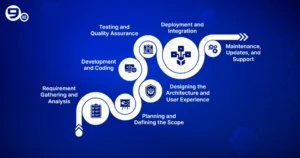
Wondering how the enterprise software development process takes place? Software development companies follow a structured approach for development to measure performance and workflows. Here are the following steps:
Step 1 – Requirement Gathering and Analysis
The first step begins with in-depth research for software development for collecting, organising, and documenting all the key functions and non-functional tasks for development. Once you identify all the requirements, it will be easier to draw a blueprint for the steps and timelines to build the right product. The development team can perform multiple analyses for the market and customer, interact with stakeholders, and review historical records.
Step 2 – Planning and Defining the Scope
Here, at this stage, as the developing team gathers all requirements and aligns software needs, it will be easier to plan for features, development approach, timelines, and resource allocations. Following this process, it easily defines roles among the development team, establishes structured communication channels, and tracks any risks during the development.
Step 3 – Designing the Architecture and User Experience
At this point, the development team can start by outlining the software UI/UX design based on the business needs. Begin with user research to determine needs, developing personas, to visualize for defining layout, integrating for software architecture, adding icons, selecting for color theme, and defining typography styles by following the UI guidelines. This step needs a prototype for enterprise software to integrate features and wireframes.
Step 4 – Development and Coding
In this building phase of enterprise software development, real coding and integration of tools and frameworks are performed by the in-house development team. Businesses can opt for low-code or no-code development to configure and enable faster deployment for software. No code development allows building using simple drag-and-drop functionalities to build the right software.
Step 5 – Testing and Quality Assurance
It is one of the crucial stages for the enterprise software development process that checks for reliability, security, and user responses. Several tests were performed to verify software integrity, including User Acceptance Testing (UAT), integration, Unit, end-to-end, and system testing to meet specific software requirements. Developers can measure testing on different factors like reliability, speed, reaction time, and scalability for the expected workload.
Step 6 – Deployment and Integration
Deployment is known to be the final stage of the enterprise software development process. It followed through different data migration strategies, whether on-premises or cloud deployment, within the right environment. Also, for extended usage, integration with other systems, cloud support, CRM, and ERP will help with easy workflows. Other deployment strategies, like CI/CD pipelines, blue-green, and rollout ease deployment, avoid any disruptions.
Step 7 – Maintenance, Updates, and Support
Post deployment, there is an additional step to conduct for regular monitoring, fix-ups, and software updates. It includes addressing the visible software issues, ongoing maintenance, and support for security patches. This way, businesses can adopt new UI changes, program features, and upgrade software after the release phase. Further updates ensure business continuity, compliance, and scalability through the number of users, code efficiency, and infrastructure.
Best Practices for Enterprise Software Development in 2025
The software industry is heading towards following the best practices for software development and procedures to follow for considering the code quality and project enhancements. These practices benefit stakeholders, designers, and project managers to ensure that their development process helps reduce errors, streamline workflows, and provide consistent outcomes.
Agile and DevOps Approaches
Following these two approaches for enterprise software development brings more efficiency and predictability within the entire procedure. WitAnile approach for enterprise software development, it focuses on collaboration and customer feedback for rapid release. The DevOps approach supports removing data silos from the existing development process and operation teams to automate processes for quick deliveries.
Cloud-Native Development and Microservices
For value delivery, cloud-native development integrates technical and organisational shifts to design, construct, and deploy within the cloud environment. This methodology boosts agility and productivity improvement for businesses to meet customer demands. Microservice is an integral architecture of cloud-native development, breaking services into small, self-contained services to focus on specific functionalities.
Data Security and Compliance Management
Software development without any data integrity will be a huge mistake for the business. With the growing risk of cybersecurity and data breaches, companies are focusing on security and compliance to protect users’ confidential data. Following the practice of data tokenisation, encryption data and other key practices helps to save data across the software applications.
Business Goals
The project goal will act as the centre point for the development process that helps the team move in the right direction. Every core team member will work under the vision to fulfill project objectives that eliminate the risk of deviation and miscommunication. Setting up business goals like improving CRM systems, sales tracking, or data reporting will be defined as success metrics and used to assess the performance.
Reuse Frameworks
Following the practice of reusing frameworks helps in creating pre-built code components that help software developers build without resource wastage. The developing team understands how to utilise the framework and library with the right approach, focusing on mainstream coding rather than repetitive routine tasks of database management and format conversions.
Future Trends in Enterprise Software Development
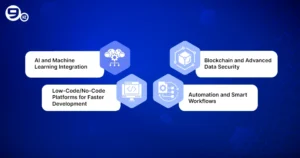
With rapid technology advancements for AI and ML and development approaches, it brings innovations through future trends for enterprise software development. Considering that the software industry is dynamic and it should align with changes in user expectations and market demands. Top enterprises are aiming to invest in digital transformation to accelerate their advanced enterprise software development services.
Here are the following trends for software development that help to remain competitive in the industry.
AI and Machine Learning Integration
Some key developments that AI and ML bring into the segment are trends for ethical AI, AI-as-a-service, Natural Language Processing NLP, Generative AI, and Automated Machine Learning. This integration helps to simplify complex data, speed up processing for insights, and bridge the gap between manual and NLP capabilities. It enhances software usage for process automation, predictive analytics, personalisation, and operational efficiency.
Low-Code/No-Code Platforms for Faster Development
Low-code development is the best process to build custom software using basic coding without any programming experience in programming and code knowledge. With minimal resources, no-code development makes the process easier through simple drag and drop, where a non-development team can complete the process without any coding knowledge. These solutions ensure faster deployment and turn it into a cost-effective approach.
Blockchain and Advanced Data Security
For data security and avoiding cybersecurity attacks, blockchain comes as an innovative solution to record, store, and secure data. Also, blockchain operates across a series of networks, and this decentralisation results in no single point of failure. This trend helps to offer resilience from outages, tampering, and fraud for validating existing data. Specifically for industries like healthcare, finance, and government, it creates more transparency and builds trust among stakeholders.
Automation and Smart Workflows
With the advent of AI, it streamlines business operations and improves overall productivity to process high volumes of data. Automated workflows facilitate better communication and collaboration through centralised information repositories for inter-departmental functions. Smart workflows ease flexibility to adapt to changing business needs and scale to handle increased workloads.
Common Challenges in Enterprise Software Development
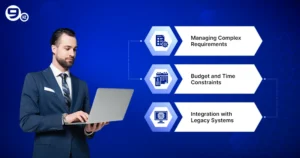
Like any other technical procedure, enterprise software development processes create certain challenges regarding changing requirements, data integration, and compatibility checks. To remain competitive, development should overcome these challenges to get the desired results and deliver the right product.
Managing Complex Requirements
Businesses having multiple points of contact, and this might be a complex requirement for enterprise software development, create a challenge to meet changing expectations. A few ideas suggested by stakeholders can clash with employees, resulting in undue time spent on coding and bugs, along with resource wastage for testing features. In such scenarios, developers are required to prioritise features to not limit the functionalities.
Solution: Using technical documentation, conducting detailed analysis of requirements helps to avoid any clash and miscommunication.
Budget and Time Constraints
Due to the urgent and faster deliveries, it can negatively impact enterprise software development processes. To meet this market demand and internal deadlines, developers might overlap tasks and miss out on essential features, resulting in failed deployment, performance incompatibility, and fixing bugs. Limited budget compels the team to look for cheaper alternatives that might increase the risk of quality issues.
Solution: Following agile and scrum methodologies for faster deployment and distributing development into small phases to manage time.
Integration with Legacy Systems
Using the traditional systems and software integration will be a major challenge, as it doesn’t support modern technologies. Following the practice of poor documentation and not using scalable solutions creates difficulty in ensuring data migration across old to new systems. It also increases the risk of data loss, replacement, and hinders scalability.
Solution: With the help of APIs and middleware, developers can ease data transfer and phased migration, preventing data loss.
Conclusion
By the end of the blog, you must have understood the importance of enterprise software development. This aligns with your business needs, offers more flexibility and scalability, cost cost-effective, integrated operation, and automates processes. Enterprise software offers varied benefits to balance cost, easy third-party system integration, and enhanced security measures.
Additionally, hiring the best enterprise software development provider will bring value for time, investment, and overall business services. You can connect with NineHertz, the #1 enterprise software development company across the globe, with the right team and expertise to deliver products on time and within budget.
FAQs
What are the 7 stages of the software development process?
Here are the seven common stages for the enterprise software development process that every company follows:
- Planning
- Analysis
- Software designing
- Development and Implementation
- Software testing
- Deployment
- Maintenance and Updates
What is Enterprise Software Development?
It refers to the process of building large-scale software with complex feature integration to structure operations, automate tasks, and improve existing systems.
What is ERP in an enterprise?
ERP is an integrated platform designed to integrate or centralize business processes like sales, finance, HR, and supply chain for unified data flow.
What are the biggest challenges in developing enterprise software?
Some of the biggest challenges include integrating complex legacy systems, handling high-scale data, managing changing requirements, preventing sensitive data, and software maintenance post-deployment.
