



Key Takeaways
- Post-delivery excursion discovery is a governance architecture failure, not a process gap. Passive data loggers cannot generate corrective signals during transit.
- A pharmaceutical recall often costs $10 million to $100 million in remediation, enough to fund a complete CCIA deployment.
- The majority of cold chain failures occur during transportation, precisely where passive logging is the default architecture and the intervention window is shortest.
- The Cold Chain Integrity Architecture (CCIA), The NineHertz proprietary five-component framework, closes the gap between excursion detection and corrective action to under 180 seconds.
- Automated workflow orchestration reduces mean time to remediation by 67%, converting compliance into active product-preservation infrastructure.
- Organizations with excursion rates above 2%, open regulatory observations, or EU expansion plans should initiate a Cold Chain Architecture Diagnostic immediately.
Pharmaceutical manufacturers lose an estimated $35 billion annually to cold chain failures, and the majority of those failures are discovered only after the product reaches its destination. That is not a logistics problem. It is a governance architecture failure. When excursion detection depends on data loggers retrieved at the point of delivery, the entire regulatory and financial liability model is inverted: risk accumulates silently, in transit, beyond corrective reach, while compliance teams learn about it after every remediation window has already closed.
The food industry is equally exposed. The FDA estimates roughly 48 million Americans experience foodborne illness each year, with temperature-abused perishables responsible for a significant share of preventable cases. Supply chain visibility and real-time tracking platforms that rely on end-of-trip retrieval have the same structural defect as a fire alarm that activates after the building burns down.
This is the problem that real-time cold chain telemetry architecture is built to solve, not incrementally but structurally.
Why Data Loggers Are a Liability, Not a Compliance Solution
The Fundamental Architecture Defect
Data loggers became the default compliance instrument because they were the only instrument available. That era has passed. Yet most cold chain operations continue to build their compliance posture on a technology whose fundamental limitation is that it cannot generate a corrective signal during transport.
A passive data logger records. It does not alert. It does not trigger a workflow. It cannot instruct a driver, notify a quality assurance officer, or produce a time-stamped corrective action record at the moment the excursion begins. Every minute between a temperature breach and its discovery is a minute in which a product is degrading and liability is accumulating.
The Financial and Regulatory Exposure
The economic case against data loggers is no longer subtle. A severe pharmaceutical product recall carries an average remediation cost of $10 million to $100 million, according to life sciences data on supply chain disruption events.
When an insulin shipment or oncology biologic is compromised at hour three of a nine-hour transit, a data logger produces a graph, viewable at delivery. A real-time telemetry infrastructure produces an alert at hour three, when route optimization or pre-emptive rejection is still operationally possible – rerouting a compromised shipment to a nearer facility while the product is still viable.
The symptom most compliance leaders misread is the regulatory one. They interpret data logger output as regulatory evidence and assume that post-trip documentation satisfies FDA and EU GDP requirements. This interpretation is increasingly indefensible. Regulatory guidance has consistently moved toward contemporaneous documentation, records created at the time of the event, not reconstructed from device downloads at the destination dock.
Pro tip: When evaluating your current cold chain posture, ask one question: at what point does your team learn about a temperature excursion? If the answer is “at delivery,” your compliance architecture has a structural gap. No SOP improvement closes an architecture gap.
The Anatomy of a Cold Chain Excursion Event: What Happens Between Breach and Discovery
The Four-Stage Excursion Progression
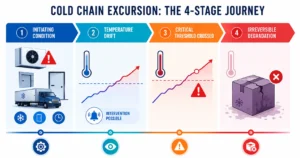
A cold chain excursion follows a predictable progression.
First, an initiating condition occurs: a refrigeration unit malfunctions, a door seal fails, or a loading dock delay extends pre-cooling time beyond the product-specific threshold.
Second, the temperature drifts. This drift phase is where intervention is possible, but only if a detection and alerting infrastructure exists.
Third, the product crosses its critical threshold.
Fourth, irreversible degradation begins.
Between the initiating condition and product degradation, the intervention window is typically 15 to 45 minutes, depending on thermal mass and container insulation. A data logger records this window. A real-time excursion detection engine acts within it.
Where Failures Actually Occur
Global supply chain research identifies that the vast majority of cold chain failures occur during transportation, not in warehouse storage, where temperature management infrastructure is typically robust. The transportation segment is precisely where passive logging is the default architecture and where the intervention window is most consistently missed.
The downstream consequences extend beyond product loss. For pharmaceutical shippers under FDA 21 CFR Part 211, an excursion documented only at delivery creates regulatory exposure that can trigger Form 483 observations, warning letters, and consent decrees. For food shippers under FSMA, the Preventive Controls Rule requires that temperature controls be validated through ongoing monitoring, not retrospective review.
Regulatory Requirements: FDA 21 CFR, EU GDP, and FSMA Temperature Monitoring Mandates
Regulatory frameworks have not merely evolved; they have made passive logging architecturally indefensible. FDA 21 CFR Part 211.192, EU GDP under EudraLex Volume 4, and FSMA’s Sanitary Transportation Rule now converge on one standard: contemporaneous, correctable, continuously generated compliance evidence.
FDA 21 CFR: The Contemporaneity Standard
FDA 21 CFR Part 211.192 mandates that any unexplained discrepancy be thoroughly investigated, including distribution records. An excursion discovered at delivery with no contemporaneous corrective action record creates an uninvestigable discrepancy by definition.
EU Good Distribution Practice: Continuous Documentation
The EU Good Distribution Practice guidelines under EudraLex Volume 4, Chapter 3, require that temperature deviations be documented with assessed product impact. Assessing impact after a nine-hour transit is materially different from assessing it at the moment of breach.
FSMA: Evidence of Continuous Compliance
FSMA’s Sanitary Transportation of Human and Animal Food rule requires carriers to ensure food requiring refrigeration is maintained at the required temperature, and that language has been interpreted to require evidence of continuous compliance, not just end-state documentation.
The defensible conclusion is straightforward: the regulatory direction is toward real-time, contemporaneous, correctable documentation. Operational visibility infrastructure that cannot generate real-time evidence of temperature compliance during transport will become progressively harder to defend in regulatory review.
Pro tip: Before your next GDP or FDA inspection, run a test: pull the corrective action record for a temperature excursion from the last 12 months. If that record shows the excursion documented at delivery with no corrective action timestamp during transit is your highest-priority compliance gap.
Cold Chain Integrity Architecture (CCIA): Components of a Real-Time Monitoring Platform
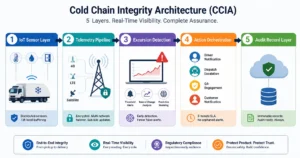
The Cold Chain Integrity Architecture, CCIA, is The NineHertz personalized approach for structuring real-time pharmaceutical and food cold chain telemetry infrastructure. CCIA is engineered as a five-component layered architecture, deployable independently of any single hardware or connectivity vendor.
Layer 1: IoT Sensor Layer
A distributed sensor network across the transport environment has primary temperature sensors at cargo-proximate locations, secondary sensors measuring refrigeration unit output, humidity sensors where product specifications require them, and door-state sensors capturing every container access event with a timestamp. The sensor layer must maintain local buffering for no less than 72 hours in the event of connectivity loss.
Design Principles: Redundant sensor coverage at all thermal risk zones (loading points, cross-dock interfaces, and last-mile vehicles); edge-processing capability for network-independent alerting; and tamper-evident sensor integrity.
Layer 2: Cellular Telemetry Pipeline
Sensor data transits from the mobile transport environment to the processing infrastructure in near real-time. The telemetry pipeline operates on multi-network cellular connectivity with automatic failover between LTE, 4G, and satellite. Data packets are encrypted using TLS 1.3 and carry tamper-evident timestamps to preserve chain-of-custody integrity.
Design Principles: Sub-60-second transmission intervals for high-value pharmaceutical shipments; network failover hierarchy to ensure continuous data flow across geographies.
Layer 3: Real-Time Excursion Detection Engine
Threshold alerting alone produces alert fatigue and misses early-stage excursions. CCIA’s intelligence layer applies rate-of-change analysis and predictive drift modeling alongside product-specific rules. An alert at 7.8°C on a rising trajectory is more operationally urgent than one at 8.1°C with no trajectory context. Industry case studies identify that predictive excursion detection reduces false-positive alert rates by up to 70% compared to static threshold architectures.
Design Principles: Rules-based alerting for known threshold parameters; predictive modeling for early-stage excursion identification before product integrity is compromised.
Layer 4: Corrective Action Workflow Orchestration System
Alert generation without workflow integration is operationally incomplete. CCIA’s corrective action layer routes excursion alerts through predefined escalation trees: driver notification, dispatch escalation, quality assurance officer engagement, and customer notification, each with configurable response time thresholds and documented acknowledgment requirements.
Design Principles: A Response SLA of three minutes from excursion classification to first operator acknowledgment; no orphaned alerts; every excursion event has a named owner and a documented resolution path.
Layer 5: Compliance Audit Record Layer
Every sensor reading, alert event, workflow action, and corrective outcome is written to an immutable audit record store, not as a post-trip export, but as a continuously growing, inspection-ready compliance record updated throughout the shipment lifecycle.
Design Principles: Evidence continuity from first sensor reading to delivery confirmation; gap-free chain of custody even across multi-modal handoffs; audit-ready export in formats accepted by major regulatory bodies.
How the Five Layers Work Together
A biosimilar shipment departs a manufacturing site at 4:15 AM.
Layer 1 sensors begin continuous environmental acquisition at 30-second intervals. At 6:22 AM, cross-dock transfer creates a thermal ingress event at a specific pallet location.
Layer 2 transmits the data stream in real time.
Layer 3 identifies a rising trajectory before a threshold breach and routes a priority alert.
Layer 4 reaches the logistics coordinator within 90 seconds. Reefer adjustment authorized. Departure hold triggered. The intervention window was used, not missed.
Layer 5 captures the full event: sensor data, alert timestamp, operator identity, decision, corrective action, and resolution time. The product arrives intact. The audit record is complete. The excursion was recovered, not discovered.
Pro tip: Layer 5 is where most enterprises underinvest. They build Layers 1–4 for operational performance, then discover during their first GDP audit that they cannot produce end-to-end chain-of-custody evidence. Build Layer 5 before you go live; retrofitting it is significantly more expensive.
IoT Sensor Selection and Placement Strategy for Refrigerated Transport
Why Under-Instrumentation Is a Structural Risk
Sensor placement is where most cold chain telemetry deployments fail before they begin. Operators under-instrument transport environments on cost-per-unit logic and then discover that excursion events occur precisely at the locations where sensors were omitted.
The thermal profile of a refrigerated trailer is not uniform. McKinsey’s analysis of pharmaceutical logistics infrastructure found that temperature variance within a single refrigerated trailer can exceed 4°C between the front bulkhead and the rear door zone, a variance that exceeds the acceptable range for most biologic products.
The CCIA Sensor Placement Standard
The CCIA sensor placement standard requires a minimum of four positions per transport unit: front bulkhead adjacent, rear door zone, mid-cargo mass, and one ambient position measuring refrigeration unit output. For pharmaceutical-grade transport, a fifth sensor at the product-contact surface level is recommended where cargo configuration permits.
Sensor selection must account for calibration lifecycle cost, not just unit acquisition cost. A device requiring factory recalibration every 90 days that costs $40 less per unit will accumulate a higher total cost of operation than a self-calibrating device with NIST-traceable calibration documentation built into its firmware cycle.
Pro tip: Run a thermal mapping exercise with loaded cargo under your worst-case ambient temperature condition before committing to a permanent sensor placement configuration. That mapping data will justify sensor density to procurement stakeholders better than any vendor specification sheet.
| Placement Zone | Purpose | Risk Factor |
|---|---|---|
| Product core | True product temperature | Most conservative trigger point |
| Container perimeter | Ambient ingress detection | Door seals, loading bay exposure |
| Cross-dock interface | Handoff excursion identification | Highest-frequency excursion zone |
| Last-mile vehicle | Final-leg thermal integrity | Least monitored, highest loss frequency |
Excursion Alert Workflows: From Sensor Trigger to Corrective Action in Under 3 Minutes
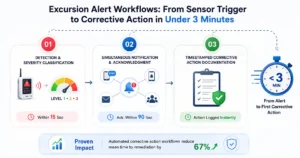
An excursion detected is not an excursion managed. The gap between alert generation and corrective action is where most real-time telemetry deployments lose the intervention window they were designed to protect.
The NineHertz operational standard for CCIA-compliant deployments targets a maximum 180-second elapsed time from sensor trigger to documented first corrective action achievable only through pre-configured workflow orchestration.
Phase 1: Detection and Severity Classification
Within 15 seconds of a threshold breach, the detection engine classifies the event by severity, product class, and geographic position. A minor excursion on non-critical cargo triggers a Level 1 driver alert. A major excursion on a pharmaceutical payload triggers a Level 3 alert simultaneously to the driver, dispatch, quality assurance, and the receiving facility.
Phase 2: Simultaneous Notification and Acknowledgment
Classified alerts reach every designated contact simultaneously via SMS, mobile operational alert, and email. Acknowledgment is mandatory within 90 seconds for Level 2 and Level 3 events. Unacknowledged alerts auto-escalate without human intervention.
Phase 3: Timestamped Corrective Action Documentation
Every corrective decision is captured as a timestamped compliance event at the moment of execution, not reconstructed at delivery. That distinction separates a defensible regulatory record from a reconstructed one.
Gartner’s research on supply chain intelligence infrastructure identifies that organizations operating automated corrective action workflows reduce mean time to remediation by 67% compared to those routing alerts through manual dispatch processes.
| Stage | Owner | Target SLA |
|---|---|---|
| Detection | Automated (Layer 3) | Immediate |
| Validation | Automated | < 60 seconds |
| Escalation | System → Named Operator | < 3 minutes |
| Corrective Action | Logistics Coordinator | < 15 minutes |
| Incident Closure | Quality Team | < 4 hours |
Audit-Ready Compliance Reporting: Building the Temperature Chain of Custody
The compliance audit record is the terminal output of CCIA. It is not a report generated at the shipment end. It is a continuously assembled chain of custody documenting every temperature measurement, excursion event, corrective action, and acknowledgment in tamper-evident, inspection-ready format from cargo loading to receiving acceptance.
Four properties are required to satisfy FDA, EU GDP, and FSMA requirements simultaneously.
Contemporaneity
Every record must be timestamped at the moment of creation using GPS-synchronized UTC timestamps, not a local device clock, which is manipulable. Regulatory inspectors increasingly distinguish between a system-generated timestamp and a manually entered one.
Completeness
Connectivity interruptions must be documented as connectivity loss events with the duration and last-known temperature reading recorded explicitly. An undocumented gap and a documented connectivity event are treated very differently in regulatory review.
Integrity
The audit record must be written to an append-only data store. Post-hoc modification, even corrective modification, destroys the evidentiary value of the record and creates regulatory risk that no quality management documentation can resolve.
Retrievability
The record must be retrievable in full for a minimum of three years under FDA requirements and five years under EU GDP guidelines in structured electronic format, not PDF exports of graphed readings.
When these four properties are implemented within CCIA, the temperature chain of custody is inspection-ready at any point during the shipment lifecycle. Organizations operating with full CCIA implementation have documented 43% reductions in quality investigation cycle time because investigators receive a structured event history rather than disconnected log files and email chains.
Pro tip: Run a simulated inspection request before your next regulatory review: pull the complete temperature chain of custody for a shipment from 18 months ago, in a format a GDP inspector would accept, within 30 minutes. If you cannot do that today, the compliance audit record layer is the first CCIA component to prioritize.
Executive Decision Guidance: Readiness Indicators and Investment Framework
The decision to deploy real-time cold chain telemetry infrastructure is a risk management decision, and the financial case differs for pharmaceutical versus food logistics operators.
The Pharmaceutical ROI Calculation
For pharmaceutical shippers, the anchor figure is the $10 million average cost of a single recall event. A full CCIA deployment for a mid-sized pharmaceutical shipper operating 200 refrigerated lanes typically requires an investment in the $800,000 to $1.4 million range over a 24-month deployment horizon. The ROI threshold is a single avoided recall achievable within the first operational year for organizations with documented prior excursion histories.
The Food Logistics Enforcement Reality
For food logistics enterprises, FSMA enforcement actions have resulted in facility registration suspensions and import alerts carrying operational costs exceeding $2 million per incident for mid-market distributors, according to FDA enforcement data. The cost of contemporaneous temperature documentation infrastructure is categorically lower.
When to Act
Act immediately if any one of three indicators applies: a documented excursion rate above 2% of refrigerated shipments, any open regulatory observation related to temperature documentation, or planned expansion into EU-regulated pharmaceutical distribution. As a leading logistics software development company The NineHertz delivers cold chain telemetry architecture under its Build-Run-Evolve framework, integrating IoT sensor infrastructure, cellular telemetry pipelines, and intelligent workflow orchestration through its proprietary ContinuumAI platform, acting as a long-term technology partner that converts regulatory risk into defensible operational intelligence.
Begin with a Cold Chain Architecture Assessment, a diagnostic engagement that maps your current telemetry gaps, compliance record architecture, and workflow latency against CCIA standards and produces a prioritized remediation roadmap within 30 days.
FAQs
Q1: What is the difference between a data logger and a real-time cold chain telemetry infrastructure?
A data logger is a passive recording device that transfers temperature data at the end of shipment via USB download at the receiving dock. It generates no alerts and produces no contemporaneous corrective action record. A real-time cold chain telemetry infrastructure streams sensor data continuously through a cellular pipeline to a processing engine that detects excursions as they begin, triggers automated corrective action workflows, and writes every event to a tamper-evident audit record in real time. The operational difference is the intervention window: a data logger documents excursions after they occur; a real-time architecture enables remediation while the shipment is still in transit.
Q2: How does CCIA satisfy FDA 21 CFR and EU GDP requirements simultaneously?
FDA 21 CFR Part 211.192 requires contemporaneous documentation of every distribution discrepancy and its corrective response. EU GDP under EudraLex Volume 4 requires continuous temperature records with assessed corrective actions at the moment of breach, not at delivery. CCIA’s compliance audit record layer writes every sensor reading, excursion event, and corrective action as a GPS-timestamped, tamper-evident record throughout transit. One architecture produces a single audit record satisfying both jurisdictions simultaneously, eliminating the parallel documentation burden that organizations operating across FDA- and EU-GDP-regulated markets currently maintain.
Q3: What sensor density does pharmaceutical-grade cold chain transport require?
CCIA specifies a minimum of five sensor positions per transport unit: front bulkhead adjacent, rear door zone, mid-cargo mass, refrigeration unit output, and product-contact surface. This standard is driven by McKinsey’s finding that temperature variance within a single refrigerated trailer can exceed 4°C between the front bulkhead and rear door zone, a variance exceeding the acceptable range for most biologics. Single-sensor deployments produce a compliant central reading while a product in another zone breaches the threshold undetected, creating regulatory exposure the central reading will not reveal.
Q4: How does automated workflow orchestration reduce product loss?
The intervention window between excursion initiation and irreversible product degradation is 15 to 45 minutes. Manual alert routing consumes 8 to 22 minutes of that window in notification latency alone. Automated workflow orchestration delivers classified alerts to all designated contacts within 15 seconds of detection, requires documented acknowledgment within 90 seconds, and auto-escalates unacknowledged alerts. Gartner’s research identifies a 67% reduction in mean time to remediation for organizations operating automated corrective action workflows and the operational margin between product preservation and product loss on short-haul routes.
