


AI is transforming businesses globally. 42% of enterprises are already embracing AI benefits, while the industry is projected to achieve a valuation of $244.22 billion by the end of 2025. However, the challenge now doesn’t lie in implementing AI, but implementing the right AI. For instance, adaptive AI vs generative AI has gained momentum among businesses for their particular benefits, applications, and use cases. While some perceive them to be the same, those who know the difference embrace more competitive advantages.
The increased economic uncertainties, critical management of organizational resources, and synchronizing with trending technologies have made it extremely challenging for businesses to sustain in the competitive market. However, artificial intelligence has evolved as a solution to all these, as well as many more problems. However, to make sure that you choose the right AI solution, it is important to explore the technology.
In this blog, we will unfold the real difference between generative AI vs adaptive AI, working principles of both, along with the use cases and features.
What is Adaptive AI?
Adaptive AI is the combination (Adaptive+AI) that directly signals towards a technology that can adapt information, user behaviour, input intent, and many other things automatically. Unlike traditional AI solutions, it doesn’t require manual updates to learn new information, adapt to user behavior, and offer customized outputs. It has the capabilities to learn, adapt, and execute, all by itself.
The core competency of adaptive AI is that it can make changes in the code according to the input given by the user. So, it is open to self-improvement, adaptability, and problem-solving prowess. An experienced adaptive AI development company builds such systems by relying on customer interaction, feedback, and RAG (to grab information from external internet sources).
What is an Example of Adaptive AI?
Adaptive AI is applied in instances where it is not feasible to make real-time manual updates. Autonomous vehicles are the best example of adaptive AI. It helps the vehicle to gather real-time information from the environment to know about surrounding vehicles, road conditions, traffic congestion, and much more. Thus, adaptive AI helps to control the steering, apply brakes, and take the routes that are less crowded.
At the same time, as soon as any obstacle comes within a specific radius of the vehicle, speed is automatically reduced, and brakes are applied. Here, the user is not giving any manual command or making changes to the code. Adaptive AI automatically learning from the environment and executes the actions.
Key Features of Adaptive AI
Here are the key features that make adaptive AI highly advanced and versatile-
- Consistent Learning– Adaptive AI continuously learn by analyzing and processing new data. For the same, it uses machine learning algorithms, draws predictions, and extracts valuable insights from customer interactions.
- Adaptability– Adaptive AI not only learn new things but also adapts them to enhance the interaction experience and quality of output. For instance, it can actively monitor the user’s emotional tone from the input and adjust the output accordingly.
- Self-improvement– Adaptive AI doesn’t rely on manual updates and coding changes to improve the outcome quality. It can analyze the feedback given by the user, a series of questions, and the results of the previous actions to make real-time improvements.
- Quick Adaptation– Whether it is a self-driving car or just a normal chatbot, adaptive AI quickly adapts to the surrounding environment to execute the action in no time.
- Evolutionary Algorithms– This technology is incorporated with evolutionary algorithms that help to alter the parameters according to changing business or user needs. These algorithms encourage consistent changes and adaptability in the system.
Applications of Adaptive AI
Adaptive AI use cases are prominent across industries and domains, enabling businesses to leverage a more sustainable and advanced future. Here are the key applications of adaptive AI in different industries-
- Healthcare– Adaptive AI helps healthcare institutions to offer personalized treatment plans by analyzing patient data and medical history. Medical image analysis plays a vital role in modern healthcare infrastructures to accurately and quickly analyze MRIs, X-rays, and CT scans, identifying the root causes of diseases.
- Finance– The novel technology is capable of actively scanning the entire system in real time to identify the anomalies. As soon as any error is reported, the case is escalated to the concerned authorities, while pre-defined measures are automatically deployed.
- Supply Chain Management– Adaptive AI brings the predictive analytics feature that allows suppliers to accurately predict the inventory demand and thus maintain an efficient stock level.
- Transportation– Traffic analysis becomes highly accurate with adaptive AI that helps drivers to take the less crowded routes, reducing the chances of accidents and fuel wastage.
- Retail– Adaptive AI can be designed to analyze the product prices on competitors’ websites and thus facilitate the dynamic pricing according. Thus, it helps to gain competitive advantages without impacting the overall profit margins.
What is Generative AI?
As indicated by the terminology, generative AI is a subset of artificial intelligence that helps to generate different types of media formats, including texts, images, audio, videos, and more. An experienced generative AI development company builds such solutions by training them on large datasets, which are then used by the software as the knowledge base to provide the output. Generative AI allows users to provide any prompt, ask questions, have conversations, analyze images, and much more.
Generative AI basically works on the principles of encoding and decoding, where it encodes the existing information into a vector space. This helps to prioritize the data according to its relevance to the question or prompt provided by the user. Decoding includes crafting an output by using the information that has close relevance to the prompt in vector space. This principle ensures that generative AI solutions offer a more accurate and relevant response.
What is an Example of Generative AI?
AI-powered chatbots like ChatGPT, Perplexity, and Gemini are great examples of generative AI solutions. These platforms offer a chat interface that allows users to directly ask questions, seek suggestions, upload files, and provide any kind of prompt. The chatbot analyzes the input to generate different types of content, including texts, images, videos, or even audio.
Most of the AI chatbots analyze the prompt by identifying the core keywords. It then fetches the relevant information from the trained datasets to prioritize the information in the vector space. The output is curated by these AI chatbots by including the information that is closer to the user prompt in vector space. Thus, it helps in creating the output with accurate information.
Key Features of Generative AI
Here are the key features of generative AI that encourage its use cases in different scenarios-
- Creative Content Generation– Generative AI solutions can produce unique and creative content in different formats that can easily mimic human creativity. Competencies like image and video generation further contribute to the increased use cases of generative AI.
- Contextual Understanding– The latest generative AI solutions can understand the context of the prompt along with the tone and emotions to curate a personalized output accordingly.
- Quick Content Generation– Generative AI solutions generate the relevant content in different media formats within seconds without compromising quality. Thus, it helps to save human time by drafting emails, analyzing documents, and creating unique designs.
- Personalization– It is very easy to generate personalized content using generative AI at a large scale. This feature helps the sales and marketing professional to cut down their writing and drafting time.
- Multimodal AI– Most of the generative AI platforms now can entertain multiple media formats (text, image, videos, audio) as input and output, which opens up the door to more accurate interaction.
Applications of Generative AI
Here are the core generative AI use cases-
- Image Generation– Generative AI is highly used by marketers and designers to generate creative images by providing simple prompts in multiple formats like sketch, futuristic, oil paint, black & white, and much more.
- Video Generation– Similar to image generation, generative AI models are applied to produce high-quality video content while automating the range of tasks like video composition, adding special effects, animation, and editing video snippets.
- Audio Generation– Generative AI is also used to create new music pieces by providing the idea about tones, lyrics, and genre. At the same time, features like text-to-speech or speech-to-text also help users to use audio as input or output.
- Text Generation– This is the most traditional application of generative AI that allows users to generate a large volume of text within seconds. It covers generating new ideas, answering questions, drafting emails or reports, and even summarizing large content.
- Code Generation– Generative AI is now highly used to generate customized code functions or even entire programs on the basis of prompts. It helps to automate repetitive coding tasks.
6 Key Differences Between Adaptive AI and Generative AI
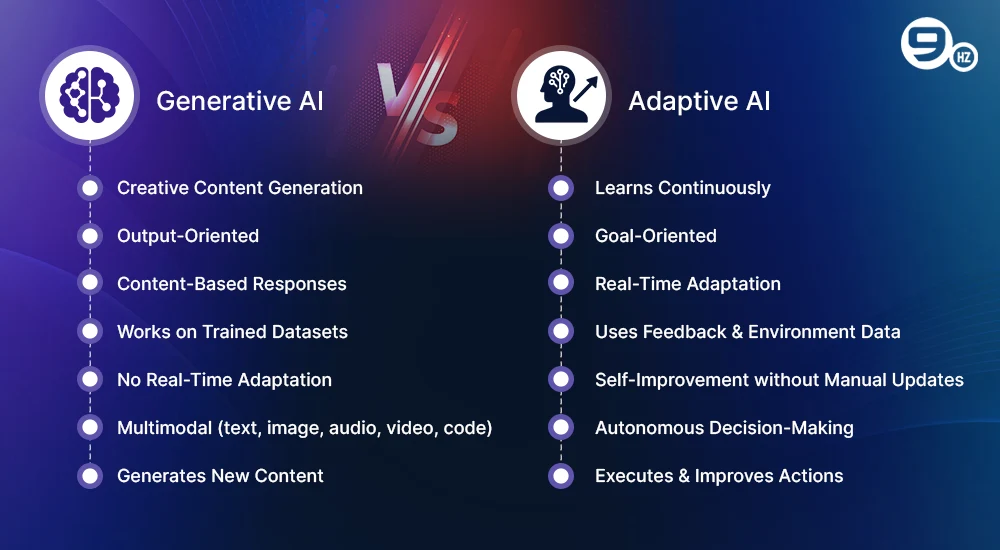
While you might experience confusion among businesses regarding the different subsets of artificial intelligence, it is important to understand the real differences to choose the right one according to real-time business needs. Whether it is the cost of implementing generative AI or the application of adaptive AI, everything gets altered during the deployment. So, here is a quick comparison of generative AI vs adaptive AI based on different factors-
1. Working Mechanism
- Generative AI– This subset is designed to generate new content on the basis of a trained dataset. The working of generative AI explicitly follows pre-existing patterns and algorithms to curate outputs, ensuring that responses are relevant and aligned with the training data.
- Adaptive AI– On the other hand, adaptive AI solutions are designed to consistently learn from user interaction and the external environment. Thus, the accuracy and efficiency of this model always improve with time.
2. User Base
- Generative AI– It is mostly used by professionals working in creative domains like marketing, designing, and content creation. Its natural language processing helps to understand commands and generate creative ideas.
- Adaptive AI– It is highly used for real-time decision-making in dynamic settings where continuous learning is crucial to ensure accuracy.
3. Output
- Generative AI– These types of platforms are designed to produce creative outputs like literature, videos, content, images, emails, and much more. The generated content is always unique, innovative, and carries human-like tones.
- Adaptive AI– Adaptive AI produces insights and accurate forecasting based on large volumes of data, user interaction, and real-time environment. It offers the data-driven insights that help in accurate decision-making.
4. User Interaction
- Generative AI– It requires consistent human interactions and manual commands to generate any kind of content or media files. The generative AI-based chatbots and virtual assistants are also designed to interact directly with humans.
- Adaptive AI– This AI application doesn’t require direct human interaction as it is capable of adapting the data over time. It is designed to help humans in informed decision-making and accurate predictions.
5. Evolution Limitation
- Generative AI– It is limited by the defined set of rules and data used during the model training process. Thus, it can not evolve and shape the content without human command.
- Adaptive AI– It is designed to automatically learn from new information and user interaction. Therefore, adaptive AI can evolve without human command.
6. Complexity
- Generative AI– This subset of AI can produce distinctive and unique findings on difficult topics, but requires increased processing power.
- Adaptive AI– It can manage a particular degree of complex tasks. However, it might fail to offer novel results.
| Key Factor | Adaptive AI | Generative AI |
|---|---|---|
| Definition | An AI model designed to consistently learn from human interaction. | An AI model designed to generate content, images, and videos from training data. |
| Training | Requires a small data volume as it can learn automatically over time. | Requires huge data volumes to feed learning patterns. |
| Flexibility | Open to learn and adapting the new data to increase the accuracy. | Highly limited to the training data as long as RAG is not integrated. |
| Complexity | Ability to handle complex data, but unable to generate unique or creative outputs. | Capable of generating complex and accurate outputs with high computing power. |
| Use cases | Highly used for trend forecasting, demand prediction, and recommendation systems. | Highly used to generate images, audio, videos, and language translations. |
Adaptive AI vs Generative AI: How to Choose the Right Approach for Your Business
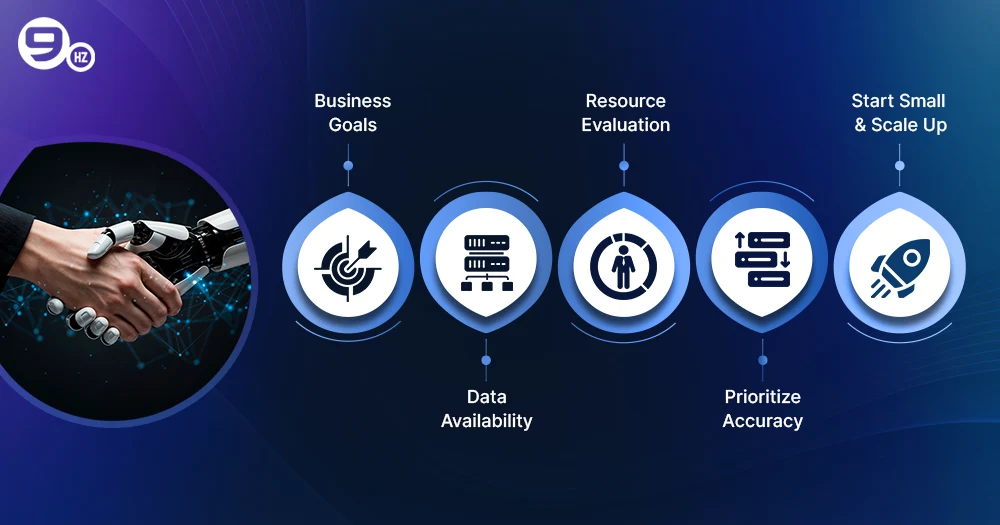
Choosing between adaptive vs generative AI is one of the most crucial tasks of the development process, as it determines the outcomes and business benefits. For instance, the cost of implementing adaptive AI vs generative AI doesn’t influence the choice, as both models have different purposes. Therefore, we have enlisted the key factors that will help you choose the ideal technology in generative AI vs adaptive AI.
1. Business Goals
The first and most important factor to consider is your business objectives that you envision to achieve by the implementation of artificial intelligence. For instance, if you aim to generate fresh content in the least time without compromising the quality and efficiency, generative AI proves to be the best option. It helps you strengthen your online presence by curating SEO friendly content. On the other hand, if you aim to understand market trends, analyze data, and make predictions, adaptive AI can be a better option as it can continuously learn from new data and produce outputs accordingly.
2. Data Availability
When you choose between generative AI vs adaptive AI, it is crucial to consider the quality and quantity of the data that you have. While both the AI model requires accurate and high-quality data for training, the quantity and type of information differ significantly. For instance, adaptive AI needs a continuous influx of data to ensure consistent learning. On the other hand, generative AI requires large volumes of data to generate new and creative content.
3. Resource Evaluation
Both the AI models are resource-intensive and thus play a vital role in choosing between adaptive AI vs generative AI. In order to make the right choice, you must evaluate the expertise of your development partner, available data with your business, the existing technological infrastructure of the company, and much more. All this evaluation helps significantly choose the right AI model.
4. Prioritize Accuracy
Both the AI models are designed to produce varied types of information. Thus, it is a good approach to prioritize the option that curates the most accurate and relevant information according to your business environment. If the firm requires instant content generation, generative AI solutions should be chosen. Similarly, if you want to have a calculated glance into the near future trend, adaptive AI stands a bigger chance.
5. Start Small and Scale Up
Irrespective of the choice you make between adaptive AI vs generative AI, it is always a good option to begin with a minimum viable product. It allows you to check the efficiency of the software in a live environment and make the improvements without deploying the entire product for the end users. Not only does it help to save costs to build adaptive AI and generative AI solutions, but it also makes sure that the final product aligns with business objectives.
Why Choose The NineHertz for Adaptive AI and Generative AI Implementation?
The choice of the right artificial intelligence development services to deploy the right AI model into your business defines a lot about the overall outcomes and results. An inexperienced company might save you a couple of dollars at the beginning, but you might have to compromise a lot on the outcomes. On the contrary, an experienced AI development company focuses more on building a full-fledged solution that helps to achieve the business objective.
The NineHertz is a leading adaptive and generative AI development company with 12+ years of experience. We work with a team of 250+ developers who help to understand particular business needs and curate the solution accordingly. Here are the key benefits of partnering with The NineHertz for AI implementation-
1. Free Consultation
The NineHertz offers a free consultation to make sure that you make the right choice between adaptive AI vs generative AI. Our experts conduct a profound business analysis to identify the real-time challenges and curate the solution accordingly. At the same time, we also offer guidance on important features, the cost to build AI solution, the development timeline, and much more.
2. Everything Under One Roof
Whether you choose adaptive AI or generative AI, you get an experienced development team for all technologies under one roof. We have a large team of engineers who help to build various types of digital products while imparting unique features.
3. Domain Specific Expertise
Our team of AI developers consists of domain-specific experts who help to better understand the challenges and opportunities available in the industries. This analysis allows our developers to curate the most relevant and useful features to secure the competitive advantages.
4. Cost Efficiency
The NineHertz is partnered with businesses of different sizes and investment capabilities. So, we offer cost-efficient AI development services to make the novel technology accessible to a wider range of businesses. However, we ensure the defined quality standard for each AI solution that we build.
5. Non-Disclosure Agreement
We understand the privacy of project and client information. So, we sign a non-disclosure agreement, which ensures that any information related to the client or project is kept confidential between the concerned parties.
Conclusion
Generative AI vs adaptive AI has been the topic of discussion among businesses due to their defined capabilities. While generative AI helps to create unique, fresh, and creative content for stakeholder interaction and strengthening online presence, adaptive AI is more preferred to analyze market trends & drive data-driven decisions. Therefore, it is highly important for businesses to choose the right AI model by analyzing factors like data availability, resource evaluation, business requirements, and more.
Frequently Asked Questions (FAQs)
1. What Is the Difference Between Generative Learning and Adaptive Learning?
Generative AI is designed to create new and unique content according to the prompt provided by the user. On the other hand, adaptive AI is designed to adapt to new information from user interaction and provide personalized recommendations, accurate predictions.
2. What Should I Choose Between Generative AI vs Adaptive AI for My Business?
The choice between adaptive AI vs generative AI depends on a range of factors, including your business objective, resource & data availability, project goals, etc.
3. What are the Working Mechanisms of Generative AI and Adaptive AI?
Generative AI solutions are trained on large datasets that are used to create images, videos, and unique content, according to user prompts. On the other hand, adaptive AI is the solution that can adapt to the new information from user interaction and thus make continuous improvements.
4. What are the Limitations of Adaptive AI?
Adaptive AI fetches the data from the user interaction, which might not be of high-quality standards, and thus, the overall outcome quality is also affected. At the same time, these AI solutions pose a threat to user security as it is consistently collecting user data to expand the knowledge base.
5. What are the Limitations of Generative AI?
Generative AI can only produce the results from the trained datasets and thus, it doesn’t incorporate the latest information (as long as RAG is not integrated). Also, if the trained dataset carries incomplete information, it might create biased results.
