



One of the emerging AI technologies coming into the mainstream this year is conversational AI. Given the surge in interest, I thought it would be helpful to share aggregated trends on the applications, strategies, and business impact of AI-powered conversational AI.
Conversational artificial intelligence (AI) enables people to interact with businesses through natural, two-way communication. And companies achieve this through chatbots, virtual assistants, or voice interfaces, such as virtual receptionists.
Conversational AI is now much more accessible and beneficial for businesses in 2026. Why?
AI technologies are incorporating voice and a superior adoption of natural language understanding into real-time conversations, such as voice AI-powered phone answering systems. This technology is now widely available to businesses of all sizes, including startups, small businesses, and enterprises.
Behind the scenes, machine learning, generative AI, and large language models (LLMs) handle the dialogue itself. At the same time, automation and business logic enable the system to take action, such as handing off to customer service agents. Customer service teams appreciate this feature because it delivers faster support, reduces their workload, lowers costs, and elevates client satisfaction.
In fact, our recent customer experience study has found that 92% of companies have already implemented AI-powered solutions to some degree. This includes conversational AI tools, such as chatbots, sentiment analysis, translations, and proactive issue resolution.
But that’s only the start of it.
There is a ton of data to examine, trends to test, and stats to know when researching all aspects of conversational AI. We’ve compiled the latest insights so you can understand how brands globally are using it today and what these trends mean for your own business.
Key Conversational AI Statistics
Conversational AI is quickly becoming a normal part of customer service. The market is growing fast, and more companies are hiring AI-focused CX roles. Customers are also getting comfortable with AI — many even prefer it over waiting for a human to come online.
Here’s a quick snapshot of how conversational AI trends are shaping customer experience today:
- The conversational AI market in intelligent contact centers is growing at a CAGR of 18.66% from 2025 to 2030. (QKS Group)
- To such an extent that 42% of organizations are expected to hire for AI-focused CX roles, such as conversational AI designers and automation analysts, by 2026. (Gartner)
- 57% of businesses are either using self-service chatbots or plan to do so in 2025 or later. (Nextiva)
- The average conversation with an AI chatbot lasts about 11 minutes. (Tidio)
- Not just that, for the more basic questions, tickets get closed with just about 11 tickets. (Tidio)
- No wonder 82% of customers would rather talk to an AI chatbot than wait for a human rep. (Tidio)
Conversational AI Market Size and Growth
The industry adoption of conversational AI solutions continues to swell. Here are several key data points to consider when assessing the market.
Global market overview
The global conversational AI market is experiencing rapid growth, with North America leading the adoption and driving the majority of the growth. Among solution types, chatbots remain the most widely used. Here’s what the numbers show:
- The conversational AI market is projected to reach USD 41.39 billion by 2030. This puts its CAGR at a 23.7% growth rate from 2025 to 2030. (Grand View Research)
- North America is expected to lead the conversational AI market in 2025, accounting for 33.62% of global revenue, with the United States holding the dominant position. (Markets and Markets)
- In fact, the number of voice assistant users in the United States is expected to reach 157.1 million by 2026. (Statista)
- If you look at the conversational AI type, then AI chatbots dominated the market in 2024. (Fortune Business Insights)
- Customer support accounted for 42.4% of the chatbot market size in 2024. (Mordor Intelligence)
Industry adoption rates
Industry adoption is strongest in sectors with high customer interaction, such as retail, commerce, and healthcare, where these sectors are emerging as major early adopters. Larger enterprises in tech, media, telecom, and healthcare are also deploying conversational AI agents.
- Retail and commerce lead all industries in conversational AI adoption, holding a 21.2% market share. (Fortune Business Insights)
- Another industry that greatly benefits is healthcare, with studies saying it can save the U.S. healthcare economy about $150 billion annually by 2026. (Fortune Business Insights)
- Among larger companies, the three industries that deploy AI agents most in service operations are technology, media and telecom, and healthcare. (McKinsey)
Key growth drivers
Conversational AI is growing fast because businesses want better automation, smarter LLMs make it more useful, and customers prefer quick self-service. But navigating the conversational AI landscape isn’t all smooth.
Conversational AI challenges, including privacy concerns, data scarcity, and the risk of inaccurate AI responses, are slowing progress.
Here’s how the numbers portray this tension:
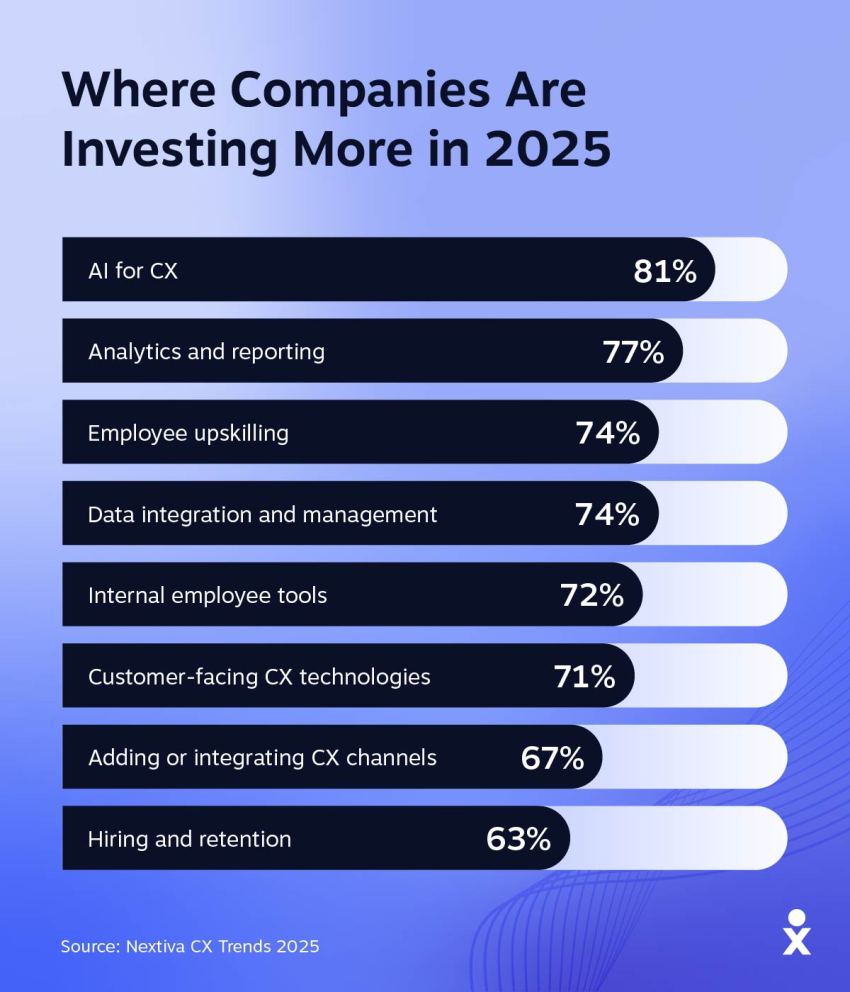
- 81% of businesses say they plan to invest in AI technologies for customer experience in 2025 and beyond. (Nextiva)
- At the same time, only 7% of businesses say they don’t face any challenges when implementing AI tools. (Nextiva)
- Key growth boosters for conversational AI include advances in LLM-based natural language processing (NLP) (+5.8%), increased usage of messaging apps (+4.2%), and pressure to cut down on 24/7 support costs (+3.1%). (Mordor Intelligence)
- At the same time, some unresolved issues slow down its growth. This includes privacy and regulatory concerns (-3.4%), integration complexity (-2.8%), and hallucination (-2.1%). (Mordor Intelligence)
- It also helps that conversational AI feels far more natural than traditional chatbots, especially since 29% of consumers find scripted, canned responses very frustrating. (Kayako)
Chatbot and Virtual Assistant Usage
From support and sales use cases to how often customers interact with bots and what they prefer, here’s how conversational AI services show up in real-world interactions.
Business use cases
Businesses are primarily using conversational AI chatbots and virtual assistants for customer support, but newer use cases, such as HR and sales, are quickly emerging. Here’s how companies are using conversational AI solutions to support key business functions:
- Customer support held 42.4% of the chatbot market in 2024, but HR and recruiting use cases are growing at the fastest rate, with a 25.3% CAGR through 2030. (Mordor Intelligence)
- Looking at the future, 72% also believe AI will initiate proactive customer service in the future. (Genesys)
- Beyond chatbots, some other ways businesses are using conversational intelligence are sentiment analysis (22%) and empathy analysis (20%). (Genesys)
Customer interactions
While consumers are increasingly open to using AI agents, their experiences are mixed. Some love the speed and convenience, while others get frustrated when conversations miss the mark.
Here’s how people actually interact with conversational AI:
- While 35% of customers prefer talking to AI agents simply to avoid repeating themselves, 32% say they do it for faster service. (Salesforce)
- But it’s not always smooth-sailing. 3 out of 5 customers say they’ve had a bad experience with customer service bots. (Verint)
- A main reason for the bad experience for 68% of customers is that the bot couldn’t answer their questions or understand their needs. (Verint)
- Surprisingly, 95% of consumers say they’re fine with slower live chat support as long as the quality is good. (Kayako)
- That’s why hybrid human-plus-AI models work well. AI in real-time agent-assist tools is said to reduce issue resolution times by 30% (AWS)
- Finally, customers are most comfortable with AI agents making appointments for them (40%) and least comfortable with them making financial decisions (58%). (Salesforce)
Business Adoption and Impact
Let’s look at how businesses of different sizes are adopting conversational AI, and what kind of impact it’s actually having.
Adoption by business size
Adoption looks very different depending on a company’s size. Like most tech developments, enterprise adoption is leading the way, while smaller businesses are quickly catching up. Here’s how AI maturity levels compare across businesses:
- Although large enterprises held 68.2% of the AI chatbot market in 2024, small and medium-sized enterprises are growing at the fastest rate, with a 25.1% CAGR. (Mordor Intelligence)
- Within enterprises, healthcare and life sciences are the largest adopters of conversational AI, growing at a 20.1% CAGR. (Markets and Markets)
- Nearly half of large enterprises still opt for on-premise deployments to protect proprietary models, but high infrastructure costs do limit broader adoption rates. (Mordor Intelligence)
- While only one-third of small businesses have reached the scaling phase for AI agents, nearly 50% of companies with more than $5 billion in annual revenue have achieved this milestone. (McKinsey)
- Larger organizations are also following more best practices for AI deployment when compared to smaller businesses. (McKinsey)
Business benefits
Businesses are turning to conversational AI for both operational efficiency and revenue gains, and many are already seeing strong results. From cost savings to better customer experiences, here are some conversational AI benefits that support business objectives:
- A business’s top motivations for investing in conversational AI are increasing revenue growth opportunities (54%) and efficiency gains (46%). (Nextiva)
- For enterprises, customer service automation via conversational AI can cut enterprise support costs by up to 92%. This saves approximately $4.13 USD per interaction compared to human agents. (Mordor Intelligence)
- While 81% of companies with mature AI programs reported high value, even 80% of early-stage adopters are seeing mid- to high-value. So it’s never too late to adopt AI in your CX interactions. (Nextiva)
- The three areas where businesses are finding the most significant benefits from AI agents are Innovation (64%), employee satisfaction (45%), and customer satisfaction (45%). (McKinsey)
Consumer Perception and Behavior
This section looks at how customers actually feel about AI. Things like customer expectations, what they’re comfortable with, and where trust is still an issue.
Adoption and engagement
Customers are increasingly optimistic about conversational AI and talking to AI agents. But they want transparency and clear handoffs to humans when needed. Here’s what they expect from AI-driven interactions:
- 24% of customers expect AI solutions to match human capabilities within the next five years. (Salesforce)
- Even now, 40% of customers say they expect better experiences if a brand uses AI in CX. (Salesforce)
- Not just that, 40% of businesses are investing in AI for customer interactions simply because customers demand it. (Nextiva)
- 72% of customers say they need to know upfront if they’re talking to an AI agent. (Salesforce)
- Similarly, 46% of customers would only talk to an AI agent if there was a clear escalation path to humans. (Salesforce)
- One other reason 11% of customers prefer an AI bot is that it’s more conversational than the search bar for self-service. (Tidio)
Trust and satisfaction
Trust is becoming a key factor in AI-powered support. People value fast resolutions, but more than that, they want clarity around data use and strong ethical standards.
- 52% of people say the main benefit of self-service chatbot technology is faster issue resolution. (Verint)
- 18% of customers say they’d use a chatbot a second time only if it moved their issue forward the first time. (Gartner)
- Only 20% of consumers say tech providers are “very clear” about the data they collect, and only 20% say it’s “very easy” to control their data. (Deloitte)
- In a similar vein, in 2024, only 49% of customers felt companies use their data in a way that benefits them. The number was 60% in 2022. (Salesforce)
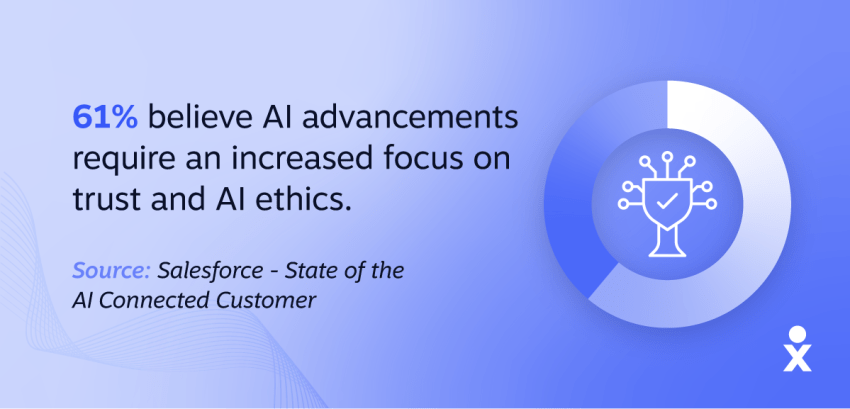
- 61% also believe AI advancements require an increased focus on trust and AI ethics. (Salesforce)
How to Implement Conversational AI in Your Business
Conversational AI can support efficiency, reduce costs, and increase customer satisfaction. However, these results only become apparent when automation, AI capabilities, and human support work together. Customers still want clear escalation paths, and agents need the proper training and tools to make AI effective.
Companies that balance all three see higher satisfaction on both sides and much smoother AI adoption. Here’s how to put that balance into practice:
1. Start with key use cases
Start by choosing the areas where conversational AI will have the most immediate impact. This can be customer communication, where AI can handle high-volume, repetitive questions, and free agents to focus on complex issues that require personalized support. Other areas include sales tasks, such as lead qualification and product recommendations, as well as internal operations, including HR inquiries and IT help desk requests.
For example, Cedar Financial, a debt collection agency, adopted Nextiva because they needed conversational, AI–powered outbound dialing to place calls at scale and then route live answers to the right agent using AI-driven skill-based routing.
Bring your teams into the process early. With 33% of employees worried AI might replace their jobs, asking them which routine tasks slow them down — and how AI could support them — helps reduce resistance and uncover the most practical use cases.
2. Pick the right technology
Once you’ve defined your use cases, choose technology that matches how your customers and employees actually communicate. If most interactions happen through chat, a text-based assistant may be enough. But if the phone is more popular, prioritize VoIPs, smart routing, and voice bots.
Look for agent-assist AI capabilities as well. These can provide real-time suggestions, summarize calls, pull account context, and help agents address customer requests faster. And they’re also great for team morale, as Michael Fitzpatrick, the CTO of Sequential Technology, puts it:
“Agent assistive technologies are huge in their ability to make people feel more confident in their job, more productive in their job, eliminate burnout, and be able to truly measure who’s doing a great job.”
From there, select a conversational AI vendor that integrates cleanly with your CRM, help desk, and knowledge sources so the AI can access real context and resolve issues instead of deflecting them.
Look for platforms that handle sensitive data automatically, offer redaction, and support key standards like PCI, HIPAA, or GDPR — especially if you’re in a regulated industry. For example, Nextiva includes built-in CCaaS compliance features such as sensitive data redaction, quality monitoring, and regulatory support to ensure data security and regulatory compliance.
3. Measure and improve
After deployment, track a few key metrics to determine whether your AI is actually delivering value. This includes factors such as response time, resolution rate, client satisfaction, escalation frequency, and cost per interaction.
Look for patterns in where the bot succeeds or gets stuck, and review real conversation transcripts to spot gaps in intent coverage or knowledge. Use these insights to retrain your model, adjust workflows, and refine handoff points.
You can see this in action with the National Employee Benefits Administrators, Inc. (NEBA). They used real-time dashboards and performance data to refine routing, reduce wait times, and simplify escalations. In fact, they improved answer rates by 20% in just the first month.
Compare your metrics against industry benchmarks like average chatbot CSAT scores, typical automation rates, or standard resolution times — not just your internal historical data.
Partner with Nextiva for Your Conversational AI Strategy
The conversational AI trends we’ve seen make one thing clear: customers expect AI-first customer service, but more importantly, they expect it to be done right. That means speed, clear handoffs, transparency, and ethical use of their data. And if you get this right, then these conversational AI trends can convert into real improvements in speed, cost, and customer satisfaction.
If you’re ready to invest in the future of conversational AI, Nextiva provides a secure, AI-powered contact center foundation to build on, complete with self-service bots and agent-assist tools such as sentiment analysis.
And because it’s fully omnichannel, your conversational AI works consistently across every channel, such as voice, chat, messaging apps, and more.