



Key Takeaways
- Healthcare providers face various challenges, such as clinician burnout, data security and compliance, inefficiencies in operations, and workforce shortages in the absence of agentic AI in healthcare.
- The global agentic AI market is expected to rise to $190 billion by 2034 with a compound annual growth rate of 40%.
- There are many agentic AI use cases in healthcare, such as virtual nursing, patient scheduling, diagnosis, and drug discovery.
- Agentic AI help reduce burnout and improve patient care with their goal-oriented behaviour.
- A trusted agentic AI developmet company can help you overcome such challenges with their innovative solutions.
Imagine having a personal assistant who can take over repetitive tasks, allowing physicians and nurses in your organization to focus on other important tasks. This is just one of the simple tasks an agentic AI can do for you.
Unlike traditional AI, agentic systems can prioritize and finish a task based on the goals you set for them. According to industry estimates, only 3% of data is being used effectively, as the data is unstructured and siloed, making it difficult for humans to process it.
For example, an oncologist reviewing PSA results has to go through multiple documents and systems within a 15- to 30-minute consultation. This situation creates backlogs that are making it nearly impossible for clinicians to prioritize high-risk patients.
Agentic AI solution can make this process easier by organizing data, identifying high-risk patterns, and providing evidence-backed recommendations for flagged patients, keeping the oncologist in the decision loop.
This instance is just one of the agentic AI use cases in healthcare. In this blog, we will discuss how agentic AI is transforming health care, high-impact use cases of agentic AI, and steps to implement it in your health-care organization.
How Agentic AI Is Transforming Healthcare Operations
According to the WHO, there will be a shortage of 11 million healthcare workers by 2030, leading to an increase in workloads at hospitals and patient waiting times, affecting the quality of healthcare.
Though traditional and generative AI have been widely popular, the goal-oriented behavior and decision-making capability of agentic AI have brought more value to various industries, including healthcare.
The usage of agentic AI in enterprise software applications is expected to grow up to 33% by 2028, which was at just 1% in 2024.
What is agentic AI in healthcare?
Agentic AI is an autonomous or semi-autonomous system that can take agency towards its clinical or operational goals. It includes software systems that can reason, plan, and make decisions for users, physicians, or other systems.
An agentic AI solution is proactive and can learn and adapt its behavior based on real-time data, and is good at tackling the complexities of healthcare systems.It don’t operate on a single monolithic model but work as a team of intelligent specialists who have different roles.
For example, one agent continuously monitors vital signs of patients, another agent allocates beds and staff based on demand to avoid overcrowding, and another agent looks for regulatory issues in EHR documentation.
All the agents work together, correct themselves, and adapt to dynamic hospital environments.
Let us see what makes an AI system more agentic than just being reactive:
- An agentic AI solution can understand the objective of a process.
- It can automatically create the sequence of steps needed to achieve the goal.
- Agentic AI can pull data from multiple systems like insurance portals and EHR, and reconcile if there is any mismatch in the data.
- It can modify a plan when things do not happen as expected.
- An agentic AI system can escalate the issue to a doctor or administrator when human judgment is needed.
According to a report by AHA, more than 40% of total hospital expenses are associated with administrative costs.
You should also understand the difference between Agentic AI vs. AI Agents.
4 Benefits of agentic AI in healthcare Industry
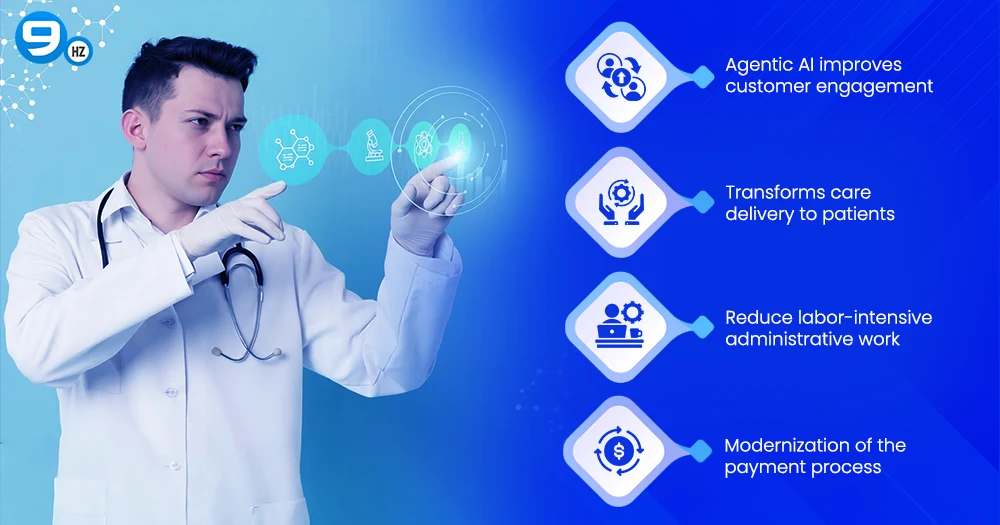
1. Agentic AI improves customer engagement:
AI agents can act as digital care assistants for patients. They can guide patients during check-ins. An agent can explain reports in simple language and give personalized wellness tips based on the health history of patients.
This will make patients feel that they are being supported well. At the same time, AI agents also reduce the burden on customer support teams.
2. Transforms care delivery to patients:
Agentic systems can collect and correlate data from EHR, imaging, and pharmacy to get a clear perspective of a patient’s health.
They can detect missing lab reports, duplicate prescriptions, or missed follow-ups to reduce risks or medical errors.
AI agents can prevent adverse events like death or readmissions by flagging risks in a patient’s health condition. They are also capable of sending follow-up reminders to patients. This enables clinicians to spend more time on direct patient interaction and other complex tasks.
3. Reduce labor-intensive administrative work:
In many hospitals, staff spend time reviewing imaging reports, matching scans with previous records, and manually entering data into multiple systems.
Physicians and other staff end up with burnout due to the documentation burden and repetitive tasks.
AI agents can free up your staff time by analyzing data and highlighting if there are any abnormal values, allowing them to focus on complex tasks.
4. Modernization of the payment process:
The healthcare payment process is complex, as it involves insurance eligibility checks, prior authorization, claim submission, and more. These processes have multiple steps, and errors may occur if you do them manually.
AI agents can check patients’ eligibility, validate coding accuracy, and correct errors before they submit their claims. It can execute an end-to-end sequence without human intervention.
Thus, agentic systems help reduce insurance denial rates, enable faster reimbursement, and lower days in accounts receivable.
More than 80% of healthcare organizations are actively prioritizing agentic AI to enhance clinical workflows, patient care, and revenue cycle processes.
20 Key Agentic AI Use Cases in healthcare for 2026
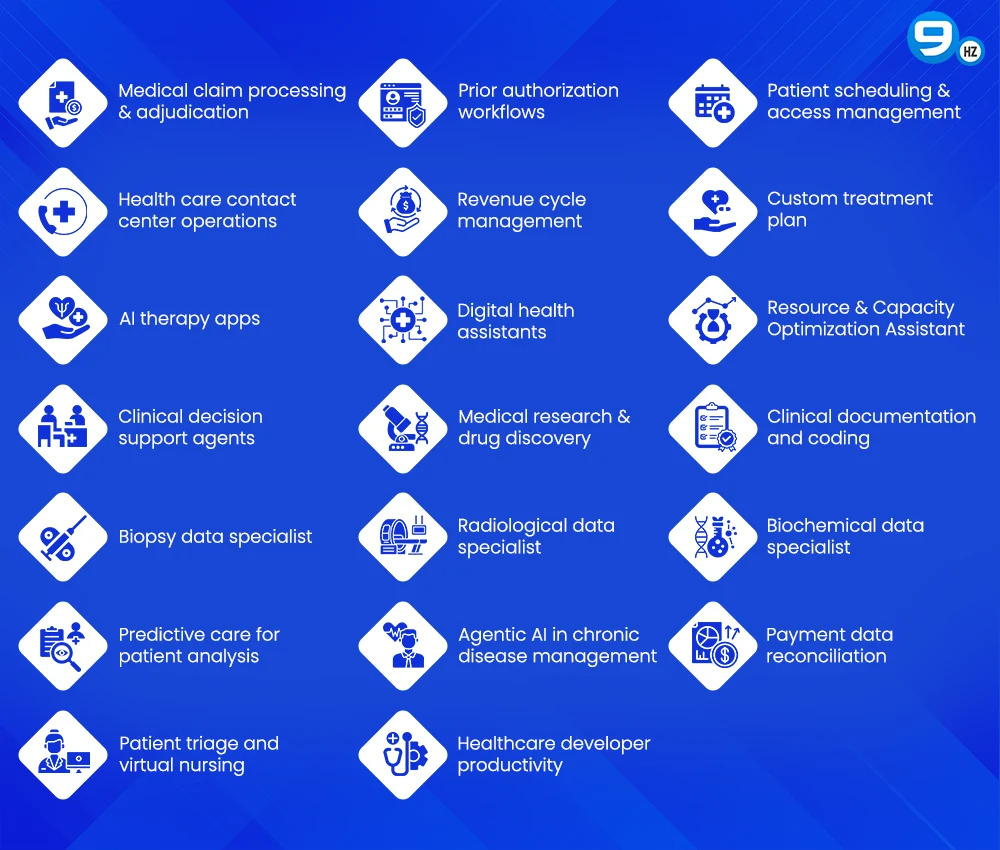
1. Medical claim processing and adjudication:
Agentic AI aggregate billing data and clinical data to check coding accuracy and the format of the claim document. It will verify if the diagnosis and procedure match, and if an insurance claim is rejected, it will analyze the denial reason. The system will create a workflow to handle denial. Agentic AI in healthcare use cases reduces revenue leakage and quickens the reimbursement process.
2. Prior authorization workflows:
Prior authorization is a complex and time-consuming process where requirements change from one individual to another. The AI agent works as a smart authorization coordinator who collects documents required for the process and retrieves notes and lab reports from the EHR, reducing manual effort.
It keeps team members in the loop if any details are missing or to address any conflicts in the documentation. Such AI agents in healthcare reduce turnaround time and care delay.
3. Patient scheduling and access management:
AI agents will take care of the complete front-door process. It will collect details of the patient, such as name, DoB, and policy number, and check if the insurance policy is active or not. AI agents in healthcare use cases will help you check for doctor availability and room capacity and detect any conflicts.
4. Health care contact center operations:
Hospital contact centers handle important tasks like appointment booking, billing doubts, insurance questions, and other general patient inquiries. When hospitals still depend on manual call routing and paper-based documentation, patients are frustrated about the long wait times.
Patients in the U.S. wait for an average of 26 days to get an appointment. Agentic AI can handle multiple channels like phone calls, chats, emails, and patient portals at the same time without being overwhelmed.
They can access patients’ full history of scheduled appointments without human intervention. In addition, agentic systems can provide multilingual support and escalate the issue to the proper clinical staff if they encounter any. They enable smooth patient entry with less confusion and less burden on the administrative team.
5. Revenue cycle management:
A healthcare organization may experience revenue leakage due to missed charges or underpayments.
Agentic AI in healthcare use cases can help solve these issues by checking for insurance eligibility in real-time, capturing accurate charges, and optimizing medical coding.
6. AI therapy apps:
Therapy apps are designed to interact with patients. AI agents behind the app can help patients manage their depression and anxiety. Agentic systems can ask questions just like a therapist and analyze the conversation by the kind of words and phrases they used.
AI agents will also suggest coping techniques and breathing exercises to the users. Therapy apps are useful in regions where there are fewer mental health professionals.
7. Custom treatment plan:
Instead of following a fixed treatment plan, AI agents in healthcare can change or adjust it based on how a patient responds to it.
They track treatment from the beginning, compare lab results, and see if the patient’s condition has improved. If not, agentic AI will suggest that the clinician adjust the plan and also help coordinate with other departments smoothly.
8. Resource and Capacity Optimization Assistant:
Imagine you have a virtual assistant that can help you manage staff scheduling and bed allocation to patients without any bottlenecks.
AI agents in healthcare use cases can do this for your organization, even in unpredictable situations, with efficiency. They can reduce patient waiting times and improve operational resilience.
9. Digital health assistants:
Patients can directly interact with AI assistants through a mobile app or website. This is one of the AI agents use cases in healthcare that allows you to provide 24/7 support to your patients.
The AI health assistants can quickly provide answers to a patient’s queries and send medication and appointment reminders. This process helps improve patient engagement and reduce the burden on healthcare workers.
10. Clinical decision support agents:
AI agents can continuously monitor patient vitals and lab reports without the need for human intervention. They can flag if there are any abnormal trends in the reports and send alerts to the care team.
These clinical decision support agents help reduce mortality rate and allow for early recognition of infections.
11. Medical research and drug discovery:
Pharmaceutical companies maintain thousands of chemical compounds. It is a time-consuming process to identify the compound that can become an effective medicine to treat a disease if it is done manually.
That’s where AI agents in healthcare use cases are reigning supreme in analyzing chemical structure and simulating molecular interaction. They help reduce the time taken to discover and develop a drug and minimize the cost of R&D.
12. Clinical documentation and coding:
AI agents can combine structured and unstructured data to create draft clinical notes. They check medical documentation to find any missing details and suggest coding-aligned improvements if there are any. These agentic AI use cases in healthcare reduce manual typing work and the documentation burden of physicians.
13. Biopsy data specialist:
AI agents in healthcare use cases are useful in prostate cancer diagnosis and monitoring. They can analyze biopsy reports, detect if a cell structure is in a normal state or not, and identify cancer patterns. Agentic systems can assist you if you assign a Gleason score and help detect the stage of cancer.
14. Biochemical data specialist:
A biochemical data specialist is one of the AI agents in healthcare use cases that analyzes PSA trends over time. It detects any sudden spike or increase in PSA values continuously and compares the value against other biochemical markers.
AI agents can assess if the cancer is aggressive or the speed at which the disease is progressing. Thus, it helps in early warning and treatment.
15. Radiological data specialist:
Radiological data specialist, one of AI agents in healthcare use cases is also helpful in cancer diagnoses by analyzing imaging data. It can measure the size of the tumor and check for metastasis.
The AI agent compares the after-treatment scan and the before-treatment scan to check if the size of the tumor has reduced or if the growth has slowed down.
16. Predictive care for patient analysis:
AI agents can identify early risks of diseases like diabetes and Alzheimer’s using predictive analytics, enabling physicians to provide preventive care.
AI models collect data from wearable devices of patients and help in real-time monitoring, improving proactive care.
17. Agentic AI in chronic disease management:
Patients with chronic health conditions like blood pressure and diabetes require remote monitoring. Healthcare providers are leveraging this use cases of agentic AI in healthcare, where they can collect daily health metrics of patients like blood glucose levels, blood pressure levels, heart rate, and sleep patterns.
AI agents in healthcare use cases can then analyze trends and detect sudden spikes or drops in values, and help with early interventions by care providers.
18. Payment data reconciliation:
Matching insurance claims data to provider information is time-consuming and prone to manual errors. With this agentic AI in healthcare use cases, healthcare organizations can accurately match payments by reducing manual effort. AI agents can detect any discrepancies and make the payment process smooth.
19. Patient triage and virtual nursing:
Patient triage is one of the most helpful use cases of agentic AI in health care. Agentic systems will collect details about patients during emergency visits. It will help you prioritize who should visit the doctor first by checking the severity and seriousness of their symptoms. Thus, agentic AI helps in improving operational efficiency and reducing the workload of physicians and nurses.
They will act as virtual nurses by reminding patients to take medicines at the right time and giving post-discharge instructions.
20. Healthcare developer productivity:
Traditional software development methods aren’t enough for the growing needs of healthcare organizations.
AI agents in healthcare use cases can help developers by auto-generating basic code and templates for API integration. They can also help developers detect and fix bugs, saving them time and giving them space for more innovation.
How to Implement Agentic AI in Healthcare (Step-by-Step)
At The NineHertz, we believe in building a structured and safe roadmap to implement agentic AI in healthcare use cases.
- In the first step, you have to identify low-risk and high-impact areas like scheduling, care coordination, and reminders. In these areas, mistakes are reversible, and the impact can be clearly seen.
- Fragmented data can lead to poor decision-making by AI agents. That’s why it is important to have structured internal and external data. Interoperable systems lay a strong foundation for implementing agentic AI systems.
- The agentic architecture should include three essential layers. One is the orchestration layer, where you need a control system to coordinate multiple agents. The next one includes audit trails, where every action taken by AI agents will be logged for compliance. The other layer is decision boundaries, where there will be clear rules and policies about which decisions an AI agent can make and when a task needs human escalation.
- It is non-negotiable in the healthcare industry to keep humans in the loop without giving complete autonomy to agentic systems. In this step, human expertise will be integrated into the automated process to review the actions of AI agents.
- The next step is to integrate the AI system into clinical workflows in such a way that it doesn’t add any extra steps for your staff to adapt.
- Establishing clear governance rules is important to ensure HIPAA and other compliance.
- If you want to scale further, make sure that the behaviour of AI agents is predictable and their decisions are explainable.
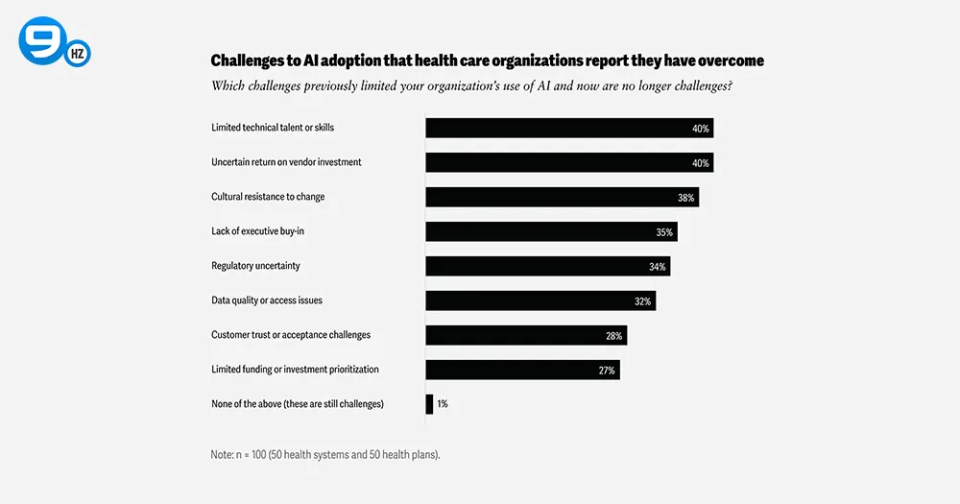
5 Challenges in Implementing Agentic AI for Healthcare Professionals
Though the AI agents are smart and autonomous, they bring various challenges for healthcare organizations. It will be helpful to avoid drawbacks in implementing agentic AI systems in your organization if you are aware of these challenges.
1. Data privacy and security
AI agents require access to sensitive data like patient records and insurance details. When you implement agentic systems, you are expanding your attack surface, creating more security vulnerabilities.
2. Lack of Integration
Most hospitals use legacy systems and outdated software, leading to compatibility issues while implementing AI agents. The challenges in integration restrict the seamless data flow between the systems.
3. Employee Resistance
There is a chance of emotional resistance among your staff due to the new changes the agentic system is about to bring. The front desk may stress about AI replacing them, and nurses may worry that their judgment will be questioned by AI.
4. Compliance Requirements
Adopting AI agents in healthcare adds an additional layer of complexity. An agentic AI has to align with other legal frameworks, such as FDA regulations for software as a medical device, along with HIPAA.
5. Patient Resistance
Not only your employees, but patients may feel doubtful about interacting with AI agents. They may be skeptical about the quality of care they receive from Agentic systems and prefer consulting a physician directly.
Global AI Agent Use-cases in Healthcare
Real-world example 1:
Mayo Clinic has integrated AI assistants into the radiology workflow. They can combine a patient’s medical history and lab reports with medical imaging to help doctors make informed decisions.
AI assistants can reduce the time taken by doctors to process an image by 30%, allowing them to handle more critical cases. They can take up mundane tasks of tumor tracing or body structure tracking to improve diagnosis.
Real-world example 2:
Cera, a U.K based healthtech company, uses AI agents as home care assistants to reduce hospital admissions by up to 70% and patient falls by 20%.
They remind users to have food and take medication on time, collect data about their wellbeing and health, and share it with care teams to decide if human intervention is necessary. This model is very helpful during peak workloads of care providers
How Does NineHertz Help You?
Healthcare organizations understand that patient care starts long before their first visit. The NineHertz, a leading custom AI solutions provider, brings this vision to reality with our innovative solutions.
We work with a team of 250+ technology experts, which helps us to deploy the best project management methodology to execute the project in the least time. Moreover, our experience has helped us to explore project areas where we can save significant development costs without affecting the overall project quality.
Our mission is to supercharge your organization’s tech initiatives by providing solutions that meet your demands and needs. We have over 15 years of experience in the IT industry, helping businesses to explore and implement technological trends.
The NineHertz offers a free consultation session to healthcare organizations planning to implement agentic AI solutions in their workflow. The session is focused on identifying business requirements and thus helping them make better decisions.
Conclusion
Agentic AI in healthcare helps you address the most pressing issues of the industry with ease. It stands out as a supportive tool for healthcare professionals, reducing burnout and improving patient outcomes. Agentic AI is trained on huge datasets that combine contextual awareness with decision-making capabilities to handle the tasks. It increases the overall efficiency, provides convenience to the patients, and ensures the optimal use of the resources.
Frequently Asked Questions (FAQs)
What are some common agentic AI use cases in healthcare?
AI agent use cases in healthcare help reduce patient wait times and the workload on the admin team. Some common use cases include clinical documentation, digital health assistants, and patient scheduling.
How is an agentic AI different from generative AI?
A generative AI is reactive and can only answer a query. On the other hand, an agentic AI will not only answer your query, but it can also create a workflow and execute a task.
How does agentic AI help improve healthcare operational efficiency?
Agentic AI can take over repetitive and time-consuming tasks like documentation and customer support. They can also help you with staff and bed allocation according to the requirements. This process will help improve healthcare operational efficiency, enabling your staff to focus on other tasks.
How much does it cost to build an agentic AI system for healthcare?
The healthcare agentic AI development cost is estimated to be between $55,000 and 80,000 on average in the common applications of symptoms diagnosis, appointment booking assistants, and patient monitoring. On a larger scale, the cost of development may be between 50,000 to 120,000 and above, based on the scope and needs of the project.
The final price will be determined by a number of variables such as the complexity of the system, the technology stack, locatiton of the development team, and accessibility and quality of healthcare data. The user interface and the system design can also be customized greatly to impact the overall investment.
